If your back twinges when you reach across the desk for a file or step out of the car at an angle, the problem usually isn't strength — it's that your spine moves when it should stay still. The bird dog exercise trains exactly that skill: keeping your trunk rock-steady while your arms and legs move. It looks easy. Done with real control, it's one of the best things you can do to teach your core to protect your spine during ordinary, slightly-twisted, real-life movements.
This single-move guide covers the setup, what good control feels like, the wobbles and cheats to watch for, and how to make it harder once it's solid.
What the bird dog actually trains
Most people think of a strong core as a six-pack or how long you can plank. The job that actually protects your back is different — it's *anti-movement*. Your deep core muscles are meant to brace your spine so it stays neutral while your hips and shoulders do the moving. When that bracing is weak or poorly timed, the movement leaks into your lower back. Reach, twist, bend — and the spine flexes or rotates a little each time when it shouldn't. Repeat that thousands of times and you get the kind of nagging, recurring ache that no single stretch fixes.
The bird dog drills the anti-movement skill directly. You're on all fours extending an opposite arm and leg, and the entire challenge is to keep your torso from sagging, twisting, or arching while a limb reaches out. Your core has to fire and hold. That's the same control you need when you lift a toddler, load the dishwasher, or carry a bag on one side.
It belongs in the same family as the other core exercises for lower back pain — the ones that train stability rather than just strength.
The strongest thing your core can do for your back is nothing — hold still while everything around it moves.
How to do a bird dog
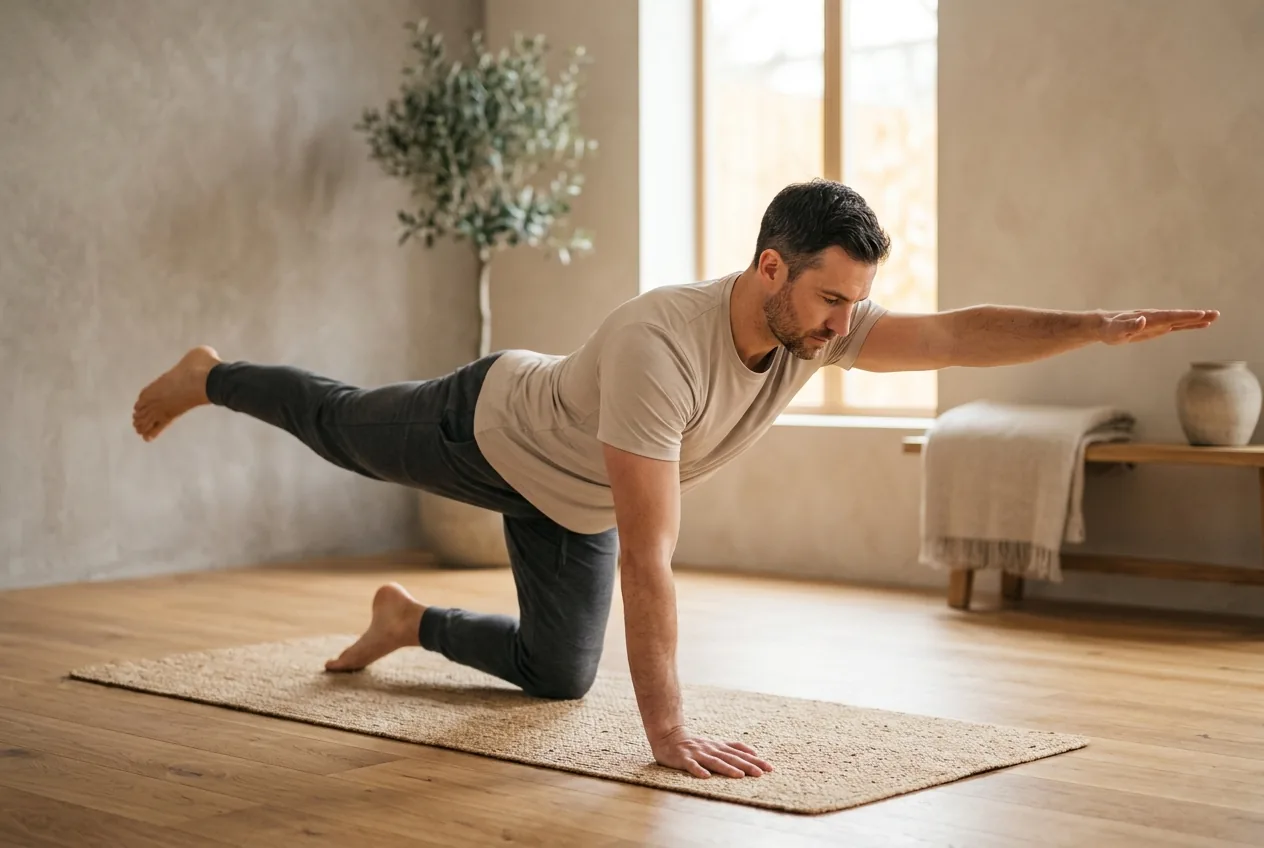
- Start on hands and knees. Wrists under shoulders, knees under hips, spine in a neutral, flat-table position.
- Set your core before you move: gently brace your stomach as if you're about to be poked in the belly — firm, not sucked in.
- Slowly reach your right arm straight forward and your left leg straight back at the same time, until both are roughly level with your torso.
- Keep your hips and shoulders square to the floor the whole time. Imagine a glass of water balanced on your lower back that mustn't spill.
- Hold for two to three seconds, reaching long through the fingertips and the heel — not lifting high.
- Return slowly and with control to the start, then switch to the opposite arm and leg. That's one rep per side.
What you want to feel: steady, quiet effort through your trunk and the back of the hip you're extending. What you don't want: your lower back arching, your hips tilting, or your body rocking to one side.
The mistakes that give it away
Lifting the limbs too high. People raise the arm and leg up toward the ceiling, which arches the lower back and hands the work straight to the spine. Reach *long*, not *high* — the limb should be level with the torso, no higher.
Twisting at the hips. When the lifted-leg side hips rotates open, the core has stopped doing its job. Keep both hip bones pointing at the floor. A flat object balanced on your low back is a useful test — if it slides off, you twisted.
Holding your breath. Bracing isn't clenching everything and stopping breathing. Keep breathing steadily through the hold.
Rushing through reps. Speed hides the wobble. Slow, deliberate reps expose where your control breaks down — which is exactly the part worth training.
If you can't keep steady with both limbs, that's fine — see the scaling below. A genuinely useful self-check: balance a TV remote or a small book flat across your lower back before you start, then do a few reps. If it stays put, your trunk is holding still. If it slides off, you now know exactly which direction you're leaking movement, and you can rein it in. Most people are surprised how much they twist once they have something measuring it.
Reps, sets, and progressions
Start with 2 sets of 6–8 controlled reps per side, holding each for two to three seconds. Quality is everything here; a handful of steady reps beats twenty wobbly ones.
If full bird dog is too much, scale down first:
- Arm only: keep both knees down, extend just one arm. Master the no-twist hold, then add the leg.
- Leg only: keep both hands down, extend just one leg.
Once the standard version feels controlled, progress:
- Longer holds: build to five-second holds.
- Add a "crunch": at the end of each rep, draw your extended elbow and knee together under your body without letting your back round, then re-extend.
- Slower tempo: take four seconds out and four seconds back.
Pair bird dogs with the glute bridge and you cover both halves of a protected back — hips that drive movement, and a core that keeps the spine still while they do.
When to see a doctor
The bird dog is gentle, but pain has limits. See a clinician promptly if you have numbness, tingling, or weakness spreading down a leg, any loss of bladder or bowel control, back pain after a fall or accident, fever with back pain, unexplained weight loss, or pain that's severe or steadily worsening. Stop the move if it reliably produces sharp or shooting pain rather than steady muscular effort.
Why core control fits into a bigger picture
The bird dog builds a genuinely useful skill, and a steadier core helps almost any back. But how much it helps *you* depends on what's pulling your spine out of neutral in the first place. If a forward-tipped pelvis or weak glutes keep dragging your back into an arch, you'll be bracing against a stacked deck — the core works harder to hold a position your posture keeps undoing.
That's the limit of any single exercise. It can build the skill, but it can't see the pattern you're bracing against. Knowing your own deviations is what tells you which moves to prioritise and in what order. A posture assessment measures where your alignment actually drifts and builds the routine around it, so your core work has a fair fight.
Drill bird dogs slowly, keep the trunk still, and progress only when control holds. Then set them inside the routine your body actually needs — that's where a protected spine becomes the default.
Common questions
What does the bird dog exercise do?
It trains your core to hold the spine steady while your arms and legs move — the anti-movement skill that protects your back during ordinary things like reaching, twisting, and lifting.
How many bird dogs should I do?
Start with 2 sets of 6 to 8 controlled reps per side, holding each two to three seconds. Quality is everything; a handful of steady reps beats twenty wobbly ones.
Why does my lower back arch during bird dog?
Usually because you're lifting your arm and leg too high. Reach long, not high — keep the limbs level with your torso. If your back still arches or your hips twist, scale down to one limb at a time.
How do I know if I'm doing bird dog correctly?
Balance a small book or remote flat across your lower back. If it stays put through your reps, your trunk is holding still. If it slides off, you're leaking movement and can rein it in.