
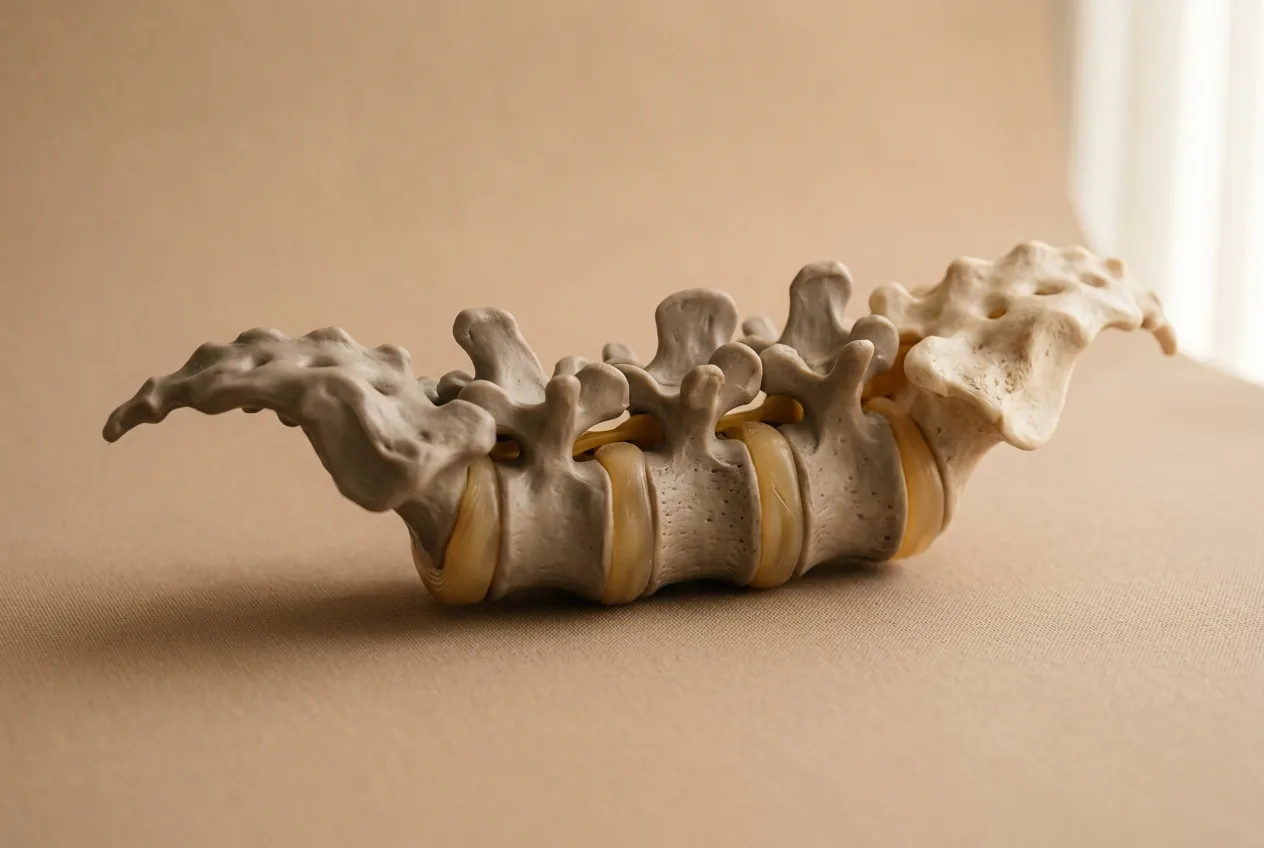
You got the MRI back and there it was in plain text: a bulging disc in the lower back. Now every twinge feels like proof that something is slipping, and you've started moving like the floor might give way. That fear is doing more to your day than the disc is.
Here's a fact that takes some pressure off. Disc bulges are extremely common, and plenty of people walk around with them and feel nothing at all. A bulge on a scan is not the same as a verdict on your back. What it tells you is that one disc has spread slightly past its normal edge — usually at the segment that's been carrying uneven load for years. The question that actually matters is how your back behaves when you move, not how it looks in a photo.
Bulge, herniation, what's the difference
People use the words loosely, so it's worth being clear. A bulging disc is when the disc spreads outward fairly evenly, like a tyre that's lost some pressure. A herniation is when the soft centre pushes through a tear in the outer ring more sharply, sometimes pressing on a nerve. A bulge is generally the milder, earlier picture — though either can be painless or painful depending on whether a nerve is involved.
If a nerve is involved, you'll usually feel it past the back itself: pain, numbness, or tingling into the buttock or leg. If symptoms stay local to the lower back, you're more likely dealing with irritation in the disc and surrounding muscles rather than direct nerve pressure. Sorting that out matters, and how to tell muscle pain from disc pain covers the distinguishing signs.
Why this disc, and why now
A bulge rarely appears at a random spot. It tends to show up where load has been concentrated, and load concentrates when posture is off. A common pattern: tight hip flexors from years of sitting tilt the pelvis forward, the lower back over-arches to compensate, and one segment ends up absorbing what several should share. The disc spreads under that repeated pressure.
This is why two people with identical scans can need different routines. The bulge is downstream of how your body has been loading itself. Treat only the disc and ignore the loading pattern, and the relief tends not to hold.
What actually helps
The aim early on is simple: take pressure off the irritated segment, keep moving gently, and avoid the positions that aggravate it.
- Frequent short walks. Walking loads the spine in a friendly, rhythmic way that helps the disc exchange fluid and keeps you from stiffening. Several short walks beat one long march.
- Gentle back extension. Lying face down and propping on your forearms, letting the lower back relax into a mild arch, eases many bulges that have spread backward. If it increases leg symptoms, leave it out.
- Hip and glute work, once symptoms settle. Bridges and side-lying hip exercises rebuild the support that takes load off the lower back. Weak glutes are a quiet driver of recurring lower-back trouble.
- A light core brace during daily tasks. Learning to gently engage the deep abdominal muscles before you bend or lift gives the segment protection without bracing rigidly all day.
A bulging disc isn't a fragile back. It's a back asking you to change how it's loaded.
What to ease off
- Repeated deep forward bending. Toe-touches and slumped folding load the front of the disc and push the centre backward. Hinge from the hips instead and keep the spine long.
- Prolonged sitting. Sitting raises disc pressure, and slumped sitting raises it more. Stand up every twenty to thirty minutes and check whether your chair is letting your pelvis roll backward.
- Loaded twisting and heavy lifting too soon. Give the tissue a few weeks of calm before testing it under real load. For a broader list, see exercises to avoid with lower back pain.
If symptoms run into the leg, the gentle, nerve-friendly approach in sciatica stretches at home overlaps usefully, since a bulge pressing on a nerve is a common source of sciatica.
A realistic timeline
People want to know how long this lasts, and the honest answer is: usually weeks, sometimes a couple of months, and rarely in a straight line. A bulging disc that's flared tends to settle in stages. The sharp, can't-get-comfortable phase often eases within the first week or two if you stop feeding it. The lingering stiffness and the occasional twinge on a bad day can hang around longer while the tissue calms and your back relearns how to move without guarding.
What trips people up is the bad day in the middle of getting better. You'll have a stretch of feeling almost normal, then bend the wrong way reaching into the boot of the car and feel a flash of the old pain. That's a flare, not a relapse. Discs are slow-healing tissue, and a single awkward movement doesn't undo weeks of progress. Note what provoked it, ease back for a day, and carry on. The trend over weeks matters far more than any single morning.
It also helps to set the bar in the right place. The goal isn't a scan that reads "normal" — many pain-free people would never pass that test. The goal is a back that lets you live your day. If you can sit through a meal, lift your kid, and sleep through the night, the disc is doing its job whatever the picture shows.
When to see a doctor
Most bulging discs settle with time and sensible movement, but a few signs deserve prompt attention. Check in with a clinician if you have numbness or weakness spreading down the leg, a foot that catches when you walk, or back pain after a fall or accident. Seek urgent care for any loss of bladder or bowel control, or numbness in the saddle area between the legs — uncommon, but treated as an emergency. Also get assessed for pain that's severe, steadily worsening, or paired with fever or unexplained weight loss. This is a short safety list, not a reason to panic. Your clinician is the right person to confirm the diagnosis and guide treatment.
The part that makes relief stick
Calming the disc is step one. Keeping it calm is the harder part, and that's where knowing your own pattern earns its keep. If your pelvis tips forward and your lower back over-arches, the corrective routine that helps you will look different from someone whose back is flat and stiff. Generic advice can't tell those apart. A routine matched to your specific deviations, repeated daily, is what gradually shifts load off the irritated segment for good. That's the thinking behind the posture-based method for chronic back pain — it starts by measuring how your body is actually positioned, then builds around that.
A bulging disc in the lower back is not a sentence, and nothing here cures it or replaces your doctor's guidance. But for most people, moving in the directions their back tolerates, easing off the ones it doesn't, and rebuilding the support it lost is enough to get ordinary life back — bending to tie a shoe without bracing for impact, sitting through dinner, sleeping without the dull ache that wakes you at 3am.
Common questions
Is a bulging disc serious?
Often not. Disc bulges are common, and plenty of people have them on a scan and feel nothing. A bulge means one disc has spread slightly past its normal edge. What matters more than the picture is how your back behaves when you move.
What's the difference between a bulging disc and a herniated disc?
A bulging disc spreads outward fairly evenly, like a tyre that's lost pressure. A herniation is when the soft centre pushes through a tear in the outer ring more sharply, sometimes pressing on a nerve. A bulge is generally the milder, earlier picture.
How long does a bulging disc take to settle?
Usually weeks, sometimes a couple of months, and rarely in a straight line. The sharp phase often eases within the first week or two if you stop feeding it, while lingering stiffness can hang around longer. A bad day in the middle of getting better is a flare, not a relapse.
When should I see a doctor about a bulging disc?
Check in for numbness or weakness spreading down the leg, a foot that catches when you walk, or pain after a fall. Seek urgent care for any loss of bladder or bowel control or numbness in the saddle area. Your clinician should confirm the diagnosis and guide treatment.