You catch your reflection in a shop window and your shoulders are rolled forward, your upper back rounded, your head pushed out ahead of you. That shape didn't appear overnight, and you can't stretch your way out of it alone — the muscles meant to pull you upright have gone weak and long while the front of your body stays tight. Dumbbell exercises for the back are one of the better ways to rebuild that pulling strength, and a pair of dumbbells gives you more honest control than machines do.
Free weights make each side of your body work on its own, so the strong side can't quietly carry the weak one. For a back that's drifted into a forward, rounded posture, that matters.
What a weak back actually costs you
The back isn't one muscle. There's the broad lats down the sides, the trapezius and rhomboids between and above the shoulder blades, and the erector spinae running up either side of the spine. Together they pull your arms down and back, draw your shoulder blades together, and hold your spine upright all day.
Sitting hunched over a desk does two things at once. It keeps these pulling muscles switched off and stretched for hours, and it lets the chest and front of the shoulders tighten and shorten. Over years the back loses the strength to hold your shoulders back, so they default to rolled-forward, and your upper back rounds to match. The muscles that should fix this are there — they've just stopped being asked to work.
Strengthening the back with weights asks them to work again. Pull-style movements wake up the muscles between the shoulder blades and rebuild the strength to hold an upright posture without effort. This pairs naturally with strengthening the spinal muscles directly, the focus of back extensor exercises.
A rounded upper back isn't a stretching problem alone. The muscles that pull you upright have to be strong enough to hold the position.
The dumbbell back exercises that matter
Pick a weight you can control through the full movement with good form. With back work, feeling the right muscles pull beats heaving a heavier dumbbell. Move slowly, especially on the lowering half of each rep.
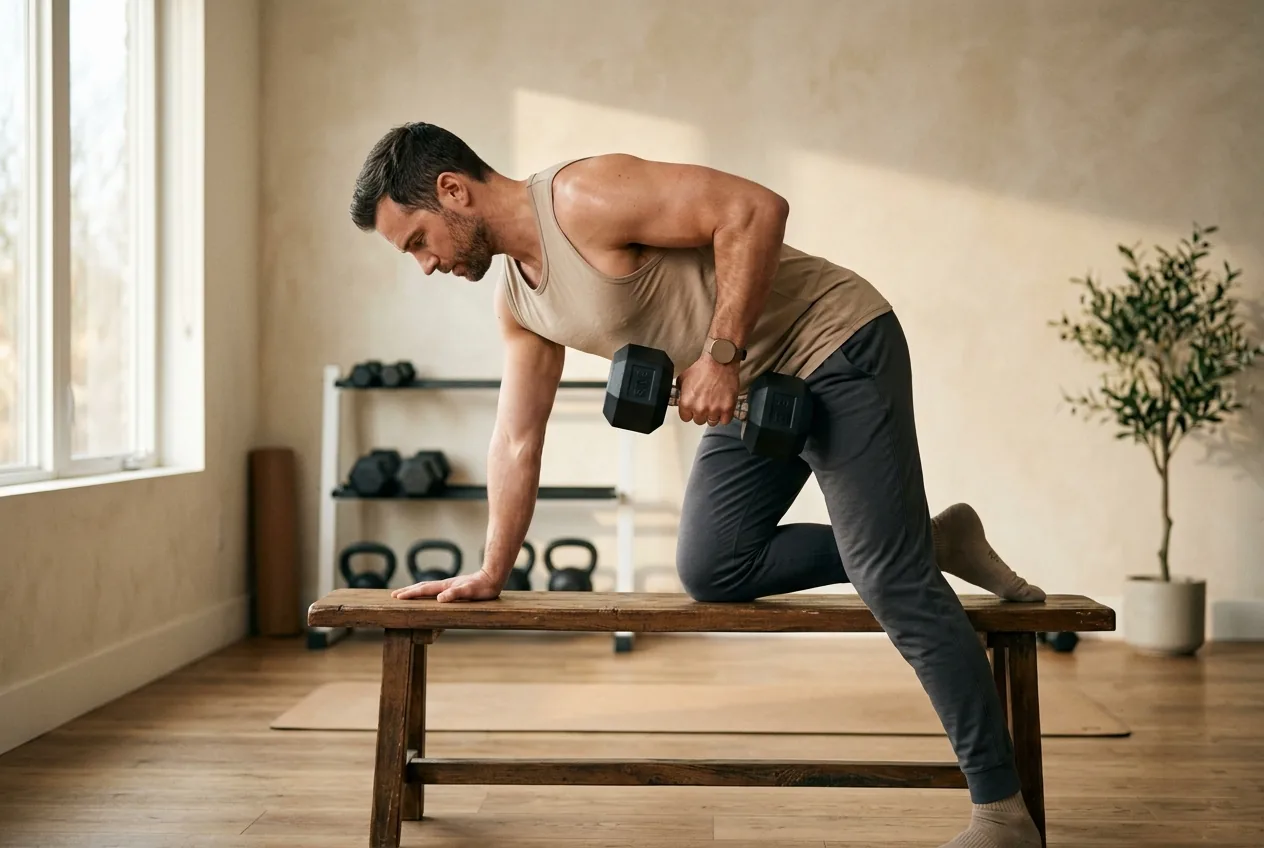
One-arm dumbbell row
Put one knee and one hand on a sturdy bench, back flat and roughly parallel to the floor. Let the dumbbell hang from your other hand, then pull it up toward your hip, leading with your elbow and squeezing your shoulder blade back. Lower slowly. Keep your back flat and your hips square — don't twist to help the lift. Three sets of eight to ten per side. This is the cornerstone free-weight back exercise.
Bent-over two-arm row
Stand with feet hip-width, soft knees, and hinge forward from the hips with a flat back until your torso is around forty-five degrees. Let both dumbbells hang, then row them toward your lower ribs, squeezing the shoulder blades together. Lower with control. Keep the back flat the whole time. Three sets of eight to ten. If a flat-back hinge bothers your lower back, start with the supported one-arm row instead.
Reverse fly
Hinge forward as in the row, dumbbells hanging with a slight bend in the elbows. Raise both arms out to the sides like opening wings, squeezing the shoulder blades together, then lower slowly. This hits the rear shoulders and the muscles between the blades directly — the ones most responsible for holding shoulders back. Use a light weight; this is about control. Two or three sets of twelve to fifteen.
Dumbbell pullover
Lie across or along a bench, hold one dumbbell with both hands above your chest, and lower it slowly back over your head with a slight elbow bend, feeling the stretch through your lats, then pull it back over your chest. Keep your lower back from arching off the bench. Two sets of ten to twelve.
Dumbbell shrug
Stand tall, a dumbbell in each hand at your sides, and lift your shoulders straight up toward your ears, hold a beat, then lower slowly. This strengthens the upper traps that help carry the weight of your arms and support your neck. Keep it controlled — no rolling. Two sets of twelve to fifteen.
How to program it and what to avoid
A couple of sessions a week is plenty to build back strength if you're consistent. These moves slot into a broader plan; if you're building a routine, the principles in posture-correcting workouts cover how to balance pulling work against the tight front of your body.
Common mistakes that turn good moves into sore-back moves:
- Rounding the lower back on rows and hinges. This is the big one. Keep your spine flat and hinge from the hips, not by curling your lower back. If you can't hold a flat back, the weight's too heavy or you need the supported version.
- Heaving the weight with momentum. Swinging the dumbbell up with your whole body trains momentum, not your back. Slow down and let the back muscles pull.
- Skipping the lowering half. Most of the benefit is in lowering the weight under control. Don't drop it.
- Only training the front. People who do dumbbell work often pile on chest and shoulder presses and neglect the back. For posture, the pulling muscles need more attention, not less.
- Letting the strong side dominate. Do the same reps each side, and if one side is clearly weaker, train it first while you're fresh.
When to see a doctor
Strength work is exercise and education, not medical treatment. Stop and see a clinician promptly if lifting brings on numbness, tingling, or weakness down an arm or leg, any loss of bladder or bowel control, or if you have back pain after a fall, fever with back pain, unexplained weight loss, or pain that's severe or steadily worsening. Get a sharp or sudden back pain during a lift checked before you load it again.
Why "strengthen your back" depends on your back
Pulling strength helps most people whose shoulders have rolled forward from years of sitting. But the catch is that the same row helps one posture and does little for another, because the reason your back rounded depends on how your whole spine is stacked. An upper back that's collapsed forward needs different emphasis than one that's stuck stiff and flat. General strengthening is a fair starting point. The version that actually fixes your posture is matched to how your spine is loaded, which is what a posture assessment built around your own pattern is for, rather than guessing from how a lift feels.
Common questions
What are the best dumbbell exercises for the back?
The one-arm row and bent-over row build overall back strength, the reverse fly targets the muscles that hold your shoulders back, and the pullover works the lats. For posture specifically, rows and reverse flies matter most because they strengthen the pulling muscles that fight a rounded, forward-shoulder posture.
Can dumbbell back exercises improve posture?
They can, because a rounded upper back partly comes from weak pulling muscles that can't hold the shoulders back. Strengthening those muscles with rows and reverse flies rebuilds the ability to sit and stand upright without effort. It works best paired with loosening the tight chest and front of the shoulders.
How heavy should the dumbbells be?
Light enough to control through the full movement with a flat back and no swinging. For back work, feeling the right muscles pull matters more than the number on the dumbbell. Start lighter than you think, master the form, and add weight only when the movement stays clean.
How often should I do dumbbell back exercises?
Two sessions a week is enough to build back strength if you're consistent and progress gradually. Give the muscles a day or two between sessions to recover. Pair the pulling work with stretching the tight front of your body for the best posture results.