Your lower back aches, so you stretch your lower back. It helps for an hour, then the ache creeps back. You've been treating the place that hurts — but the place that hurts often isn't where the problem starts. For a huge number of office workers, the real driver sits at the front of the hips. A good hip flexor stretch for lower back pain can do more for that nagging ache than any amount of stretching the back itself.
The hip flexors are a group of muscles at the front of your hip that lift your knee toward your chest. The main one, the psoas, runs from your thigh up through your pelvis and attaches directly to your lower spine. That attachment is the whole story. When the hip flexors get short and tight, they pull on your lower back — literally tugging it into an exaggerated arch. The back muscles then clench to manage the strain, and that clench is the ache you feel.
From our own quiz data: of 3,486 people who told us what sets their pain off, sitting led at 35% — but standing was right behind it at 30%. That pairing is the hip flexor signature: shortened by the chair, then complaining the moment you stand up and ask them to lengthen again.
Why sitting is the culprit
When you sit, your hip flexors are in a shortened position. Hold that for eight hours a day, five days a week, for years, and the body does what it always does — it adapts. The muscles shorten and tighten to match the position you keep them in. Then you stand up, and they don't lengthen back out. They stay short, and now they're pulling your pelvis forward and your lower back into an arch all day long.
This is the common pattern behind a forward-tipped pelvis, and it explains why so many people's backs feel worse after a long day at a desk. The full picture of how desk life builds this is in tight hip flexors from sitting.
The muscle that's screaming isn't always the muscle that's at fault. Tight hip flexors make your lower back do the complaining.
The hip flexor stretch that helps
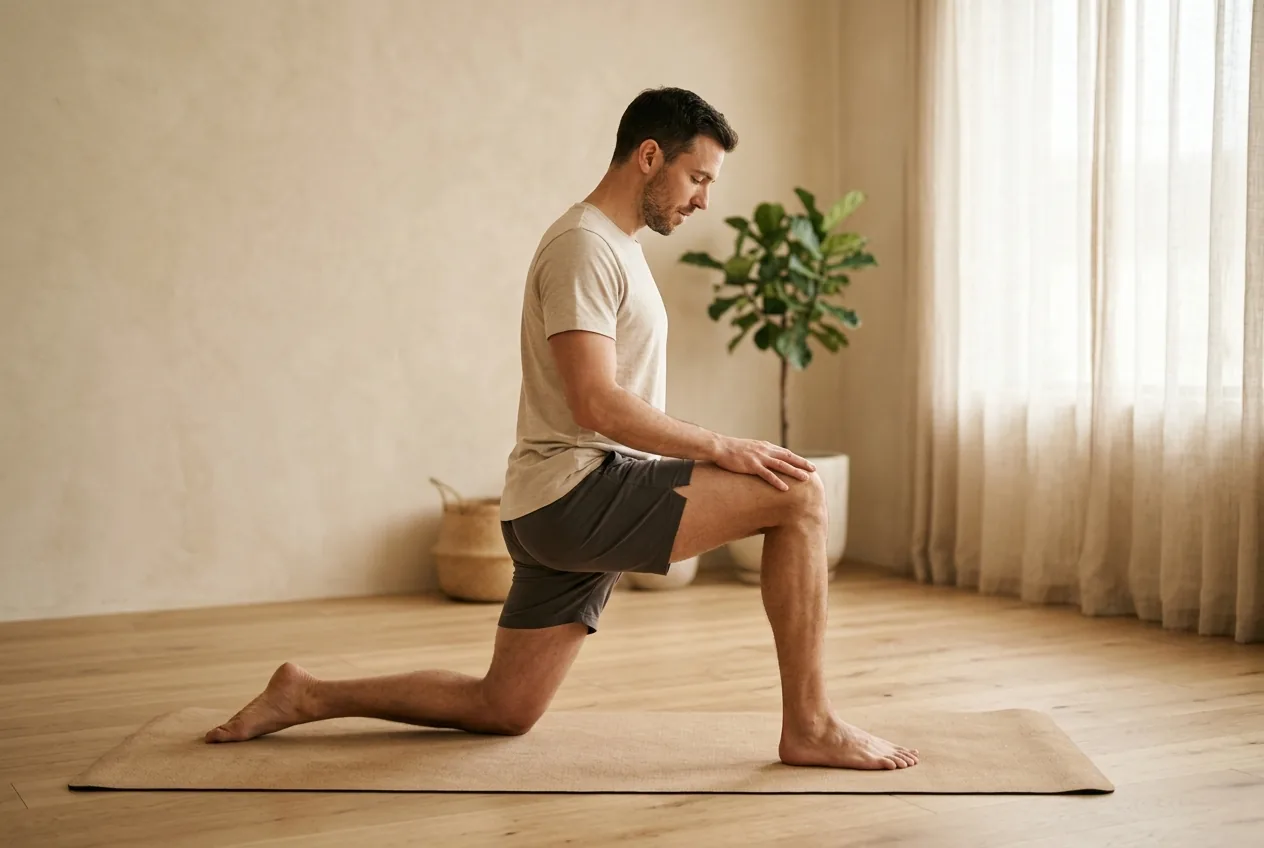
The classic and most effective move is the half-kneeling hip flexor stretch. Done with attention, it targets exactly the muscles pulling on your back.
- Kneel on one knee, the other foot flat in front of you, both at right angles — like a proposal pose.
- Before you move forward, tuck your tailbone under by gently squeezing your glute on the kneeling side. This flattens the arch in your lower back. This step is the one most people skip, and it's the one that makes the stretch actually work.
- Keep your torso tall and ease your hips forward — just an inch or two — until you feel a stretch at the front of the hip and thigh on the kneeling leg.
- Hold 30 seconds, breathing slowly. Two or three rounds each side.
The tailbone tuck matters because without it, people arch their lower back to "feel a stretch," which loads the very area they're trying to help and stretches almost nothing at the hip. Keep the glute engaged and the back flat, and you'll feel it where it counts.
A couple of supporting moves help too:
- Standing hip flexor stretch: in a staggered stance, tuck the tailbone and shift your weight gently forward over the front foot.
- Couch stretch (advanced): with the back foot elevated on a low surface, deepens the same stretch — only once the basic version is easy.
Don't just stretch — wake up the opposite muscles
Here's the part that separates a quick fix from a lasting one. If your hip flexors are tight from sitting, the muscles on the opposite side — your glutes — have usually gone quiet. Sitting on them all day switches them off. So even after you stretch the hip flexors, weak glutes let the pelvis tip forward again.
Stretching the tight side and strengthening the weak side together is what holds the change. Pair the stretch with glute work like bridges, which you'll find in core exercises for lower back pain. The stretch gives you room; the strengthening keeps it.
This is why people get frustrated stretching alone. They lengthen the hip flexors in the morning, sit on their switched-off glutes all day, and by evening the pelvis has tipped right back. Without waking the glutes up, the stretch is a temporary loan you keep having to repay. Do both, and the new position has something holding it in place.
Don't forget to move during the day
A stretch twice a day fights eight hours of sitting, and eight hours usually wins. The cheapest fix is to stop staying down for so long at a stretch. Stand up every 30 to 45 minutes, even briefly. Take a short walk after lunch. Each break interrupts the shortening before it sets in, so your two daily stretches aren't starting from scratch every time. The pattern you build at your desk is covered in more detail in tight hip flexors from sitting.
When to see a doctor
Stretching is for ordinary mechanical tightness and the back ache that comes with it. See a clinician promptly if you have numbness, tingling, or weakness running into a leg, any loss of bladder or bowel control, pain after a fall or accident, fever with back pain, unexplained weight loss, or pain that's severe or steadily worsening. A deep ache in the front of the hip that doesn't ease with stretching is also worth getting looked at.
Why this works for some backs and not others
The hip flexor link is real and common — but it isn't everyone's story. If your pelvis tips forward and your lower back over-arches, this stretch can be a genuine turning point. If your back is flat and your pelvis tucks under instead, aggressively stretching the hip flexors may do little or even nudge you the wrong way. Same move, opposite outcome, depending on your pattern.
That's the catch with any single stretch. It assumes a problem you may or may not have. Lasting relief comes from knowing your own pattern — whether your hips actually tip forward, which muscles switched off, which are overworking — and matching the routine to that. A posture-based approach to chronic back pain measures your real deviations first, then prescribes the stretches and strengthening that fit your body, instead of hoping the popular hip flexor stretch happens to be the right one for you.
A fair test: do the half-kneeling stretch (with the tailbone tuck) twice a day for a week, alongside some glute work. If your lower back eases — especially after sitting — the hip flexors were part of your story, and you've found a lever worth pulling daily.
What I see in practice
The half-kneeling stretch is the most-recommended move in this whole category, and it's the one I most often watch people do at the wrong moment. If the glutes are still asleep, a hip flexor stretch buys a few hours of slack that the pelvis pulls straight back in — I'd rather someone spend two of their ten minutes waking the glutes and eight on the stretch than the reverse. The other thing I look for is whether the tightness is even side to side. When one hip flexor is noticeably shorter than the other, that's usually rotation showing up rather than a flexibility gap, and stretching the tight side harder just deepens the twist. And to anyone who has stretched faithfully for months with nothing to show for it: tight muscles are often holding an unbalanced frame together, and they don't let go until the frame stops needing them to.
Common questions
Can tight hip flexors cause lower back pain?
They often do. The main hip flexor, the psoas, attaches to your lower spine, so when it gets short and tight it pulls your pelvis forward and your lower back into an arch — and the back muscles clench in response.
What's the best hip flexor stretch for back pain?
The half-kneeling stretch, done with the tailbone tucked under. Kneel on one knee, squeeze the glute on that side to flatten your lower back, then ease your hips forward an inch or two until you feel it at the front of the hip.
Why don't hip flexor stretches give me lasting relief?
Stretching alone is half the job. If your hip flexors are tight from sitting, your glutes have usually gone quiet, so the pelvis tips forward again. Pairing the stretch with glute work like bridges is what holds the change.
How long does it take for hip flexor stretches to help?
Many people feel a difference within a week of stretching twice a day alongside glute work, especially in how the back feels after sitting. Lasting change comes from keeping it up daily, not from one session.