
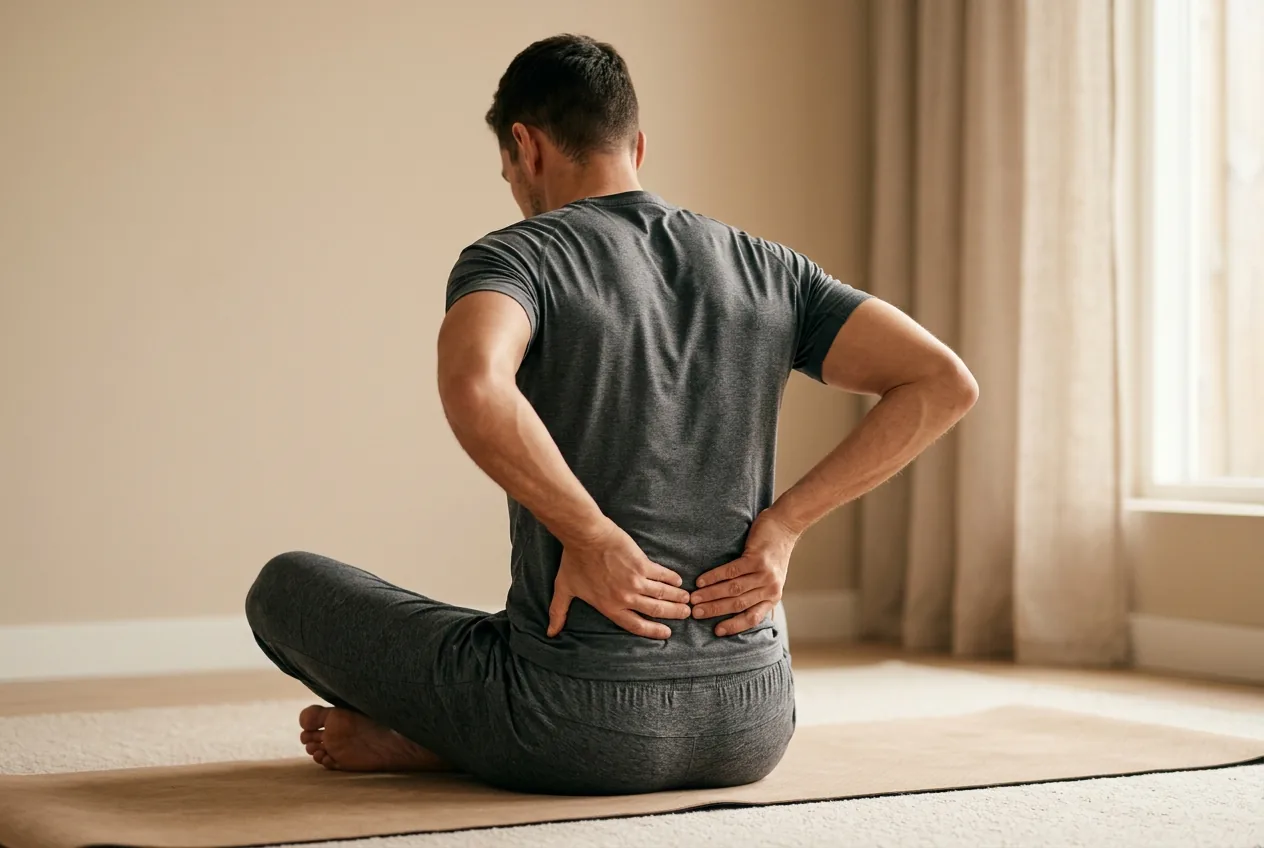
It's the band of ache right at your beltline, just above where your back meets your backside. You feel it when you stand up after a long sit, when you've been on your feet at the kitchen counter, or first thing when you swing your legs out of bed. Lower back pain above the buttocks is so common it almost feels normal — but it's telling you something.
That zone — the lower lumbar spine, the top of the pelvis, the sacrum — is where most of your upper-body weight funnels down into your hips and legs. When the load gets distributed unevenly, this is the spot that complains first.
What's going on in that zone
The area above your buttocks is a junction. Your lumbar spine stacks down into the sacrum, the sacrum meets the pelvis at the SI joints, and a dense web of muscle wraps the whole thing to hold you upright. Every time you stand, bend, or sit, force crosses this junction.
Trouble starts when the curve of your lower back is off. If your pelvis tilts too far forward, the lower back arches more than it should and the muscles across that band stay clenched all day to hold the position. They fatigue, they ache, and that fatigue sits exactly above the buttocks. If the area is flattened instead, the joints there get compressed in a different way. Either way, the load isn't being shared the way it's meant to be.
This is a posture pattern, not usually an injury. The pain marks where the strain collects.
Common causes of pain above the buttocks
- Anterior pelvic tilt. The pelvis rocks forward, often from sitting all day with tight hip flexors, and the lower back over-arches to compensate. The band of muscle above the buttocks works overtime.
- Tight, fatigued lower-back muscles. The erector muscles running alongside the spine cramp and ache when they hold tension for hours.
- SI joint irritation. The joints just above the buttocks, one on each side, can get sore when load crosses them unevenly — see SI joint pain for the deeper picture.
- Weak glutes and core. When the big support muscles aren't pulling their weight, the small muscles above the buttocks take the strain. The link is laid out in SI joint pain exercises.
- Too much sitting. Long sits shorten the hip flexors and switch off the glutes, a combination that lands squarely on this zone. If sitting is your worst trigger, lower back pain when sitting covers why.
Pain above the buttocks is usually the lower back doing a job the hips and glutes have stopped helping with.
How to relieve it
Two goals: take the constant tension out of the over-arched lower back, and get the glutes and core helping again so that band of muscle isn't working alone.
Release the over-arch
- Knees-to-chest. Lie on your back and gently draw both knees toward your chest. This flattens the over-arched lower back and gives the cramped muscles above the buttocks a break. Hold 20–30 seconds, repeat a few times.
- Pelvic tilts. Lie on your back, knees bent. Gently flatten your lower back into the floor by tilting your pelvis, then release. Slow and small, 10–15 reps. This teaches the pelvis to move out of its locked-forward position.
- Hip flexor stretch. Half-kneeling, tuck the tailbone and ease the hips forward until you feel the front of the hip stretch. Hold 30 seconds each side. Loosening these lets the pelvis sit back to neutral.
Rebuild the support
- Glute bridges, 8–12 slow reps, squeezing at the top. Strong glutes carry load the lower back is currently shouldering.
- Bird dog. On hands and knees, extend the opposite arm and leg, hold briefly, switch. This trains the deep core and back to stabilize without over-arching.
Change the inputs
Stand up and move every 30 to 45 minutes. When you do sit, keep weight even on both sit bones and avoid sinking into a slumped C-shape. When standing for long stretches, shift your weight rather than locking into a deep arch.
What to stop doing
A few common habits keep the band above your buttocks under constant tension, and easing off them often does as much as the exercises.
- Standing with an exaggerated arch. Some people pull the shoulders way back and jut the chest out, thinking it's "good posture." It over-arches the lower back and clenches exactly the muscles that already ache. Aim for a tall, neutral stack instead, ribs over hips.
- Sitting at the edge of the seat with the lower back rounded. This flattens the zone above the buttocks and compresses the joints there. Sit back, supported, with the pelvis neutral.
- Long days with no movement at all. The muscles above the buttocks ache most when they hold one position for hours. They need to move to recover.
- Heavy lifting with a rounded or over-arched back. Hinge at the hips, keep the spine neutral, and let the legs and glutes do the work rather than the small muscles above your buttocks.
These tweaks change the load landing on that band every day. Combined with the stretches and glute work, they give the area a real chance to settle.
When to see a doctor
Most pain above the buttocks is mechanical and eases with the work above. A few signs mean see a clinician first.
Get checked promptly for numbness or weakness spreading into a leg, any loss of bladder or bowel control, pain after a fall or accident, fever with back pain, or unexplained weight loss. One specific flag: pain that sits higher and off to one side near your flank, especially with burning urination, blood in the urine, or fever, can point to a kidney problem rather than a muscle one — that's worth a prompt call. Pain that's severe or steadily worsening also needs a professional look.
Why the same band keeps aching
If this band lights up week after week, it's because the underlying tilt and the sleeping glutes haven't changed. A stretch borrowed from the internet might ease it for an evening, but tomorrow the pelvis sits the same way and the same muscles clench again. And a move that suits one posture can aggravate another, which is why generic routines so often disappoint the person who needs them most.
What changes the pattern is matching the work to your actual posture — how your pelvis sits, which muscles are short, which are weak — and repeating it daily. That's the point of a posture assessment: it measures your real deviations instead of guessing. If you've been treating the symptom and the symptom keeps returning, see how a posture-based method addresses chronic back pain at the cause.
Ease the arch, wake the glutes, move more often — and the band above your buttocks finally gets to rest.
Common questions
What causes pain in the band right above the buttocks?
That zone is where your upper-body weight funnels into the pelvis. When the lower back over-arches or the glutes stop helping, the muscles across that band work overtime to hold you up, and they fatigue and ache.
Is pain above the buttocks the same as SI joint pain?
They overlap but aren't identical. The SI joints sit just above the buttocks, one each side, and can ache when load crosses them unevenly. A broader band of soreness across the beltline is more often the lower-back muscles fatiguing. Our piece on SI joint pain covers the joint-specific picture.
Why does it hurt more after sitting?
Long sits shorten the hip flexors and switch off the glutes, which tips the pelvis and lands the load on that band of muscle. Standing up after a long sit is often when you feel it most.
When should I see a doctor about it?
Get checked promptly for numbness or weakness spreading into a leg, loss of bladder or bowel control, pain after a fall, fever, or unexplained weight loss. Pain higher and off to one side near your flank, especially with burning urination or blood in the urine, can point to a kidney problem.