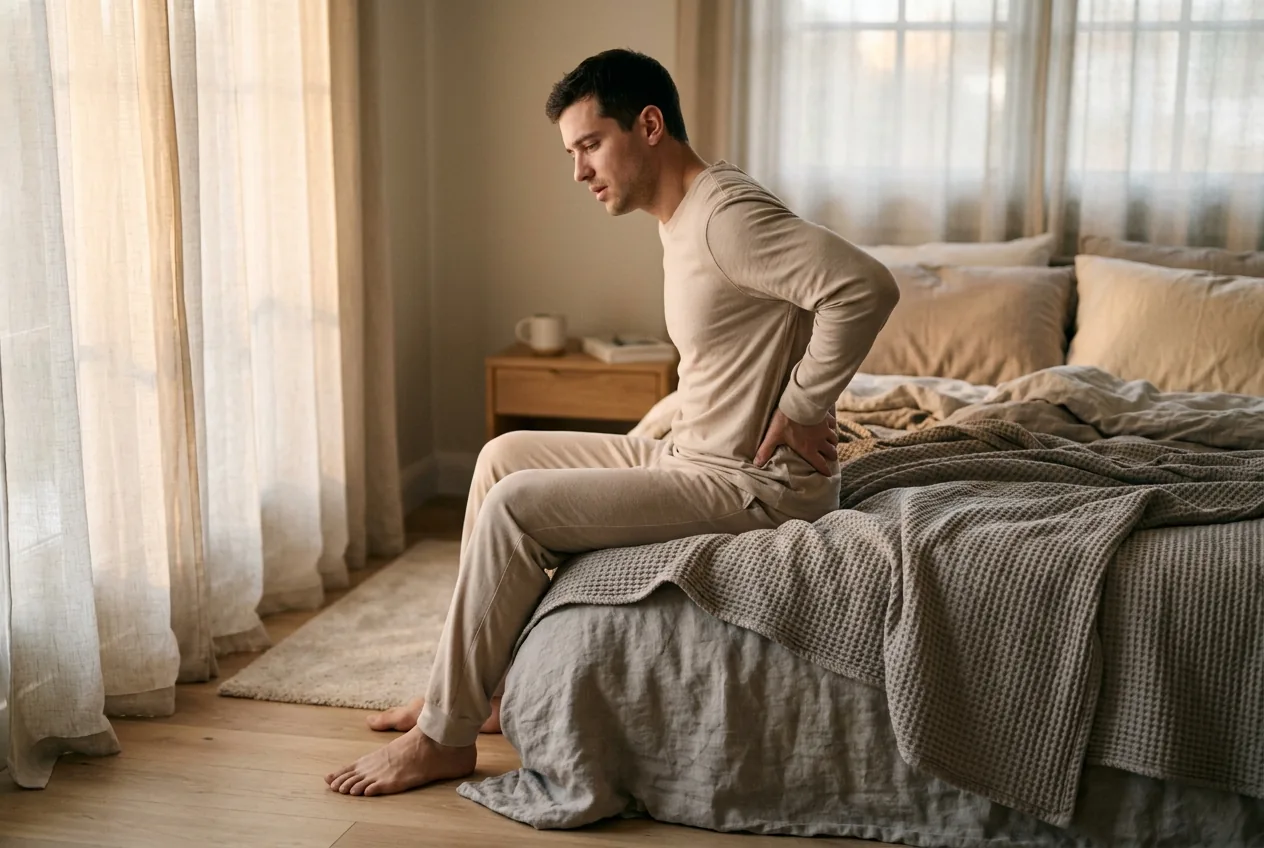

Walking is supposed to be the easy one. So when your lower back starts aching a few blocks into a walk — or on the long trudge around a supermarket — and sitting on a bench fixes it within a minute, it's worth knowing why. Lower back pain when walking has a few common causes, and most of them come down to how your pelvis and hips are working as you move.
Good news first: walking pain that eases when you sit or lean forward is usually mechanical, not a sign of something serious. It's about position and muscle balance.
What walking asks of your lower back
Every step is a small balancing act. Your pelvis has to stay level as you shift weight from one leg to the other, and your glutes have to fire to keep you driving forward. When those muscles do their job, your lower back just goes along for the ride.
When they don't — when the glutes are weak and the hips are stiff from years of sitting — your lower back starts doing the stabilizing instead. Step after step, it works harder than it should, and the ache builds. It's a slow burn, not a sudden catch, which is why it creeps up after a few minutes.
The forward lean that gives it away
Here's a telling detail: if leaning forward over a shopping trolley, or sitting down, takes the pain away, that points to the back joints being compressed in standing and walking, and opened up when you bend forward.
The usual driver is an over-arched lower back, often from anterior pelvic tilt. The pelvis tips forward, the arch deepens, and walking upright keeps those back joints pressed together with every stride. Lean over the trolley and the arch flattens, the joints open, relief arrives. The same pattern often explains pain that builds when standing still.
A second driver is sheer weakness. Lazy glutes mean the lower back muscles fatigue and tighten as the walk goes on.
A third, easy to miss, is how the load travels up from the ground. Worn-out shoes, flat unsupportive soles, or a long walk on hard pavement send each footstrike up through the chain with little to absorb it. If your hips and glutes aren't doing their share, your lower back ends up soaking up the impact one step at a time. This is why some people are fine on a treadmill or grass and sore on concrete — same walk, different shock load. It's also why a new pair of cushioned shoes occasionally fixes a problem people assumed was their spine.
How to walk with less pain
- Shorten your stride slightly. A huge stride forces the pelvis to over-rotate and the back to over-arch. Smaller, more frequent steps are kinder.
- Squeeze the glute as your foot lands. A small cue: think about pushing the ground behind you with each step. This gets the glutes carrying you instead of the lower back.
- Walk tall but not stiff. Lift through the crown of your head, keep a gentle tuck of the tailbone, unlock the knees.
- Build distance gradually. If you flare at fifteen minutes, walk twelve and stop. Then add a couple of minutes each week.
Strengthen what's missing
Glute bridges. On your back, knees bent, drive through the heels, lift the hips, squeeze hard at the top, lower slowly. Two sets of twelve. This is the most direct way to wake up the muscle that should power your walk.
Standing hip flexor stretch. Step into a short lunge, tuck the tailbone, squeeze the back glute, feel the stretch across the front of the hip. Hold 30 seconds each side. Loosening the front of the hip lets the pelvis sit level so the back stops over-arching as you walk.
Bird dog. On hands and knees, extend the opposite arm and leg, keep your back flat and still, hold a few seconds, switch. This trains the back to stay stable while your limbs move — exactly what walking demands. For more, see core exercises for lower back pain.
Build the distance the same way you'd build any training. If you flare reliably at the fifteen-minute mark, don't keep walking to twenty to prove a point — that just rehearses the compensation. Walk twelve minutes pain-free, do your glute and hip work on the side, and let the comfortable distance creep up week by week. Pain-free repetition teaches your body the better pattern; pushing into pain teaches it the worse one. Most people who do the strengthening find the wall they used to hit simply moves further out and then disappears.
If a bench fixes it in sixty seconds, your spine isn't failing. Your stride is overworking it.
What to stop doing
- Stop powering through long walks in flat, unsupportive shoes if they flare you — cushioning changes how load travels up the chain.
- Stop the locked-knee, chest-out march. It looks like good posture and deepens the arch.
- Stop ignoring the early ache and walking until you're hobbling. Rest at the first signs, lean forward, then continue.
When to see a doctor
Walking pain that eases with sitting or forward lean, with no leg symptoms, is usually mechanical. See a clinician promptly if walking brings on numbness, tingling, heaviness, or weakness in one or both legs that eases only when you sit (this pattern needs a proper exam), or if you have pain after a fall, fever with back pain, unexplained weight loss, any loss of bladder or bowel control, or pain that steadily worsens regardless of activity.
The pattern under the pain
Shortening your stride and strengthening your glutes will help most walkers. But whether your back over-arches, flattens, or hitches to one side as you walk changes which work you need — and the wrong stretch can deepen the very imbalance causing the pain. A posture assessment measures your actual deviations and builds the daily routine to match, instead of leaving you to guess. That's the principle behind this posture therapy method.
It's also worth separating two things people lump together: being tired and being in pain. After a long walk, mild fatigue in the muscles around the lower back is normal — they did work. A sharp, building ache that forces you to stop, or any symptom traveling into the leg, is different and not something to walk through. Learning to tell the two apart keeps you moving when movement is exactly what helps, and keeps you cautious when caution is warranted.
The goal is ordinary: a walk around the block, or around the zoo with the kids, without counting the minutes until you can sit.
Common questions
Why does my lower back hurt when walking but feel fine sitting?
When your glutes are weak and your hips are stiff, your lower back ends up doing the stabilizing work each step, so the ache builds as the walk goes on. Sitting or leaning forward opens up the compressed back joints, which is why it eases so quickly.
Why does leaning on a shopping trolley take the pain away?
Leaning forward flattens an over-arched lower back and opens the joints that get pressed together when you walk upright. If a trolley or a bench fixes it within a minute, the pain is usually mechanical rather than a sign of something serious.
Can my shoes cause lower back pain when walking?
They can play a part. Worn-out or flat, unsupportive shoes send each footstrike up through your body with little to absorb it, so if your hips and glutes aren't doing their share, your lower back soaks up the impact. Some people are fine on grass or a treadmill and sore on concrete.
Should I keep walking through lower back pain?
Mild muscle fatigue after a long walk is normal. A sharp, building ache that forces you to stop, or any symptom traveling into the leg, is different and not something to push through. Walk a comfortable distance, do your strengthening, and let the distance creep up over weeks.