
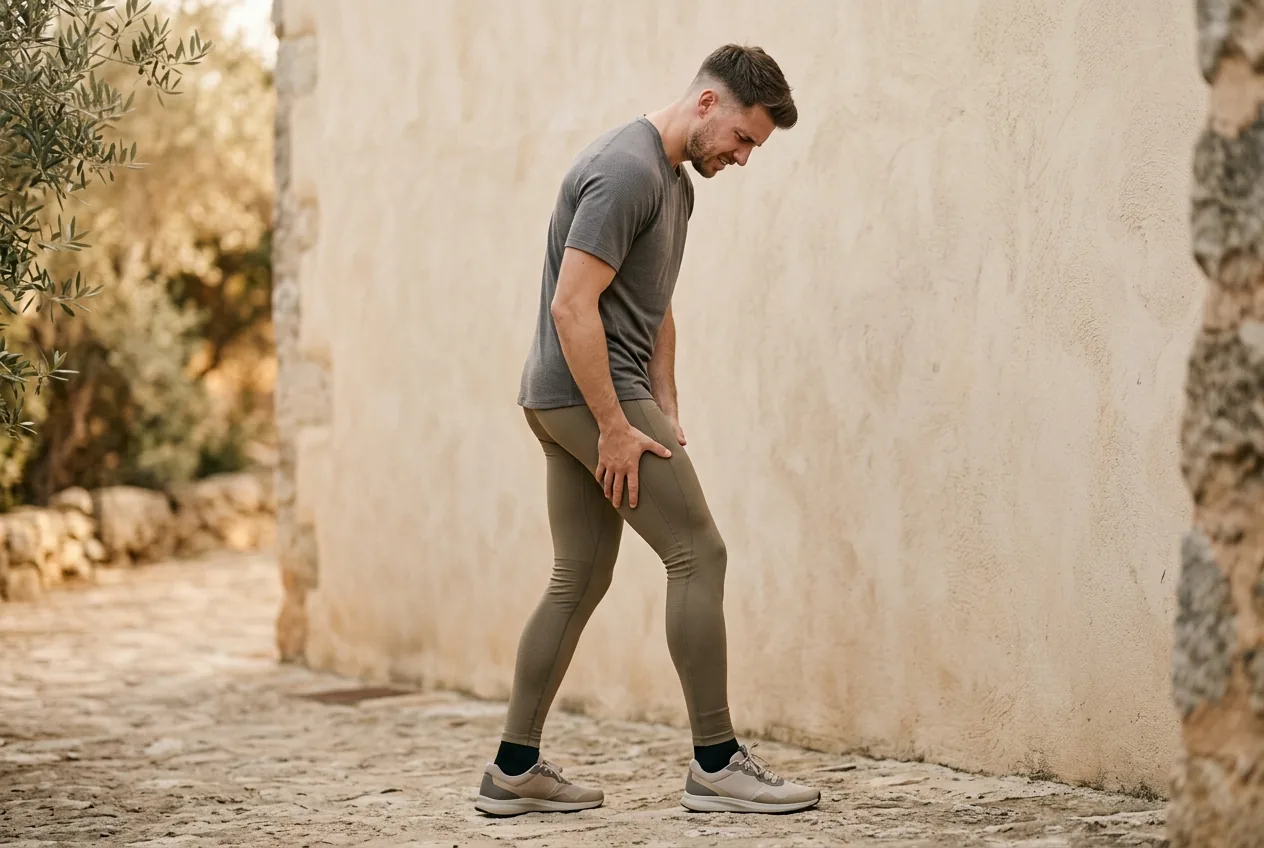
There's a tightness or a pull running down the back of your thigh, and you can't quite decide what it is. It feels like a hamstring that needs stretching — so you stretch it, and it doesn't loosen, or it gets worse. That contradiction is the whole reason this article exists. Pain in the back of the thigh is one of the most commonly misread complaints, because two very different problems live in the same spot, and the treatment for one is exactly wrong for the other.
So before you keep reaching for your toes, it's worth sorting out whether you're dealing with a hamstring or sciatica.
Two problems, one location
The back of the thigh is home to both the hamstring muscles and a long stretch of the sciatic nerve, which runs right down behind the thigh. When something hurts there, it's usually one of these two.
A hamstring problem is a muscle issue — a strain, a tear, or chronic tightness and overload. It's local. It hurts in the muscle belly or near where the hamstring attaches up at the sit bone, and it responds to the muscle: worse when you load or lengthen it, tender to press, sometimes with a specific moment you can remember pulling it.
Sciatica is a nerve issue. The sciatic nerve, irritated up in the lower back or squeezed in the buttock, refers pain down the back of the thigh even though nothing is wrong with the muscle there. It's not local — the source is higher up, and the thigh is just on the nerve's path. The broader picture of how that referral works is in sciatic nerve pain.
This is why guessing is risky. Stretching a tight hamstring helps the muscle. But hard hamstring stretching can pull a already-irritated sciatic nerve tighter and flare it — so if you've been stretching and it keeps getting angrier, that itself is a clue you may be dealing with the nerve, not the muscle.
If stretching the "hamstring" makes it worse instead of better, suspect the nerve.
How to tell them apart
Run through these honestly.
- Quality of the pain. A hamstring is a dull, pulling, achy soreness in the muscle. Sciatica burns, tingles, shoots, or buzzes, and can come with numbness.
- How far it goes. Hamstring pain stays in the thigh, roughly between the sit bone and the back of the knee. Sciatic pain often travels further — past the knee into the calf or foot — or starts up in the buttock or back.
- What triggers it. A hamstring hurts when you contract or stretch the muscle: sprinting, bending to touch your toes, sitting on a hard edge that presses the tendon. Sciatica flares with back and nerve things: long slumped sitting, bending and twisting, coughing or sneezing.
- Tenderness. You can usually press on a sore hamstring and find the spot. Referred nerve pain doesn't have a single tender point in the thigh — pressing there doesn't reproduce it.
- A clear injury moment. A hamstring strain often has one: a pop or sharp pull mid-stride. Sciatica usually builds without a single dramatic event.
If your symptoms point to the muscle but it's chronically tight rather than freshly torn, there's a twist worth knowing: tight hamstrings and a cranky back often travel together because of how the pelvis sits. Hamstring tightness and back pain explains that link, and why endless stretching often fails to fix it.
What to do for each
If it's the hamstring. Gentle, gradual loading is what heals a strained or tight muscle — not aggressive yanking. Ease into hamstring work, build it up, and give a strain time. If the issue is chronic tightness, look up the chain: a pelvis tilted forward keeps the hamstrings on permanent stretch, so they feel tight no matter how much you stretch them. Strengthening the glutes and settling the pelvis loosens them more than the stretching does.
If it's sciatica. Stop the hard hamstring stretching — it's the wrong move here. Instead, take pressure off the nerve: break up sitting, walk often, and use the gentle, nerve-calming routine in sciatica stretches at home, stopping short of anything that shoots down the leg. The whole principle flips: with the nerve, less force and more frequency wins.
The fact that the right move for one is the wrong move for the other is exactly why telling them apart matters before you commit to a routine.
When to see a doctor
This is posture education, not medical advice. See a clinician promptly if you have leg or foot weakness that's getting worse, numbness spreading into the saddle area between the legs, or any loss of bladder or bowel control — the last two are an emergency. Also get checked for a sudden severe hamstring injury with bruising or an inability to walk, a calf that's swollen, hot, or red (which can signal a clot), pain with fever or unexplained weight loss, or thigh pain that's severe and steadily worsening rather than easing.
Why your pattern decides the right move
Once you see that the same spot can hurt for opposite reasons, the value of knowing your own setup is obvious. A pelvis tilted forward keeps hamstrings tight and can crowd the nerve at the same time, so the two problems aren't even fully separate — they can share a root in how your pelvis and lower back are positioned.
That's the case for measuring rather than guessing. A posture assessment maps how your pelvis tilts and where the load is going, so you treat the actual driver — settling the pelvis, waking the right muscles, calming the nerve — instead of stretching a hamstring that was never the real problem.
When in doubt, watch what stretching does: if it loosens, it's likely the muscle; if it flares, look to the nerve and the back behind it.
Common questions
Is my back-of-thigh pain a hamstring or sciatica?
Hamstring pain is a dull, local ache in the muscle that's worse when you load or stretch it and tender to press. Sciatica is a burning, shooting, or tingling pain that's referred from the back or buttock, often travels past the knee, and has no single tender spot in the thigh.
Why does stretching my hamstring make it worse?
If the pain is actually sciatica, stretching pulls the already-irritated sciatic nerve tighter and flares it. That paradox — stretching aggravating instead of easing the "hamstring" — is one of the clearest signs you're dealing with the nerve rather than the muscle.
Can tight hamstrings be caused by my back?
Yes. A pelvis tilted forward keeps the hamstrings on constant stretch, so they feel perpetually tight no matter how much you stretch them. In that case settling the pelvis and strengthening the glutes loosens the hamstrings more reliably than stretching does.
How do I treat sciatic pain in the back of the thigh?
Take pressure off the nerve rather than stretching hard: break up long sitting, walk often, and do gentle nerve-calming movement that stops short of any shooting pain. Avoid aggressive hamstring stretching, which tends to make referred sciatic pain worse.