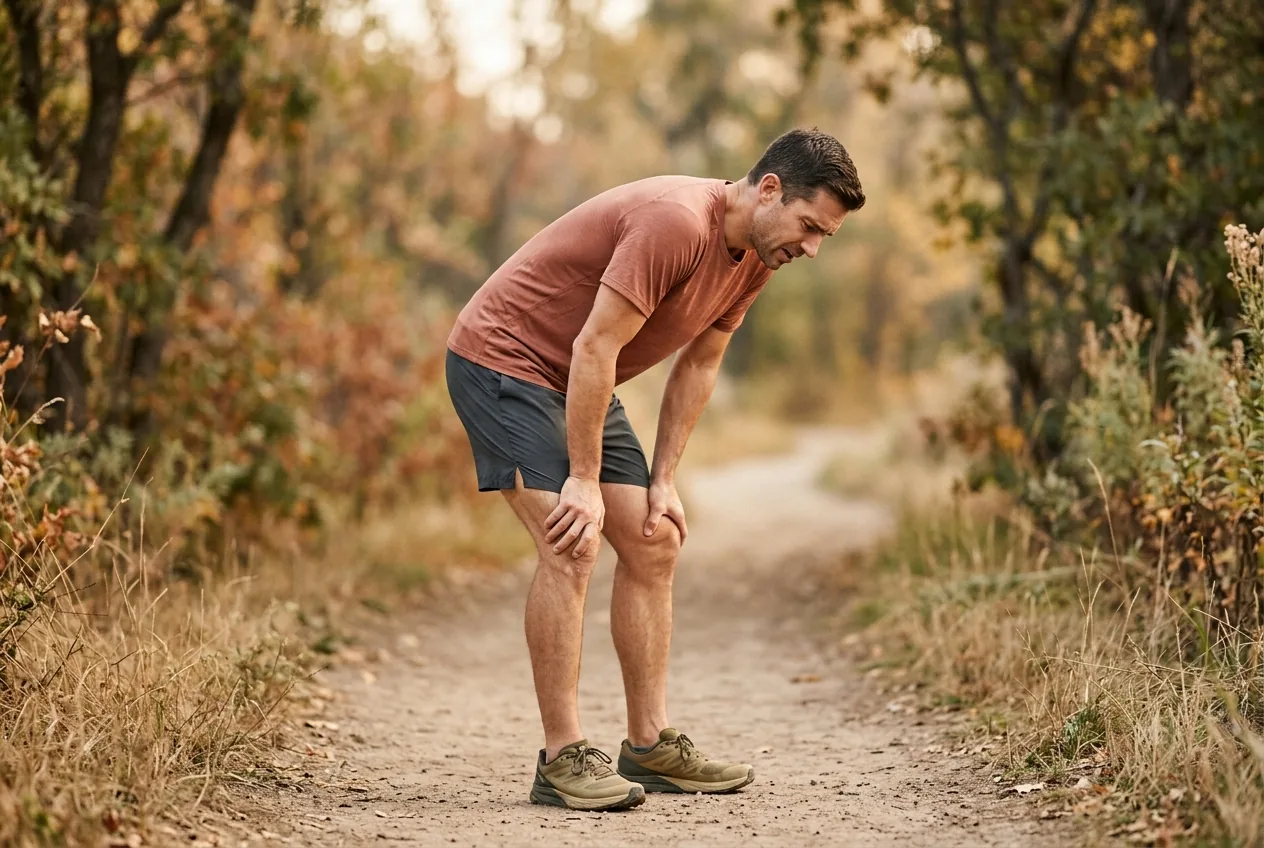

The worst moment is the first step out of bed. Your heel feels like you're standing on a bruise or a stone, the pain sharp enough to make you limp the first few strides until it eases. By mid-morning it's quieter, then it flares again after you've been on your feet a while. You've rolled a frozen bottle under your arch, bought the insoles, tried the night splint. Some relief, then it settles back in.
Plantar fasciitis is real, and it's genuinely in your foot — a thick band of tissue along the sole, the plantar fascia, gets overloaded and irritated where it anchors at the heel. But here's the part the insole ads skip. The reason that band is getting overloaded often has nothing to do with your foot in isolation. The plantar fasciitis hip connection is real: how your hips and pelvis line up changes how your weight lands on the foot, and a foot that's loaded badly from above keeps the fascia under strain no matter how much you roll it.
What the plantar fascia actually does
The plantar fascia is a strong, slightly stretchy band running from your heel to the base of your toes, holding up the arch of your foot. Every time you take a step, it stretches a little as your weight rolls forward, then recoils to help spring you off. It's built for that cycle — but it's built for it when your weight lands in a reasonably balanced way.
When the foot rolls too far inward and the arch flattens on every step, the fascia gets overstretched and pulled hard at its heel anchor with each stride. Do that thousands of times a day and the anchor point gets irritated and inflamed. That's the heel pain. The frozen-bottle roll calms the irritated tissue for a while, but it does nothing about why the foot is collapsing in the first place.
You can keep icing the place that hurts, or you can change the load that keeps hurting it. Only one of those stops the cycle.
Where the hip comes in
Here's the chain. Your foot doesn't decide on its own how to land — the leg above it does a lot of the steering, and the leg is controlled by the hip. When the muscles around the hip, especially the glutes, are weak or switched off, nothing stops the thigh from rolling inward as you load the leg. The shin rotates in with it, and that inward rotation travels all the way down and drops the arch. The foot collapses, the fascia overstretches, the heel pays.
This is the same weak-hip pattern that shows up all over the lower body. It's why weak glutes feed into back pain, and it's the link explained in knee pain and posture — the knee caves on the way down to the foot. The plantar fascia is simply the last stop on that chain.
A tilted pelvis adds to it. If you sit most of the day and your hip flexors have gone short, your pelvis tips and shifts how your weight stacks down through the legs. The pattern in tight hip flexors from sitting changes how every step lands. The foot inherits whatever's happening up the chain.
What to work on above the foot
Keep treating the foot — that part isn't wrong. But add the work higher up, where the load is being set. Go gently; nothing should sharpen the heel pain.
Calm the foot
- Calf and arch stretch. A tight calf pulls on the heel and feeds the fascia strain. Stand facing a wall, one foot back, heel down, and lean in until you feel the calf stretch. Hold 30 seconds each side, a few times a day.
- Towel or band stretch before standing. Before that brutal first step, loop a towel around the ball of your foot while still in bed and gently pull the toes back to lengthen the fascia. A minute or two takes the edge off the first steps.
Fix the load from above
- Glute bridges. Lie on your back, knees bent, push through your heels and lift your hips, squeezing the glutes. Ten to fifteen slow reps. This wakes the muscles that should be steering the leg.
- Side-lying leg lifts. Lie on your side, lift the top leg straight up without letting it drift forward. This trains the outer-hip muscles that stop the leg rolling in and dropping the arch.
- Short-foot and single-leg balance. Stand, lift the arch gently without curling the toes, then try holding a single-leg balance for 20–30 seconds with the arch held and the knee pointing forward. This ties the foot and hip together under real load — the whole point of fixing foot posture.
Change the daily input
- Get up and move often so the hip flexors don't lock short and shut the glutes down.
- Avoid long stretches barefoot on hard floors during a flare; supportive shoes give the fascia a break while you address the cause.
- Check your shoe wear — a sole worn down hard on the inner edge is a sign your foot is collapsing inward.
When to see a doctor
Most posture- and load-related heel pain eases as the foot calms and the hip starts steering the leg properly. But see a clinician for heel pain that follows a sudden injury or a pop, pain with significant swelling, redness, or warmth, numbness or tingling in the foot, pain that doesn't budge after weeks of sensible care, or pain with fever. Numbness or tingling in particular points to a possible nerve issue rather than a simple fascia strain and is worth checking. When the pain is sharp from an injury, swollen, or comes with numbness, get it assessed before assuming it's mechanical.
Why it keeps coming back
If your heel pain keeps returning despite all the rolling and the insoles, it's usually because the load hasn't changed. The hip still isn't steering the leg, the arch still collapses on every step, and the fascia keeps getting yanked at the heel. You calm the tissue, but the thing overloading it is unchanged.
Lasting relief comes from correcting the chain above the foot, and that depends on your own setup — how your pelvis sits, which hip muscles are switched off, how your feet load the ground. The right work for one alignment can be wrong for another, which is why generic foot routines often disappoint. A posture assessment measures your real deviations and builds the routine around them. If your heel keeps flaring despite the foot care, see how a posture-based method addresses chronic pain by starting from your actual alignment, head to foot.
Treat the heel, yes — but fix how the weight lands on it, and the fascia finally gets to settle.
Common questions
How can hip weakness cause heel pain?
Weak hip muscles let the thigh roll inward as you load the leg, which rotates the shin and drops the arch of the foot. That collapse overstretches the plantar fascia and pulls hard on its heel anchor with every step, so heel pain can trace straight back to a hip that isn't steering the leg.
Why is plantar fasciitis worst on the first step in the morning?
Overnight the fascia tightens and shortens. The first steps stretch that irritated, shortened tissue suddenly, which is why it feels sharp until it warms up and loosens over the first few strides.
Do insoles fix plantar fasciitis?
Insoles can support the arch and ease the strain while tissue calms, which helps the symptoms. But if the foot is collapsing because the hip isn't controlling the leg, insoles treat the load without fixing why it's there, so the pain often returns once you stop relying on them.
When should heel pain be checked by a doctor?
See a clinician for heel pain after a sudden injury or pop, pain with swelling, redness, or warmth, numbness or tingling in the foot, pain with fever, or pain that doesn't improve after weeks of sensible care. Numbness in particular can point to a nerve issue and is worth checking.