If your back feels like rusted hinges first thing in the morning — stiff, reluctant, taking a few minutes to loosen before it'll bend — the cat-cow is the move that oils them. The cat-cow stretch for back pain is one of the gentlest things you can do for a spine that's been held in one shape all day, and it's hard to get badly wrong. It moves your spine through its full range, segment by segment, and that gentle motion is often what a stiff, achy back is actually asking for.
This is a single-move guide. You'll get the step-by-step, what to feel, the small errors that flatten its benefit, and how to fit it into a morning and evening routine.
From our own quiz data: of 3,486 people who told us what sets their pain off, 15% named simply getting up out of a chair. Nothing about that movement is demanding — which is the point. A spine held in one shape for an hour doesn't need a demanding movement; it needs reminding of the range it still has.
What cat-cow does for a stiff back
Your spine is built to move — to round, to arch, to twist. Most of a modern day asks it to do the opposite: hold one fixed position for hours, usually a slightly slumped one. Joints that don't move get stiff. The small muscles between the vertebrae lose their easy give. Fluid movement in the discs and joints slows down. By the time you stand up, your back feels locked because, functionally, it has been.
Cat-cow gently reverses that. Alternating between a rounded "cat" and an arched "cow" walks your spine through flexion and extension, encouraging movement at each segment rather than bending only at the one or two spots that already move too much. It's mobility, not strength — and for a back that's stiff and protective, mobility is usually the first thing that helps.
It pairs naturally with gentle core work for the lower back: cat-cow restores the movement, core work gives the spine the control to use it safely.
A stiff back isn't always a weak back. Often it's just a back that hasn't moved through its range in hours — and cat-cow is the cheapest way to give it that.
How to do cat-cow, step by step
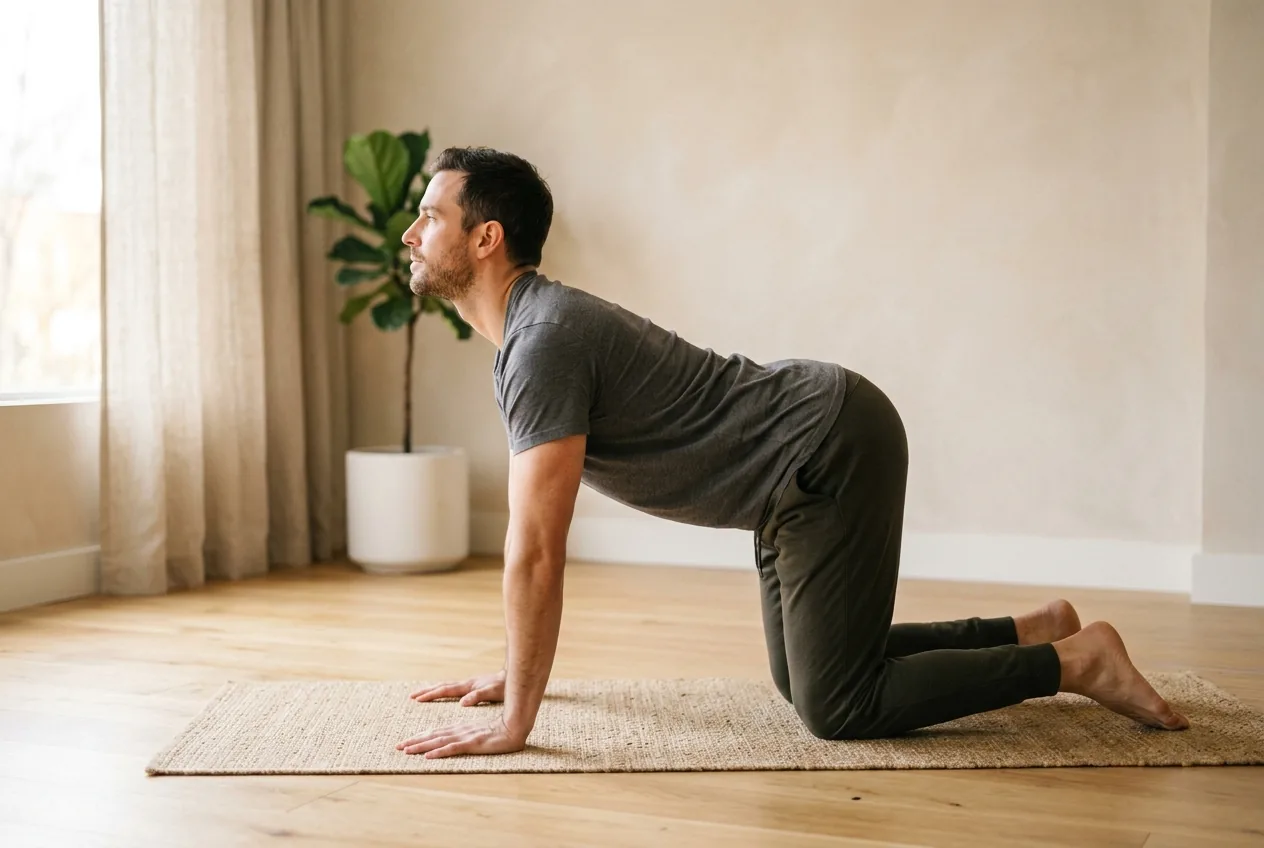
- Start on your hands and knees. Wrists directly under your shoulders, knees under your hips. Spine in a neutral, flat-table position to begin.
- Cow: Breathe in. Slowly drop your belly toward the floor, lift your chest and tailbone, and let your gaze rise gently. Your back makes a shallow valley. Don't force the arch — let it open.
- Cat: Breathe out. Tuck your tailbone, push the floor away through your hands, and round your spine toward the ceiling, dropping your head softly between your arms. Your back makes a smooth dome.
- Move with your breath — inhale into cow, exhale into cat — taking three or four seconds each way.
- Flow between the two slowly and continuously, like the spine is rolling through the movement one vertebra at a time.
The whole thing should feel like a release, not a strain. You're looking for easy motion and a light stretch, never a sharp pull.
The small errors that blunt it
Moving only from the lower back. Many people hinge at the lumbar spine and leave the upper back rigid. Try to spread the motion along the whole spine — imagine the curl starting at your tailbone and travelling up to your neck.
Rushing the reps. Cat-cow done fast is just flapping. The benefit is in slow, controlled movement that lets each segment participate. Match it to your breath and it naturally slows.
Forcing the end ranges. Cranking hard into the arch can pinch a sensitive lower back. Stay within a comfortable range, especially early on. Smaller and smoother beats bigger and forced.
Locking the elbows or hyperextending the neck. Keep a micro-bend in your elbows and let your head follow your spine rather than throwing it back.
Holding your breath. Cat-cow is meant to flow with your breath — inhale opens the cow, exhale rounds the cat. Breath-holding makes the movement stiff and jerky and skips part of the relaxation benefit. If you can't sync the breath at first, just breathe slowly and naturally and let the rhythm come.
If kneeling bothers your knees, fold a towel under them, or do a seated version: sit tall, hands on knees, round your back on the out-breath and arch on the in-breath. The point is the spinal motion, not the floor position — which is why it also fits into gentle back exercises for seniors.
Reps, timing, and when to use it
Aim for 8–10 slow cycles, once or twice a day. There's no need to push the number — a couple of unhurried minutes is plenty.
Two moments where it earns its keep:
- Morning: A stiff, achy back on waking is common. A slow set of cat-cows before you do much else gently restores movement and takes the edge off the first hour. Move within a smaller, gentler range when you're still stiff.
- Evening or work breaks: After hours in a chair, cat-cow undoes some of the fixed-position stiffness before it carries into your sleep.
If you notice your back gets stiff specifically from prolonged sitting, cat-cow is a good reset to pair with standing and walking breaks. It also sits well alongside addressing an anterior pelvic tilt, since the tailbone-tucking "cat" half gently rehearses the pelvic motion a forward-tipped pelvis tends to lose.
When to see a doctor
Cat-cow is gentle, but listen to sharp signals. See a clinician promptly if you have numbness, tingling, or weakness spreading down a leg, any loss of bladder or bowel control, back pain after a fall or accident, fever with back pain, unexplained weight loss, or pain that's severe or steadily worsening. Also stop if a particular direction — usually the deep arch — reliably triggers sharp or shooting pain rather than a gentle stretch; that's worth a professional opinion.
Why mobility alone may not be the whole answer
Cat-cow almost always feels good, and for a stiff back that's real relief. But feeling better for an hour and staying better are different things. If your back keeps stiffening up day after day, the question is *why* it's locking — and that usually comes down to a postural pattern pulling your spine into a position it then has to defend.
Mobility eases the symptom. Changing the pattern is what stops it coming back. The same is true of weak glutes quietly loading your lower back: stretching helps, but the fix is upstream. Knowing your own pattern is what turns a feel-good stretch into a routine that holds. A posture assessment measures where your spine and pelvis actually deviate so the work goes where it counts.
Use cat-cow daily for the easy relief it gives. Then look upstream at why the stiffness keeps returning — that's where lasting change lives.
What I see in practice
Cat-cow is the move I recommend most freely and expect the least from: it's a genuinely safe way to get a spine moving, and it isn't a correction. What I actually use it for is information. Watch where your back bends — most stiff spines fold at one or two lower segments and leave the mid-back almost flat, which is the same pattern that overloads those segments in the first place. If that's you, going slower and smaller and trying to start the motion up between the shoulder blades does more than another ten fast cycles. And if you need it every morning just to feel normal, that's worth noticing rather than accepting: a back that has to be un-stuck daily is telling you something about the eight hours before it, not about the stretch.
Common questions
Is cat-cow good for lower back pain?
For a stiff, achy back it usually helps. It moves your spine gently through its full range, segment by segment, which is often exactly what a back that's been stuck in one position all day is asking for.
How many cat-cow stretches should I do?
Aim for 8 to 10 slow cycles, once or twice a day. A couple of unhurried minutes is plenty — there's no need to push the number or rush the reps.
When is the best time to do cat-cow?
Two moments earn their keep: in the morning to ease the overnight stiffness before you do much else, and in the evening or on work breaks to undo the fixed-position stiffness from sitting. Keep the range smaller when you're still stiff.
Can I do cat-cow if I can't get on the floor?
Yes. Do a seated version — sit tall, hands on knees, round your back on the out-breath and arch on the in-breath. The spinal motion is the point, not the floor position.