If your lower back feels gripped and tight after a long day at the desk — that band of muscle across your waist refusing to switch off — child's pose is the first thing worth trying before bed. Child's pose for back pain is about as gentle as a stretch gets: you fold forward over your knees, let your spine round, and give the muscles that have been clenching all day permission to let go. It asks nothing of your strength and very little of your flexibility, which is why it's one of the safest places to start when your back is sore and you're wary of making things worse.
This is a single-move guide. You'll get the step-by-step, what the stretch should feel like, the small errors that flatten its benefit, the sets and timing, and who should go easy.
From our own quiz data: ask 1,477 people how well they think they're managing their own back and only 3% call themselves very satisfied; 84% aren't satisfied. Worth carrying into a page about a stretch this dependable, because the two facts don't contradict each other — a move that feels good tonight and a back you'd describe as handled are separate achievements. Nearly everyone who finds us already knows something that helps for an hour. It's the rest of the week they can't account for.
What child's pose does for a tight back
A back that's been held upright in a chair for hours is usually a back that's been working — the muscles either side of your spine bracing to keep you vertical even when you slump. By evening they're fatigued and short, and that's the tightness you feel. Lying down helps, but it doesn't actively lengthen those muscles.
Child's pose does. Folding forward puts your spine into gentle flexion, which lengthens the muscles running alongside it and eases the grip across your lower back. The position also opens the space at the back of the lumbar joints a little, which can take pressure off a back that feels compressed. For many people that combination — lengthening plus a sense of decompression — is exactly what a tight, achy lower back is asking for at the end of the day.
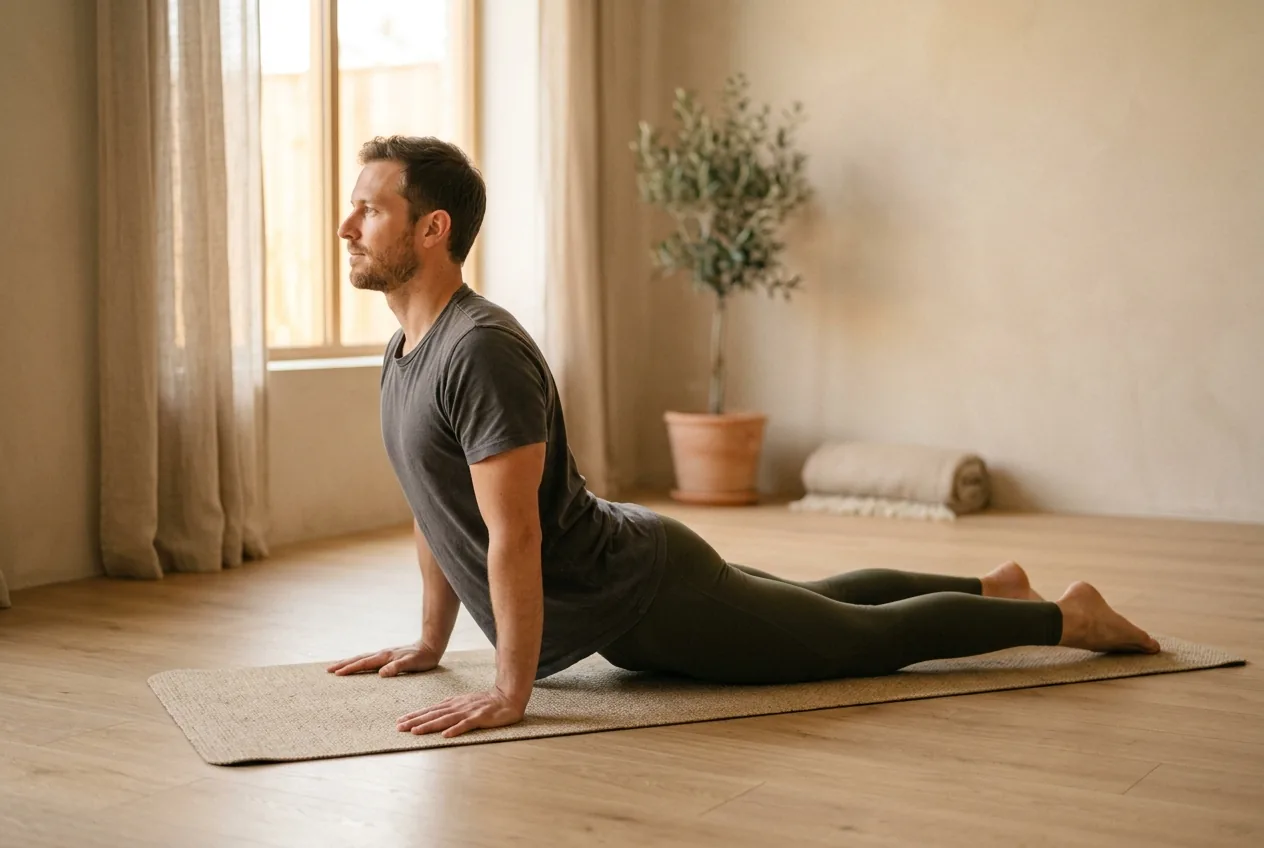
It's flexion-based, which makes it a natural counterpart to extension moves like the cobra press-up. Some backs prefer one direction over the other, and child's pose is usually the friendlier of the two for a back that feels tight rather than stuck.
A clenched back doesn't need force. It needs a position where it's finally safe to stop holding on.
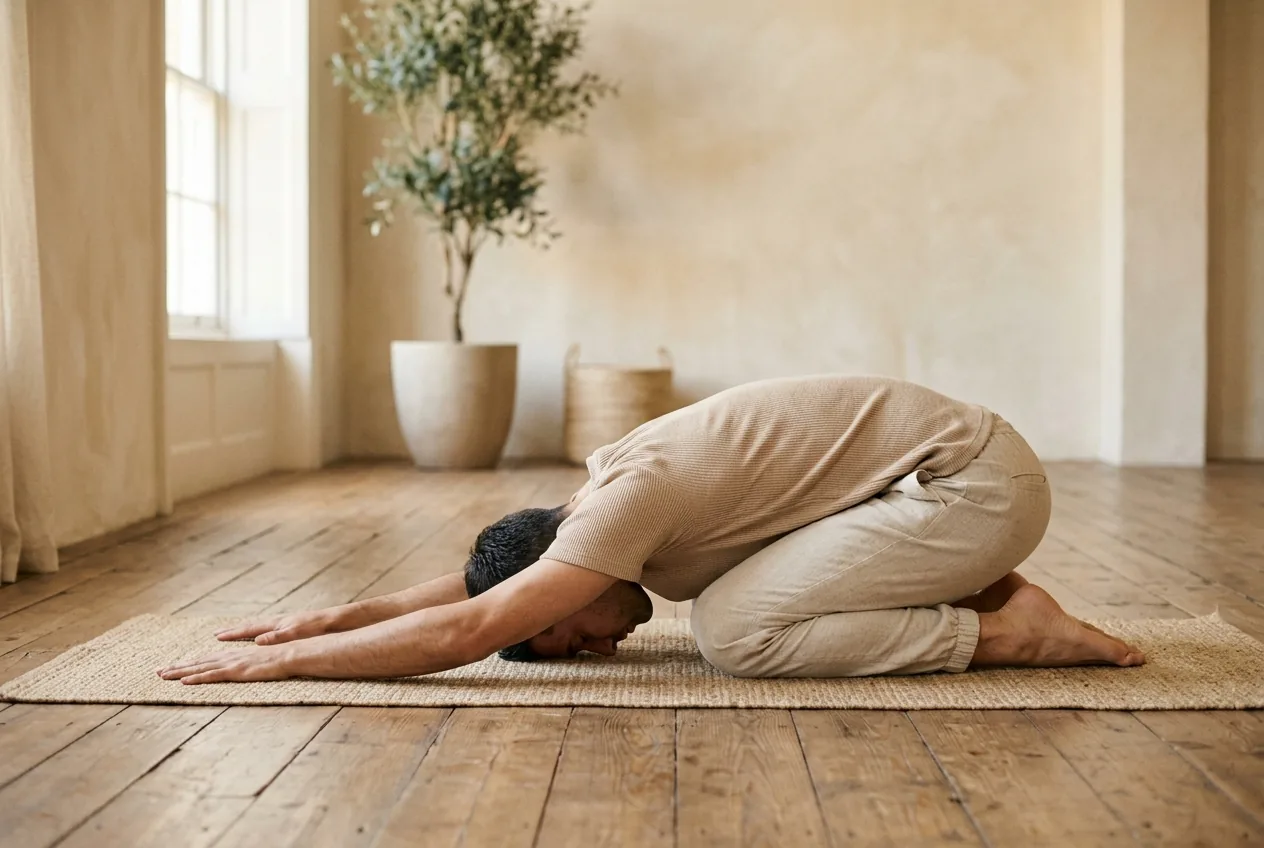
How to do child's pose, step by step
- Start on your hands and knees, wrists under your shoulders and knees under your hips.
- Bring your big toes together behind you and let your knees spread to about hip width — or wider if that's more comfortable for your hips.
- Sit your hips back toward your heels, slowly, letting your spine round and your chest sink toward the floor.
- Reach your arms forward and rest your forehead on the floor, a cushion, or a folded towel — whatever lets your neck relax.
- Let your whole back soften. Breathe slowly into your lower back and ribs, feeling the gentle expansion there with each inhale.
- Hold for 30 seconds to a couple of minutes, breathing easily the whole time.
What you want to feel: a broad, comfortable stretch across your lower back and through your hips, and a sense of the back muscles letting go. What you don't want: any sharp pull, pinch, or shooting sensation.
If your hips won't reach your heels or it strains your knees, slide a cushion between your backside and your heels, or rest your belly and chest on a stack of pillows so you're folding over support rather than into empty space.
The small errors that blunt it
Forcing the hips down. If your hips are stiff or your knees complain, jamming yourself toward your heels turns a release into a strain. Support the gap with a cushion and let the stretch be where it is today.
Holding tension in the neck and shoulders. People reach their arms forward and then keep their shoulders hunched up by their ears. Rest your forehead down, let the shoulders melt, and the upper back relaxes too.
Holding your breath. This is a relaxation stretch, and breath is most of the relaxation. Breathe slowly into the back of your ribcage — that breath into the back body is part of what releases the muscles.
Rushing in and out. Dropping into the pose fast and popping straight up wastes it. Sink slowly, stay long enough for the muscles to actually let go (30 seconds minimum), and rise gently.
Cranking the arms to feel "more." A bigger reach doesn't make it better. The release comes from settling and breathing, not from stretching harder.
Sets, reps, and when to use it
Child's pose isn't a counted-reps move — it's a held, breathing stretch. Hold it for 30 seconds to two minutes, and repeat once or twice if it feels good. There's no upper limit to worry about; it's gentle enough to use whenever your back asks for it.
A few moments where it earns its place:
- Before bed. A held child's pose helps unwind the day's clenching so you're not carrying that tension into sleep. It fits naturally into a short routine of stretches before bed for back pain.
- After long sitting. A few hours in a chair leaves the back short and tight; child's pose is a quick reset on a work break.
- As a recovery position. During any floor routine, dropping back into child's pose for a few breaths between harder moves gives your back a rest.
It also pairs well with the knee-to-chest stretch, which works the same flexion direction one leg at a time and lets you target one side if that's where the tightness sits.
Who should be cautious
Child's pose suits most tight, achy backs, but it isn't for everyone. Deep forward folding isn't ideal if your pain is clearly worse with bending or sitting and better when you stand and arch — that pattern sometimes points to a disc that prefers extension, where flexion stretches can aggravate. If folding forward reliably worsens your symptoms or sends pain or tingling down a leg, back off and favour gentle extension instead.
Go gently if you have knee problems (support the joint or skip the deep knee bend), are pregnant (widen the knees to make room, or skip it later in pregnancy), or have had recent abdominal or spinal surgery (clear it with your clinician first).
When to see a doctor
Child's pose is gentle, but pain has limits worth respecting. See a clinician promptly if you have numbness, tingling, or weakness spreading down a leg, any loss of bladder or bowel control, back pain after a fall or accident, fever alongside back pain, unexplained weight loss, or pain that's severe or steadily worsening. Stop the stretch if folding forward reliably triggers sharp or shooting pain rather than a comfortable release.
Why one stretch rarely settles it for good
Child's pose almost always feels good in the moment, and for a tight back that relief is real. But feeling looser tonight and staying loose week after week are different things. If your back keeps clenching back up day after day, the useful question is *why* — and that usually comes down to a postural pattern that keeps loading the same muscles until they grip.
Stretching eases the symptom. Changing the pattern is what stops it returning. Knowing your own deviations is what tells you whether your back actually wants flexion like child's pose or extension like a cobra — because the same stretch that helps one pattern can aggravate another. A posture assessment measures where your spine and pelvis actually drift, so the work goes where it counts. It's also worth understanding how posture and back pain connect before you assume any single stretch is the whole answer.
Use child's pose for the easy relief it gives. Then look upstream at why the tightness keeps coming back.
What I see in practice
The part of this pose I'd pay the most attention to is the cushion, which people treat as a beginner's concession and skip. It isn't. If your hips are hovering three inches off your heels and you're holding yourself there, the muscles you came to release are the ones doing the holding, and you can stay in that shape for two minutes without anything letting go — fill the gap and the same pose starts working. The other thing I'd do is treat it as information rather than only as relief: try it on four or five evenings and notice which way your back votes, because a back that reliably feels looser after folding and one that feels tighter are two different backs, and that answer tells you whether the rest of your routine should lean toward flexion or away from it. Just don't run that test first thing in the morning, when a stiff back will give you an answer about the hour rather than about you.
Common questions
Is child's pose good for lower back pain?
For a tight, achy back it usually helps. It rounds the spine gently and lengthens the muscles that clench from sitting, which often eases the grip across the lower back. It's less suitable if your pain is clearly worse with bending and better with arching.
How long should I hold child's pose?
Hold it 30 seconds to two minutes, breathing slowly the whole time, and repeat once or twice if it feels good. It's a held, breathing stretch rather than a counted-reps move, so there's no need to rush.
Why does child's pose hurt my knees?
Usually because the deep knee bend or the gap between your hips and heels is too much. Slide a cushion between your backside and heels, widen your knees, or rest your torso on a stack of pillows so you fold over support.
Should I do child's pose if bending makes my back worse?
Be cautious. If your pain is reliably worse with forward bending and better when you stand and arch, deep flexion may aggravate it. Favour gentle extension instead and check the pattern with a clinician or a posture assessment.