If your lower back aches after a long stint hunched over a laptop, and standing up to arch backward feels weirdly good, the cobra is the move that gives your spine more of that. The cobra stretch for back pain — often called the press-up or prone extension — is the opposite of how you spend most of your day. You lie face down and gently arch your upper body up, taking your spine into extension instead of the forward slump it's stuck in from morning to night. For a lot of backs, that change of direction is exactly the relief they're after.
This single-move guide covers the step-by-step, what the stretch should feel like, the common form mistakes, sets and reps, and the people who should be careful with it or skip it.
What the cobra does for a slumped spine
Picture your day. Sitting at a desk, driving, scrolling a phone, leaning over the sink — almost all of it bends your spine forward. Hours of that leaves the front of your discs and the soft tissue at the front of your spine compressed, and the muscles along your back lengthened and tired from holding you up in a slump.
The cobra reverses that direction. Arching backward into extension opens the front of the spine and gently nudges pressure toward the back of the discs — which, for a back that's been stuck in flexion, often feels like a release valve. This is the core idea behind the McKenzie press-up that physical therapists use: for certain backs, repeated gentle extension can ease pain and even draw it back toward the spine and out of the leg, a pattern clinicians call centralisation.
The catch is that direction matters. The cobra suits backs that feel better arching and worse bending. A back that prefers the opposite usually does better with flexion moves like child's pose or the knee-to-chest stretch. Knowing which camp you're in is half the battle.
The same arch that frees one back can aggravate another. Direction isn't a detail — it's the whole decision.
How to do the cobra press-up, step by step
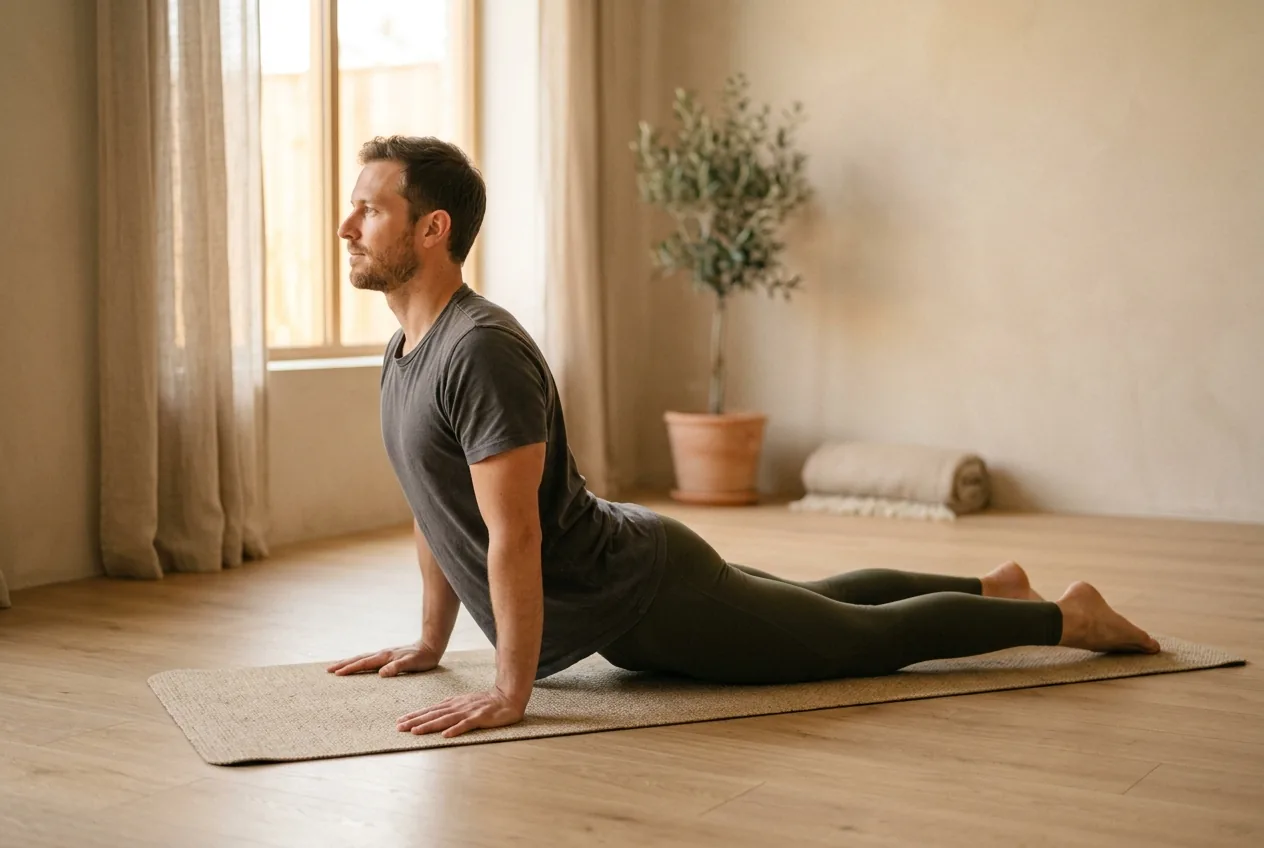
- Lie face down on the floor, legs straight and relaxed, palms flat on the floor under your shoulders as if you're about to push up.
- Keep your hips, pelvis, and legs relaxed and pressed into the floor — they stay down the whole time.
- Slowly press through your hands to lift your chest and upper body off the floor, letting your lower back arch gently.
- Go only as far as is comfortable. Early on that might be a few inches; over days it may become a fuller press with your arms closer to straight.
- Pause at the top for a second or two, letting your back sag into the stretch rather than holding it tense.
- Lower back down slowly and completely. That's one rep.
What you want to feel: a gentle stretch across the front of your torso and a comfortable arch in your lower back. What you don't want: a sharp pinch in the low back or pain shooting into a buttock or leg.
If a full press is too much at first, start with the sphinx version — up on your forearms instead of your hands — which gives a gentler, lower arch you can hold while your back gets used to extension.
The form errors that blunt it (or aggravate it)
Lifting the hips off the floor. If your pelvis and legs come up with you, you lose the extension at the lower back. Keep your hips pinned to the floor and let only the upper body rise.
Cranking the neck back. People throw the head back to feel a bigger arch. Keep your neck long and in line with your spine — look forward and slightly down, not at the ceiling.
Going too far, too fast. Forcing a deep press on day one can pinch a sensitive back. Build the range gradually over reps and over days. Smaller and smoother wins.
Tensing the back muscles at the top. This is a passive stretch — the work is in your arms, not your back. Let your lower back relax and sag into the arch rather than squeezing it.
Ignoring leg symptoms. If the press sends or worsens pain, numbness, or tingling down a leg, stop. Easing leg symptoms is the goal, not provoking them.
Sets, reps, and timing
For the McKenzie-style press-up, the usual prescription is a set of about 10 reps, holding the top for a second or two, several times through the day — roughly every couple of hours if your back is acting up. Move slowly and watch how your back responds set to set.
The useful signal is what happens to your symptoms across a set. If pain eases or pulls in from the leg toward your spine as you go, that's a good sign extension suits you — keep going. If pain spreads further down the leg or sharpens in the low back, stop and try flexion-based moves instead.
For a sore back that prefers extension, the cobra also fits well alongside thoracic extension work for the upper back, so the whole spine learns to come out of its daily slump rather than just the lumbar region.
Who should be cautious or skip it
The cobra isn't for every back. Be careful or skip it if:
- Bending forward eases your pain and arching backward makes it worse — that pattern usually wants flexion, not extension.
- You have diagnosed spinal stenosis, where extension can narrow the space around the nerves and provoke symptoms; these backs often prefer flexion.
- Pressing up reliably sends pain, numbness, or tingling further down your leg.
- You've had recent spinal surgery — clear it with your surgeon first.
When in doubt, start with the gentle sphinx version and watch your leg symptoms closely. If extension consistently feels wrong, listen to that.
When to see a doctor
The cobra is gentle, but symptoms have limits worth respecting. See a clinician promptly if you have numbness, tingling, or weakness spreading down a leg, any loss of bladder or bowel control, back pain after a fall or accident, fever with back pain, unexplained weight loss, or pain that's severe or steadily worsening. Stop the move if it reliably drives pain further down your leg rather than easing it.
Why direction is a clue, not the whole answer
The cobra can bring real, fast relief to the right back. But which direction your back prefers is itself a clue about the pattern underneath. A back that craves extension all day is often one that's been dragged into a slump by hours of sitting and a pelvis or upper back that's lost its position — and stretching the symptom doesn't change that upstream pull.
The press-up eases the ache. Knowing *why* your spine keeps ending up where it does is what stops the ache coming back. A back that prefers extension and a back that prefers flexion need almost opposite routines, which is exactly why generic stretch lists disappoint so many people. A posture assessment measures where your spine and pelvis actually deviate, so the work matches your pattern instead of guessing. It's worth understanding whether your posture is driving the pain before you commit to any one direction.
Use the cobra for the relief it gives if extension suits you. Then look upstream at the pattern that keeps pulling you back into a slump.
Common questions
Is the cobra stretch good for lower back pain?
For backs that feel better arching and worse bending, it often helps — gentle extension can ease pain and even draw it in from the leg toward the spine. For backs that prefer bending forward, it can aggravate things, so direction matters.
How many cobra reps should I do?
The common McKenzie-style approach is about 10 slow reps, holding the top a second or two, repeated several times through the day when your back is sore. Watch how your symptoms respond across each set and stop if pain spreads down the leg.
What's the difference between cobra and sphinx pose?
Sphinx is up on your forearms, giving a gentler, lower arch; cobra presses up onto the hands for a fuller extension. Start with sphinx if extension is new or your back is sensitive, then progress to the press-up.
Why does the cobra hurt my lower back?
Often you're going too far too fast, throwing your head back, or tensing your back instead of letting it sag into the arch. If a gentle, controlled press still pinches or sends pain down a leg, your back may prefer flexion — switch to child's pose or knee-to-chest and check the pattern.