
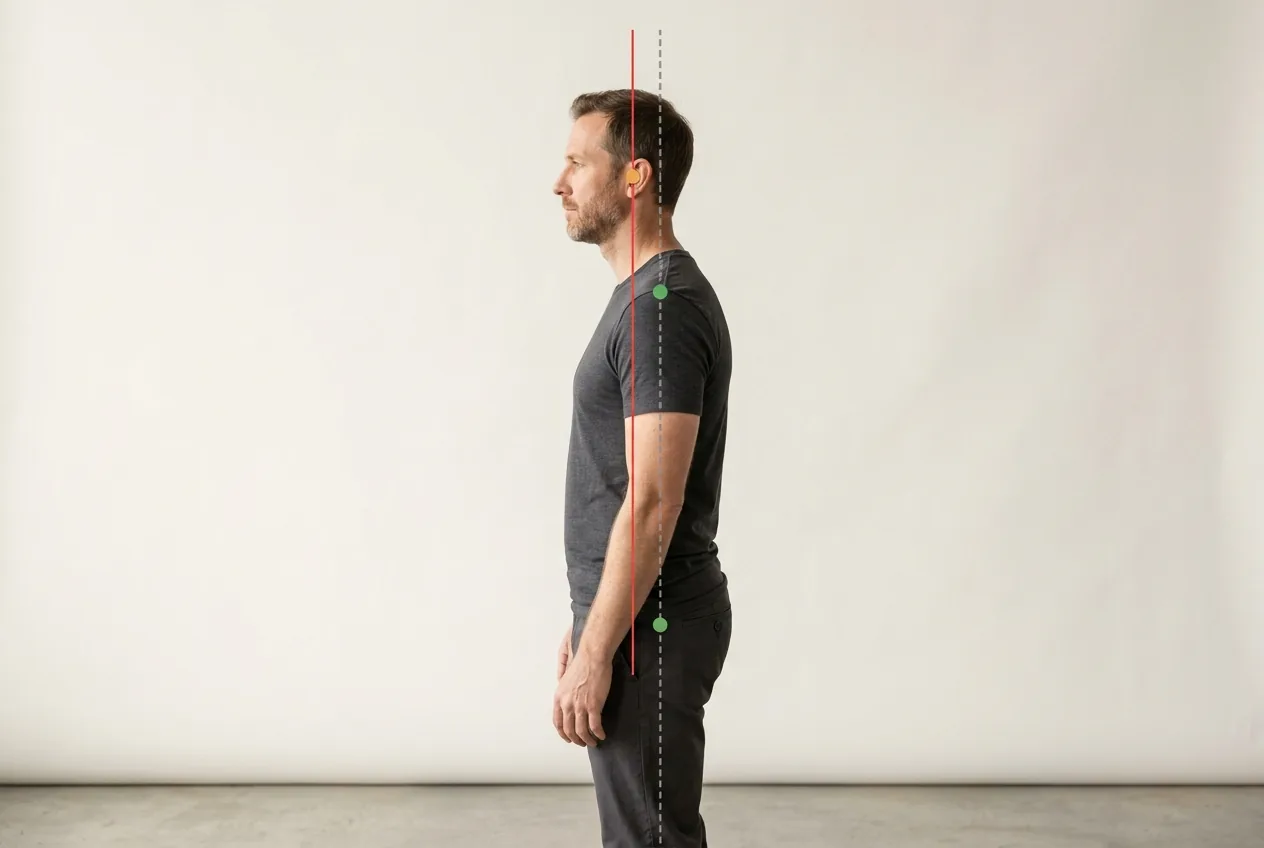
If your neck aches by mid-afternoon, your head is probably winning a slow tug-of-war with your spine. Forward head posture — clinically, an anterior shift of the head relative to the shoulders — is the body quietly adapting to thousands of hours spent looking at a screen slightly below eye level.
It rarely announces itself. There's no single moment it "happens." Instead it accumulates: a few millimetres a year, reinforced every time you settle into a chair and lean toward a monitor. By the time the ache shows up, the pattern is well established — and that's exactly why a quick stretch at the end of the day doesn't hold.
From our own quiz data: of 5,250 people who told us where it hurts, 16% named the neck — the most common answer after the lower back. The head is the lightest thing on that list and the second most complained-about region, which tells you the problem was never weight. It's leverage.
Why the load multiplies
A neutral human head weighs about five kilograms. Held directly over the shoulders, your spine carries it efficiently. But the head is a lever, and the neck is the fulcrum. As the head shifts forward, the effective load on the muscles at the base of the skull climbs steeply — which is why the same posture that feels like nothing at 9am feels like a clamp by 4pm.
The muscles don't fail loudly. They adapt. The ones at the front of the neck lengthen and switch off; the ones at the back shorten and stay switched on. Stretch the tight ones and you get an hour of relief — then the underlying imbalance pulls everything back.
Stretching treats the symptom. The pattern lives in what's switched on and what's switched off — and that only changes with repetition.
How to fix forward head posture
Knowing how to fix forward head posture isn't about forcing your chin back and holding it there. It's about restoring the sequence the body lost — waking up the muscles that should be working, releasing the ones that are overworking, and rehearsing the new alignment until it becomes the default.
- Re-activate, don't just stretch. The deep neck flexors need to switch back on. A held stretch can't do that — a specific, low-load activation can. Chin tucks are a simple starting point, and a short set of cervical posture exercises builds on them.
- Address the floor below it. Forward head rarely travels alone. Rounded shoulders and a stiff upper back usually come with it, and ignoring them is why corrections don't stick. If you spend your day on a phone, the same drift shows up as text neck, the everyday version people also call nerd neck or tech neck.
- Repeat daily, briefly. Ten focused minutes a day beats one long session a week. Change is a function of frequency, not duration.
The short version — Forward head posture is a learned pattern, not a fixed flaw. It responds to a sequenced, repeated correction — not to willpower or one-off stretching.
Where to start
Before you correct anything, you need to know what you're actually dealing with — how far forward, what's compensating, and what to address first. That's what the posture assessment is for: four photos, an analysis of your specific deviations, and a program ordered around them.
It takes about two minutes, and it's the difference between guessing and knowing.
What I see in practice
Nobody feels their head drifting forward — that's what makes this pattern so sneaky. Clients tell me about their neck, their headaches, the knot between their shoulder blades, and then the side-view photo does what no amount of describing can: they see their own ear sitting two inches ahead of their shoulder. Here's the part most advice misses: the head doesn't drift because your neck is weak. It drifts because the hips and upper back below it collapsed first, and the head is just keeping your eyes level. Chin tucks help, but they can't hold — correct the base and the head has somewhere to come home to.
Common questions
How long does it take to fix forward head posture?
There's no fixed timeline, and it depends on how long the pattern has been building and how consistent you are. Many people notice less neck tension within a few weeks of daily work, while a lasting change in resting head position usually takes longer. Frequency matters more than how hard you push on any single day.
Can forward head posture be reversed?
In most non-traumatic cases the pattern is learned, not fixed, so the muscles can be retrained toward a more neutral position. The key is matching the work to what's actually switched on and off in your body, then repeating it. Reversing it tends to stall when people only stretch the tight muscles and never reactivate the weak ones.
Is forward head posture the same as text neck?
They overlap. Text neck is the version driven by looking down at a phone, while forward head posture can come from any sustained head-forward habit, including desk work and driving. The underlying mechanics are similar.
Does sleeping position affect forward head posture?
It can. A pillow that's too high props the head forward all night, which keeps the front-of-neck muscles short. Aiming for a neutral neck while you sleep supports the work you do during the day rather than working against it.