
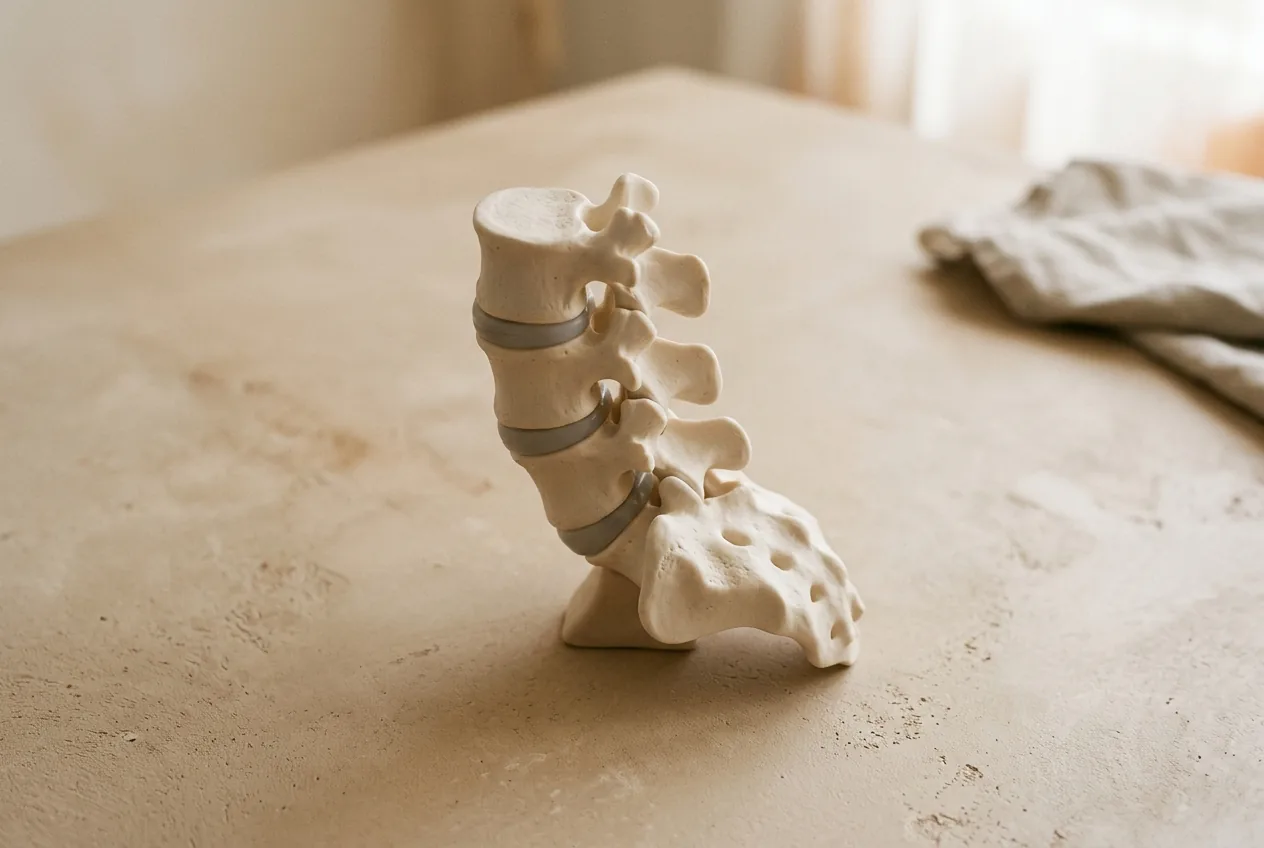
Your scan report came back with one of these terms, the radiologist used the other, your doctor maybe used a third, and now you're trying to work out whether you have the bad one or the not-so-bad one. The herniated disc vs bulging disc question gets asked a lot, partly because the words get thrown around loosely and partly because both sound alarming. Here's the plain version of what each one means — and why the label tells you less about your future than you'd expect.
Start with the disc itself. Between each pair of vertebrae sits a disc: a tough outer ring with a soft, gel-like centre. It works like a cushion and a pivot, letting your spine bear load and bend. Both a bulge and a herniation are about that disc spreading past where it should be. The difference is in *how* it spreads.
What a bulging disc is
A bulging disc spreads outward fairly evenly, like a tyre that's lost some pressure and pooches out around its base. The outer ring is still intact — nothing has broken through it. The disc has just flattened and widened under load, pushing slightly past its normal edge around a broad area.
Bulges are extremely common, and most are quiet. Plenty of people have a bulging disc on a scan and have never felt a thing. A bulge is generally the milder, earlier picture. There's a fuller walk-through in bulging disc in the lower back.
What a herniated disc is
A herniated disc is more focal. Instead of the whole disc pooching out evenly, the soft inner material pushes through a tear or weak spot in the outer ring at one point — like toothpaste squeezing out of a split in the tube. You'll see it called a "ruptured" or "prolapsed" disc too; they're describing the same thing.
Because a herniation is concentrated, it's more likely to press on or chemically irritate a nearby nerve. That's when symptoms travel beyond the back itself. The graded approach in herniated disc exercises covers how to settle one safely.
A bulge is the tyre losing pressure. A herniation is the inner tube poking through a split. Same disc, different failure.
How to tell which one you're dealing with
You can't diagnose this from feel alone — that's what imaging is for — but the symptom pattern gives strong hints.
- Pain that stays local to the back points more toward a bulge or general disc irritation. The disc and surrounding muscles are unhappy, but a nerve isn't being pinched.
- Pain, numbness, or tingling that travels — down into the buttock, the leg, the foot, or into an arm if it's in the neck — points toward a nerve being involved, which a herniation is more likely to do.
- Weakness in a specific muscle, like a foot that catches when you walk, is a stronger nerve sign and worth getting looked at.
Sorting nerve pain from muscle and joint pain matters more than the exact label, and how to tell muscle pain from disc pain goes through the distinguishing signs.
Why the difference matters less than you think
Here's the part that takes the fear out of the scan. For most people, a bulge and a herniation are managed the same way, and both tend to settle with time and sensible movement. The body reabsorbs displaced disc material whether it bulged out evenly or poked through at a point. A herniation can actually shrink more dramatically than a bulge over time, because there's more displaced material for the body to clean up.
Neither label is a verdict. A scan describes a snapshot of structure; it doesn't predict how your back will feel or function in six months. Many pain-free people would show one of these on imaging right now. The right question isn't "which one do I have" so much as "what's irritating my nerve or my back, and what calms it." Both answers usually involve the same things: take pressure off the segment, keep moving gently, rebuild support, and change the loading pattern that caused it.
What helps either one
- Frequent short walks keep the area mobile and help the disc exchange fluid.
- Gentle back extension — propping on your forearms while lying face down — eases many discs that have spread backward. Drop it if it increases leg symptoms.
- Avoid repeated deep forward bending and long slumped sitting, both of which load the disc the wrong way.
- Rebuild hip and glute support once the sharp phase settles, to take load off the lower back going forward.
When to see a doctor
Whichever label is on your scan, a few signs need prompt attention. See a clinician for numbness or weakness spreading down a limb, a foot that catches when you walk, or back pain after a fall or accident. Seek urgent care for any loss of bladder or bowel control, or numbness in the saddle area between the legs — uncommon, but an emergency. Also get assessed for pain that's severe, steadily worsening, or paired with fever or unexplained weight loss. A clinician confirms the diagnosis and decides whether anything beyond time and movement is needed.
The part the label leaves out
Whether yours bulged or herniated, the more useful question is why that particular disc gave way. Discs rarely fail at random spots. They fail where load has been concentrated for years, and load concentrates when posture is off. A common pattern: tight hip flexors tip the pelvis forward, the lower back over-arches, and one segment absorbs what several should share. The disc spreads — or tears — under that repeated pressure.
That's why two people with the same label can need different routines, and why relief that ignores the loading pattern tends not to hold. Knowing your own pattern — which muscles switched off, which are overworking — is what lets you shift load off the segment for good. A posture-based approach to chronic back pain measures how your body is actually positioned and builds a daily routine around it, rather than treating the scan as the whole story.
Herniated or bulging, the label is a description, not a sentence. Nothing here cures either or replaces your doctor's guidance — but for most people, moving in the directions the back tolerates and changing the load that caused it is enough to get ordinary life back.
Common questions
Is a herniated disc worse than a bulging disc?
Not necessarily. A herniation is more focal and slightly more likely to press on a nerve, so it more often causes pain that travels into a limb. But both can be painless or painful, and both tend to settle with time. The label matters less than whether a nerve is involved.
Can you tell a bulging disc from a herniated disc by symptoms?
You can get strong hints but not a definite answer without imaging. Pain that stays local to the back leans toward a bulge or general irritation; pain, numbness, or tingling that travels into a limb leans toward nerve involvement, which a herniation is more likely to cause. Muscle weakness is a stronger nerve sign worth checking.
Do bulging and herniated discs heal the same way?
Largely, yes. Both are managed by taking pressure off the segment, keeping up gentle movement like short walks, avoiding deep forward bending, and rebuilding support around the spine. The body reabsorbs displaced disc material in either case, and both tend to calm over weeks to months.
Which is more common, a bulging or herniated disc?
Bulges are more common and are often the milder, earlier picture, frequently showing up on scans of people with no pain at all. A herniation is a more advanced change where the inner material breaks through the outer ring. Both are common findings and neither is automatically a problem.