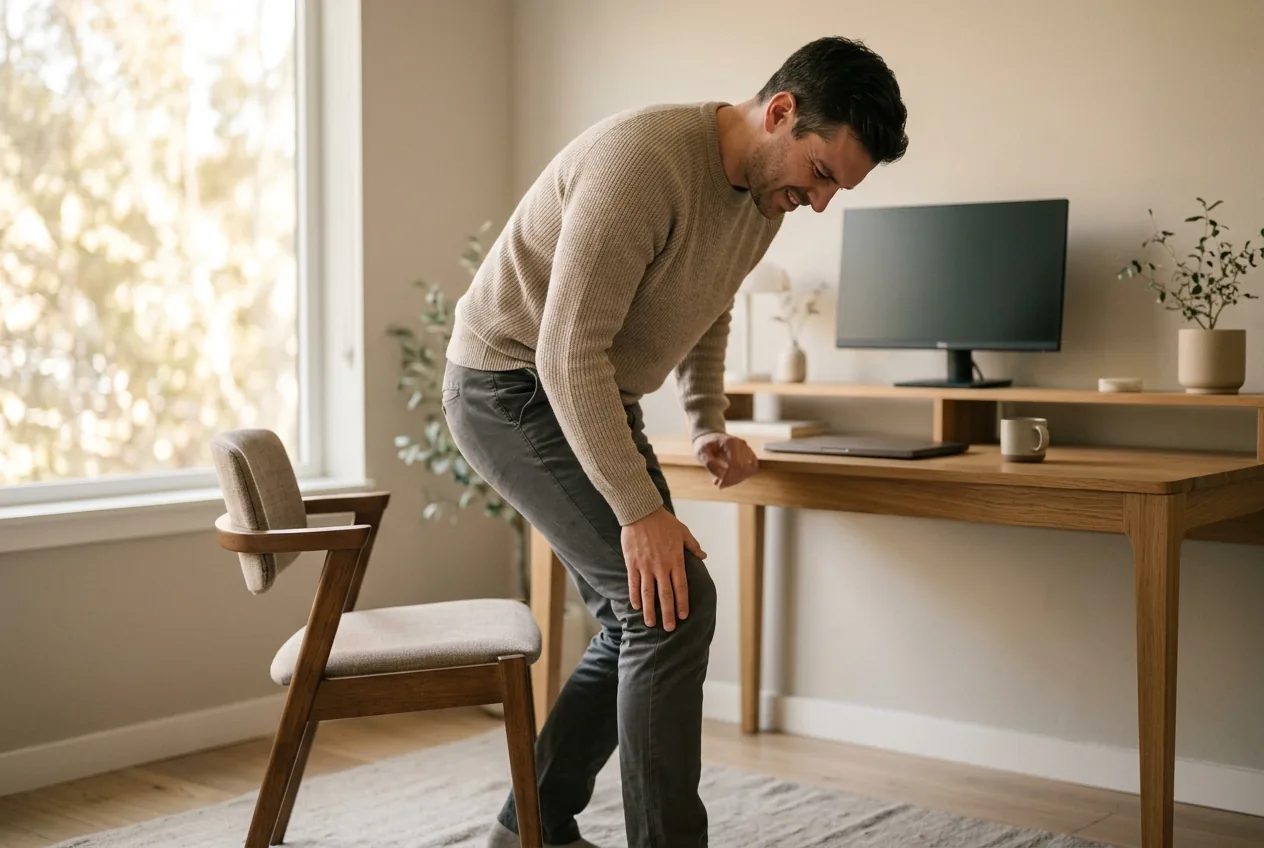
You stand up after a long meeting or a movie and your knee feels rusted shut. The first few steps are stiff and tender, maybe a dull ache behind the kneecap, and you find yourself holding the table edge until it loosens. Then, ten steps later, it's mostly fine again. Sore knees from sitting too long have this signature: worst right after stillness, better once you move.
That pattern tells you a lot. A knee that's actually damaged tends to hurt more the more you use it. A knee that aches from sitting is reacting to the position, not to wear. And a position is something you can change today.
Why a bent knee, held still, starts to hurt
Sitting parks your knee in a deep bend for an hour at a stretch. Three things happen while it's stuck there.
The kneecap gets pressed against the bones behind it. When the knee is bent, the kneecap is pulled down into its groove, and the contact pressure behind it is much higher than when the leg is straight. Hold that for an hour and the cartilage and tissue under the cap get irritated — which is why the ache so often sits right behind or around the kneecap.
The joint stops circulating fluid. Knees stay healthy by moving; motion pumps fluid in and out and keeps the tissue fed. A knee held still gets stiff and a little starved, and that's the "rusted" feeling on the first few steps.
The muscles around it shorten and switch off. Your hamstrings and calves sit slack and bunched, your hip flexors at the front shorten, and your quads go quiet. Stand up and they all have to wake up at once, and until they do, the knee feels unsupported.
A knee that hurts most right after sitting and eases once you move is reacting to a held position, not to damage.
The posture link behind it
Here's the part that gets missed. How you sit decides how hard your knee works to do nothing. If you sit slumped with your pelvis rolled back, your hips lock into a tighter angle, your hamstrings pull harder on the back of the knee, and the whole leg sits in a more strained position for hours.
Years of sitting also tighten the hip flexors and quiet the glutes. When the hips are stiff and the glutes are asleep, the knee loses its upstream support and takes on stress that should have been shared higher up. That's the same chain behind a lot of hip pain when sitting and knee pain when squatting — the hip sets the terms and the knee pays. Patterns like anterior pelvic tilt feed straight into how loaded your knees are while you sit.
What to change while you're sitting
You don't need a new chair. You need to stop holding one position.
Move the knee every 20 to 30 minutes. The single best habit. Straighten the leg out fully under the desk, hold for a few seconds, then bend it back. A handful of slow straighten-bends restores the fluid pumping and keeps the kneecap from settling under pressure.
Don't tuck your feet under the chair. Crossing your ankles behind the chair legs jams the knee into an even deeper bend. Keep both feet flat on the floor with knees at roughly a right angle, or a touch more open.
Vary the angle. Slide your feet forward to straighten the knees partway for a stretch, then back. Alternating beats holding any single angle, even a good one.
Sit tall, not slumped. Stack your pelvis upright so your hips aren't crammed into the tightest angle. This eases the pull on the back of the knee, and it's the same upright base that helps you sit with lower back pain more comfortably.
What to do on your feet
The fix isn't only about sitting better. It's about giving the knee the upstream support it lost.
- Stand and walk for a minute or two every half hour. A short loop to refill your water resets the joint far better than waiting for the ache.
- Loosen the hip flexors that long sitting shortens. A daily hip flexor stretch for back pain takes pressure off the front of the hips and, indirectly, the knee.
- Wake the glutes back up. A simple glute bridge for back pain restores the support that keeps the knee from overworking.
- Stretch the hamstrings gently. Tight hamstrings keep tension on the back of the knee even at rest.
When to see a doctor
This is posture education, not medical advice. See a clinician promptly if your knee swells up, locks, catches, or gives way, if you can't straighten or bend it fully, if there's redness and heat over the joint, if you have a fever alongside the pain, or if it followed a fall or twist. Calf swelling, warmth, or redness with knee or leg pain after a long stretch of sitting — a flight, a road trip — should be checked urgently, as it can signal a blood clot. Pain that's severe, constant, or steadily worsening also deserves a proper look.
Why knowing your own pattern matters
The movement habits above help almost everyone. But why your knee got primed in the first place — a tipped pelvis, tight hips on one side, weak glutes — is specific to you, and the wrong fix can keep you stuck.
That's the case for a proper posture assessment instead of guessing: measure your real alignment, then train the muscles that quit so your hips support the knee again and the after-sitting stiffness fades.
Common questions
Why do my knees hurt after sitting for a long time?
A bent knee held still raises the pressure behind the kneecap and slows the fluid that keeps the joint loose, so it stiffens and aches. Tight hips and quiet glutes from long sitting remove the support the knee relies on. Moving the leg every 20 to 30 minutes prevents most of it.
Why does my knee hurt when bent but not when straight?
Bending the knee presses the kneecap into the bones behind it and raises the contact pressure, especially when held for a long time. Straightening the leg unloads the cap and lets the joint breathe, which is why the ache often eases the moment you extend it.
How do I stop my knees aching from desk work?
Stand and move every 20 to 30 minutes, keep both feet flat instead of tucked under the chair, alternate between bent and straightened knees through the day, and sit tall so your hips aren't jammed into the tightest angle. Loosening tight hip flexors and waking the glutes helps the knee long-term.
Can sitting too long cause permanent knee damage?
Stiffness and aching from sitting are usually a response to the held position, not lasting damage, and they ease once you move and change your habits. If pain persists despite better movement, or you get swelling, locking, or giving way, have it assessed to rule out a joint problem.