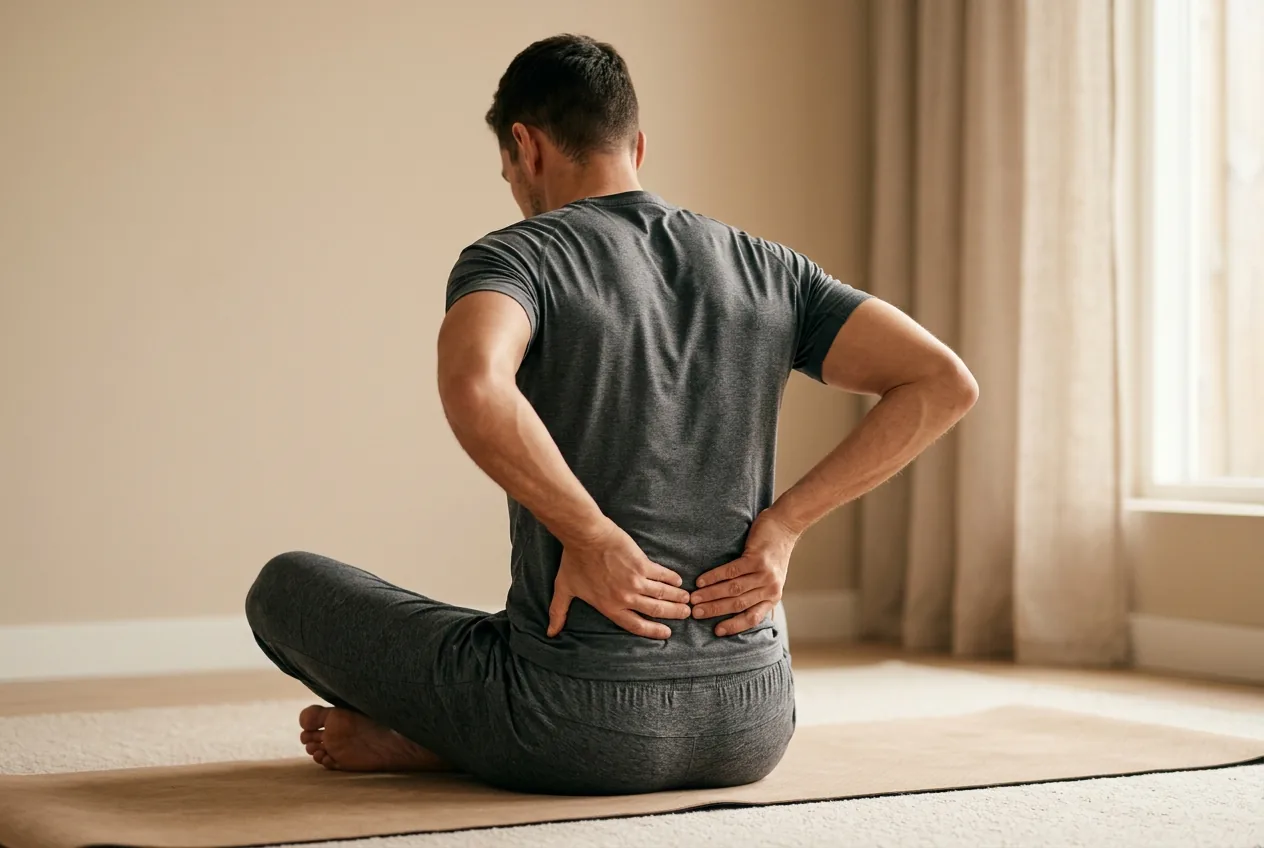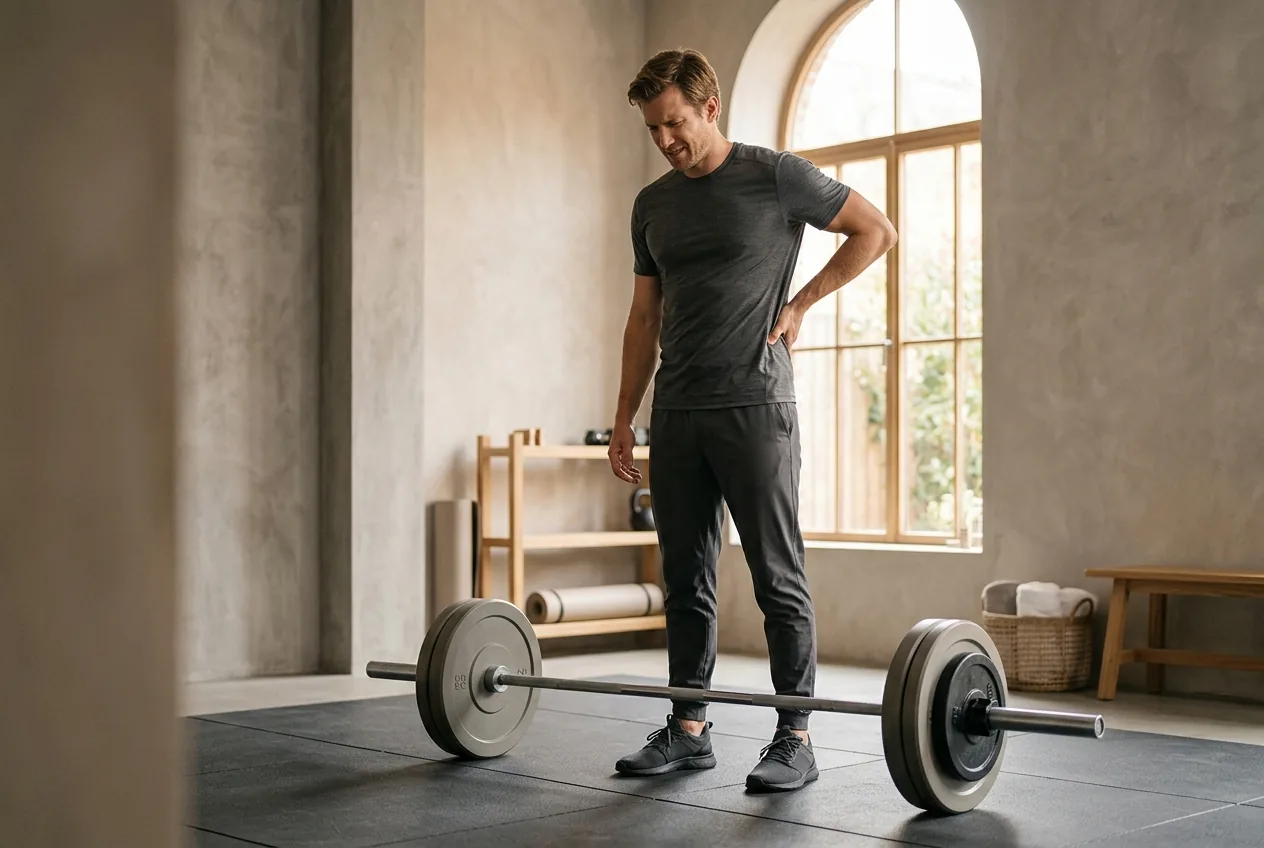
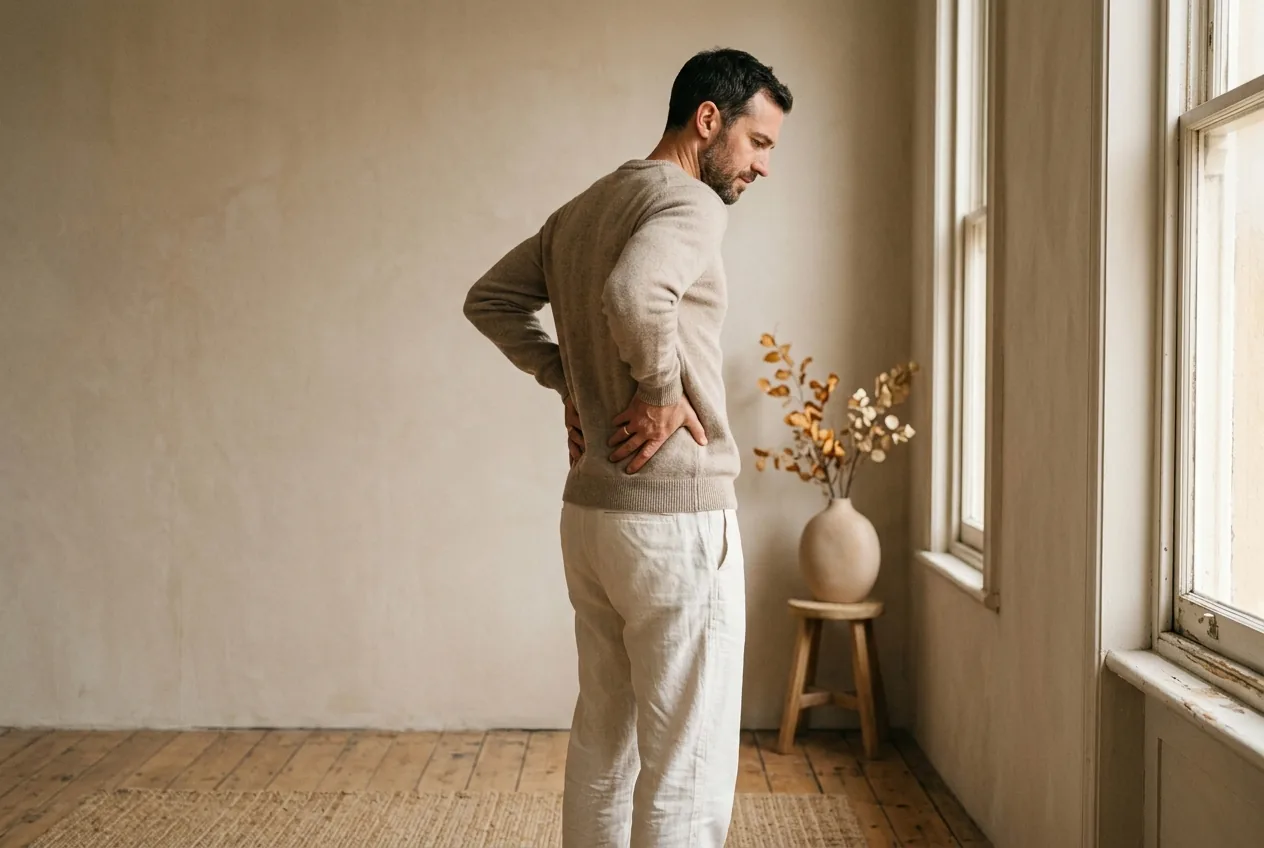
You stand up from your desk and there it is — a deep ache that runs from your lower back down into your hip, always the same side. Bending to load the dishwasher makes it bark. The other side feels like nothing's wrong at all.
When lower back and hip pain show up together on one side, people often treat them as two problems. They're almost always one. The back and the hip are linked by the same muscles, the same joint, and the same loading habits, so when one side gets overloaded, both ache together.
From our own quiz data: 30% of 3,486 quiz takers picked standing from our list of things that bring their pain on. It sounds like the most neutral thing a body can do, yet very few people stand evenly for long. Within a minute or two the weight drifts onto one leg, the opposite hip drops, and one side of the lower back and hip quietly takes the strain — which makes standing one of the places a one-sided habit gets its hours in. If your ache turns up in a queue or at the kitchen counter, notice which leg you settle onto before you reach for a stretch.
Why the back and hip travel as a pair
Your lower back and your hip are bridged by a small crowd of muscles that cross the area: the glutes, the deep hip rotators, the hip flexors at the front, and the bands of muscle running alongside your spine. They don't work in isolation. A tight hip pulls on the lower back. A weak glute makes the lower back work harder to stabilize the pelvis. The pelvis itself is the hinge in the middle, and the SI joint sits right where back meets hip.
So when your habits load one side more heavily — and most habits do — the strain doesn't stay neatly in the back or the hip. It spreads across the whole unit on that side.
That's why the ache feels like it's in both places at once. It is.
The patterns that cause it
A handful of mechanical patterns produce one-sided back-and-hip pain.
- A tilted or rotated pelvis. If one side of your pelvis sits higher or twists forward, the muscles around it pull unevenly, compressing the back and crowding the hip on that side.
- Tight hip flexors from sitting. Hours in a chair leave the muscles at the front of the hip short. They tug the pelvis into a forward tilt and the lower back arches to compensate — often worse on your dominant side.
- Sleeping glutes. When the glute on one side goes quiet, the lower back and hip flexor on that side overwork to cover, and both get sore.
- SI joint irritation. Uneven load crossing the joint where pelvis meets sacrum can ache low in the back and into the buttock and hip. The full picture is in SI joint pain.
- Piriformis tightness. A clenched deep hip muscle can ache in the buttock and refer up into the back, and it sometimes presses on the sciatic nerve too — the stretches in piriformis syndrome stretches target exactly this.
The thread running through all of these is a left-right imbalance. One side carries more, so one side hurts.
How to settle both at once
Because the back and hip share the same cause, the same plan helps both. Work the whole side, not just the spot that hurts.
Take pressure off the loaded side
- Stop crossing the same leg, and shift your weight evenly across both sit bones when you sit.
- Alternate the hip you carry bags and kids on.
- If sitting all day winds it up, change position often and check your setup — the mechanics are covered in lower back pain when sitting.
Open the tight hip
- Kneeling hip flexor stretch. Kneel on the painful side's knee, other foot flat in front. Tuck your tailbone under and ease your hips forward until you feel a stretch across the front of the hip and thigh. Hold 30 seconds, keeping your back tall, not arched. This releases the muscle that drags the pelvis forward.
- Figure-four stretch. Lying on your back, cross the ankle of the sore side over the opposite knee and gently draw the legs toward your chest. This reaches the deep hip muscles behind the joint. Hold 20–30 seconds.
Rebuild the support
The hip and back stay sore when the glutes aren't holding the pelvis steady.
- Glute bridges, 8–12 slow reps, pressing evenly through both heels.
- Clamshells on the weaker side to rebuild the muscle that keeps the pelvis level when you walk.
Keep it short and daily. A few minutes most days beats a long weekend session.
What to stop doing
The exercises help, but they're fighting an uphill battle if the habits feeding the imbalance stay in place. A few worth catching yourself on:
- Standing with your weight parked on one leg. It feels restful, but it drops one hip and loads the same side all day. Keep your weight even, or shift it deliberately between feet.
- Sitting with a wallet or phone in one back pocket. It tilts your pelvis the moment you sit. Take it out.
- Always sleeping curled toward the same edge of the bed. Try the other side, or put a pillow between your knees to keep the pelvis level overnight.
- Sitting twisted toward a second screen. Hours of low-grade rotation load one side of the back and hip. Square your chair and monitor up so you face forward.
These are small corrections, but they're the inputs that decide whether the same side keeps getting overloaded. Change the inputs and the stretches and strengthening have a chance to hold.
When to see a doctor
Most one-sided back-and-hip pain is muscular and responds to evening out the load. Some signs call for a clinician instead.
Get checked promptly if you have numbness, tingling, or weakness running down the leg, any loss of bladder or bowel control, pain that followed a fall or accident, fever with back pain, or unexplained weight loss. A specific flag worth naming: pain set high and to one side near your flank, especially with burning urination, blood in the urine, or fever, can be kidney-related rather than muscular — call your doctor that week. And any pain that's severe or steadily worsening deserves a professional look rather than more stretching.
Why it keeps coming back on the same side
If the same side keeps flaring, that's a clue. It means a fixed imbalance is feeding it — a pelvis that sits tilted, a hip that's chronically tight, a glute that's gone quiet. Generic stretches treat the symptom for an afternoon, but the load keeps landing on the same side because the pattern underneath hasn't changed. And a move that helps one posture can quietly worsen another, which is why a one-size routine often disappoints.
Knowing your own pattern — which side is tight, which is weak, how your pelvis actually sits — is what lets you match the work to the cause. That's what a proper posture assessment is for, and it's the difference between chasing the ache and ending it. See how a posture-based approach tackles chronic back pain.
Treat the back and hip as one system on one side, and you stop fighting two battles that were always the same fight.
What I see in practice
Before I suggest anything for one-sided back and hip pain, I ask which way people's habits point — the side they sleep on, the leg they rest on in a queue, the shoulder their bag lives on — and very often every answer lines up with the side that hurts. That list matters more to me than any stretch, because it's the hours, not the exercises, that decide which side gets loaded. I also like to look at people's shoes: a heel worn down further on one side is a record of how they've been standing for months, and it's harder to argue with than a mirror. When people change two or three of those habits alongside the exercises, the ache usually becomes less predictable about which side it picks, and that's the first sign the load is starting to share out. If it stays locked to one side despite all of that, it's worth getting the pattern measured rather than guessing at it.
Common questions
Why do my lower back and hip hurt at the same time on one side?
The back and hip share the same muscles, the SI joint, and the same loading habits. When one side gets overloaded, the strain spreads across the whole unit rather than staying neatly in the back or the hip, so both ache together.
Should I treat the back and the hip separately?
No. Because they usually share one cause, the same plan helps both. Working the whole side — opening the tight hip, rebuilding the glute, easing off the habits feeding the imbalance — settles the back and hip at once.
Why does the same side keep flaring up?
A fixed imbalance is feeding it: a pelvis that sits tilted, a chronically tight hip, or a glute that's gone quiet. The load keeps landing on the same side until that underlying pattern changes.
When should one-sided back and hip pain be checked by a doctor?
Get checked promptly for numbness, tingling, or weakness running down the leg, loss of bladder or bowel control, pain after a fall, fever, or unexplained weight loss. Pain high near the flank with burning urination or blood in the urine can be kidney-related rather than muscular.