You go down a flight of stairs and your kneecap sends up a dull, grinding ache. You sit through a movie and have to straighten the leg out because something behind the patella starts to throb. That deep ache around or under the kneecap, worse with stairs, squats, and long sits, is the pattern most people mean by runner's knee. The clinical name is patellofemoral pain, and the good news is that the right patellofemoral syndrome exercises tend to settle it without anything fancy.
The frustrating part is how stubborn it feels. You rest, it calms down, you go for a run, it flares again. That cycle is a clue about what's really happening.
What's actually going on behind the kneecap
Your kneecap (the patella) glides in a groove at the end of your thigh bone every time you bend and straighten the knee. When it tracks cleanly through that groove, you feel nothing. When it gets pulled slightly off-center, the cartilage on the back of the kneecap takes uneven pressure, and that's the ache you feel.
What pulls it off-center is rarely the knee itself. The kneecap is steered by the muscles above and beside it — the quads at the front, and further up the chain, the muscles at the hip. When the outer thigh and hip are tight and the inner quad and glutes are weak, the kneecap drifts outward under load. Stairs, squatting, running, and long sits all load that joint, so those are the moments it complains.
This is why pure rest never fixes it. Rest lowers the load, the ache fades, and then the same imbalance pulls the kneecap off track the moment you load it again. The pain is downstream of how the leg is being controlled. Often the same hip weakness that bothers your knee is part of a wider pattern, which is why runners knee and the hips so often show up together.
The exercises that build kneecap support
These are kneecap pain exercises chosen to strengthen the hip and quad muscles that steer the patella, not to grind the joint harder. Do them on the painful side (and the other side too — the imbalance is usually there as well). Stop any move that sharply increases the kneecap ache; mild fatigue is fine, sharp pain is not.
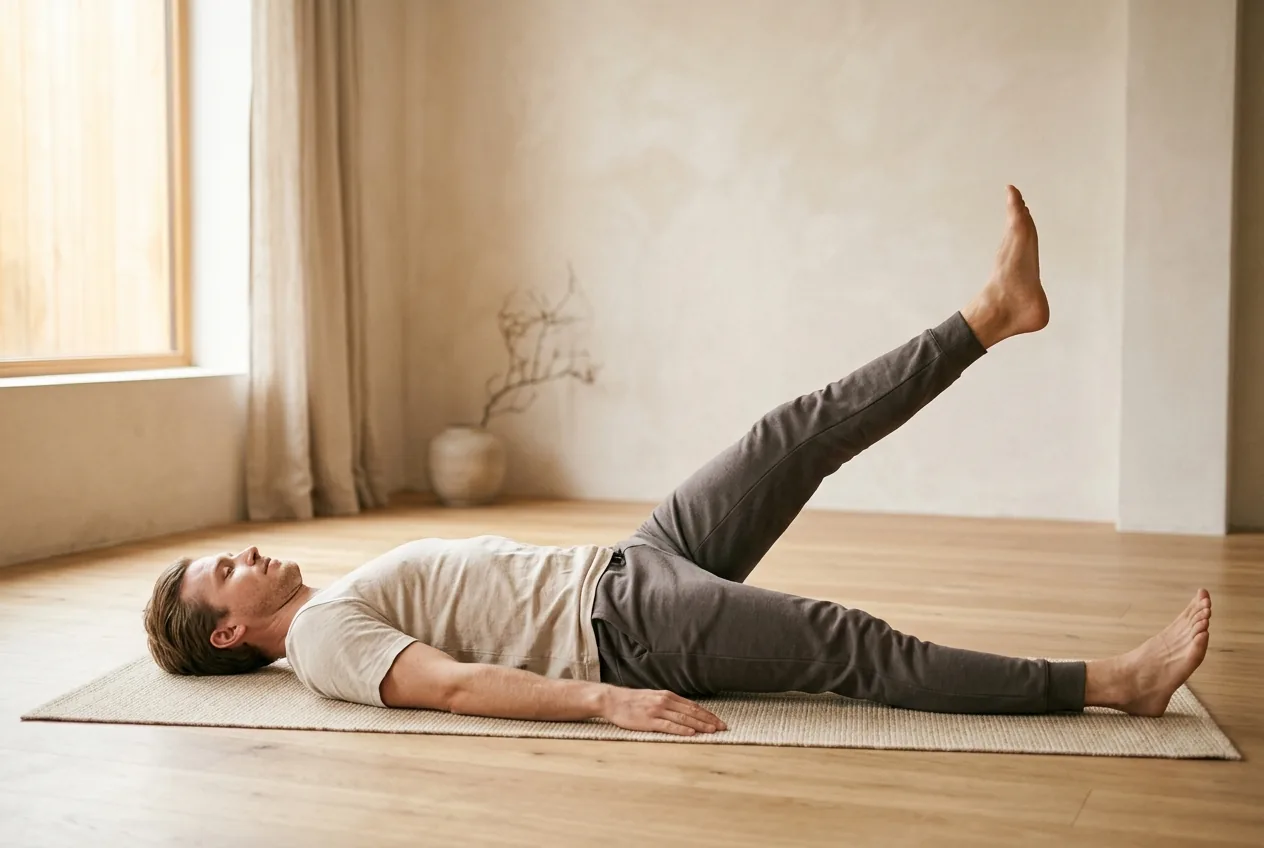
Straight-leg raises
Lie on your back, one knee bent with the foot flat, the painful leg straight. Tighten the thigh so the kneecap pulls up, then lift the straight leg to about the height of the bent knee. Lower slowly. This loads the quad without bending the knee under pressure, so the joint rests while the muscle works. Two or three sets of ten, daily.
Side-lying hip abduction
Lie on your side, painful leg on top, body in a straight line. Keeping the leg straight and the toes pointing forward (not up toward the ceiling), lift the top leg about a foot, then lower with control. You should feel this in the side of the hip, not the front. This targets the glute medius, the muscle that stops the knee from caving inward. Two sets of twelve to fifteen per side.
Glute bridges
Lie on your back, knees bent, feet flat and hip-width apart. Push through your heels and lift your hips until your body makes a straight line from knees to shoulders. Squeeze the glutes at the top, then lower slowly. This builds the hip strength that controls the whole leg from above. If you want more on this, the glute bridge for back pain walks through the same move in detail.
Wall sits (short range)
Stand with your back against a wall and slide down only to a shallow bend — about a quarter of the way to a full squat, never past the point where the kneecap aches. Hold for ten to twenty seconds, then stand. Short-range holds build quad endurance without dragging the kneecap deep into the painful part of its groove. Add depth slowly over weeks as it tolerates more.
Step-downs
Stand on a low step, painful leg planted on the step, other foot hanging off the edge. Slowly bend the planted knee to lower the free foot toward the floor, keeping the kneecap pointing straight ahead and not letting it drift inward. Tap lightly and come back up. This trains the leg to control the knee through the exact motion that hurts on stairs. Start with a low step and a small range.
Stretches that take pressure off the joint
Tightness on the outside of the thigh and at the hip drags the kneecap sideways, so a few stretches for patellofemoral pain help alongside the strength work.
- Quad stretch: standing, pull one heel toward your backside, knees together, and stand tall. Hold 30 seconds each side.
- Hip flexor stretch: in a half-kneel, tuck your pelvis under and shift gently forward until you feel a stretch at the front of the back hip. Tight hip flexors change how the whole leg loads — more on that in the hip flexor stretch for back pain.
- Calf stretch: hands on a wall, back leg straight, heel down, lean in. A stiff calf changes how your foot and knee absorb each step.
What to stop doing while it settles
- Deep squats and deep lunges that drive the kneecap into the painful range. Keep ranges shallow until the ache eases.
- Running through sharp knee pain. Mild stiffness that warms up is one thing; sharp pain that worsens as you go is your cue to back off and let the strength work catch up.
- Long, unbroken sitting with the knee bent. Stand and straighten the leg every half hour.
If squatting is a recurring trigger for you, it's worth understanding the mechanics in knee pain when squatting so you can adjust depth and form rather than just avoiding it forever.
When to see a doctor
Most runner's knee settles with patient strengthening. See a clinician promptly if the knee locks or gives way, if it's visibly swollen or hot, if the pain followed a clear injury or fall, or if it's severe or steadily getting worse despite a few weeks of sensible loading. Those signs point to something other than simple patellofemoral pain.
Why your version might differ
Here's the honest catch with any list like this: the same exercises that calm one person's kneecap can do little for another's, because the imbalance driving the knee can sit at the hip, the foot, or the way the whole posture loads the leg. Generic routines are a reasonable starting point, but lasting relief comes from training the specific weak links in *your* chain. A posture assessment that maps your actual alignment is one way to find where the pull is really coming from rather than guessing.
Knee pain that flares with load is usually a signal about control, not damage — fix how the leg is steered and the kneecap stops complaining.
Common questions
How long does it take for patellofemoral pain exercises to work?
Most people notice a difference in two to six weeks of near-daily strengthening, with fuller relief over a couple of months. Strength changes are slow by nature. The fix outlasts the flare, so keep going even after the ache fades, or the imbalance returns.
Should I keep running with runner's knee?
You can often keep running if the pain stays mild and warms up rather than worsening. Cut distance and avoid steep downhills while you build hip and quad strength. If running sharply spikes the kneecap ache, swap to cycling or swimming for a few weeks and rebuild gradually.
Are squats bad for patellofemoral pain?
Deep squats under load can aggravate it because they press the kneecap hard into its groove. Shallow, controlled squats and wall sits are usually fine and even helpful. Keep the knee tracking over the foot, avoid letting it cave inward, and add depth only as the joint tolerates it.
Is patellofemoral pain the same as arthritis?
No. Patellofemoral pain is a tracking and loading problem in a healthy joint and is common in younger, active people. Arthritis is wear of the joint cartilage and tends to come with stiffness, swelling, and an older age profile. If you're unsure, a clinician can tell them apart.