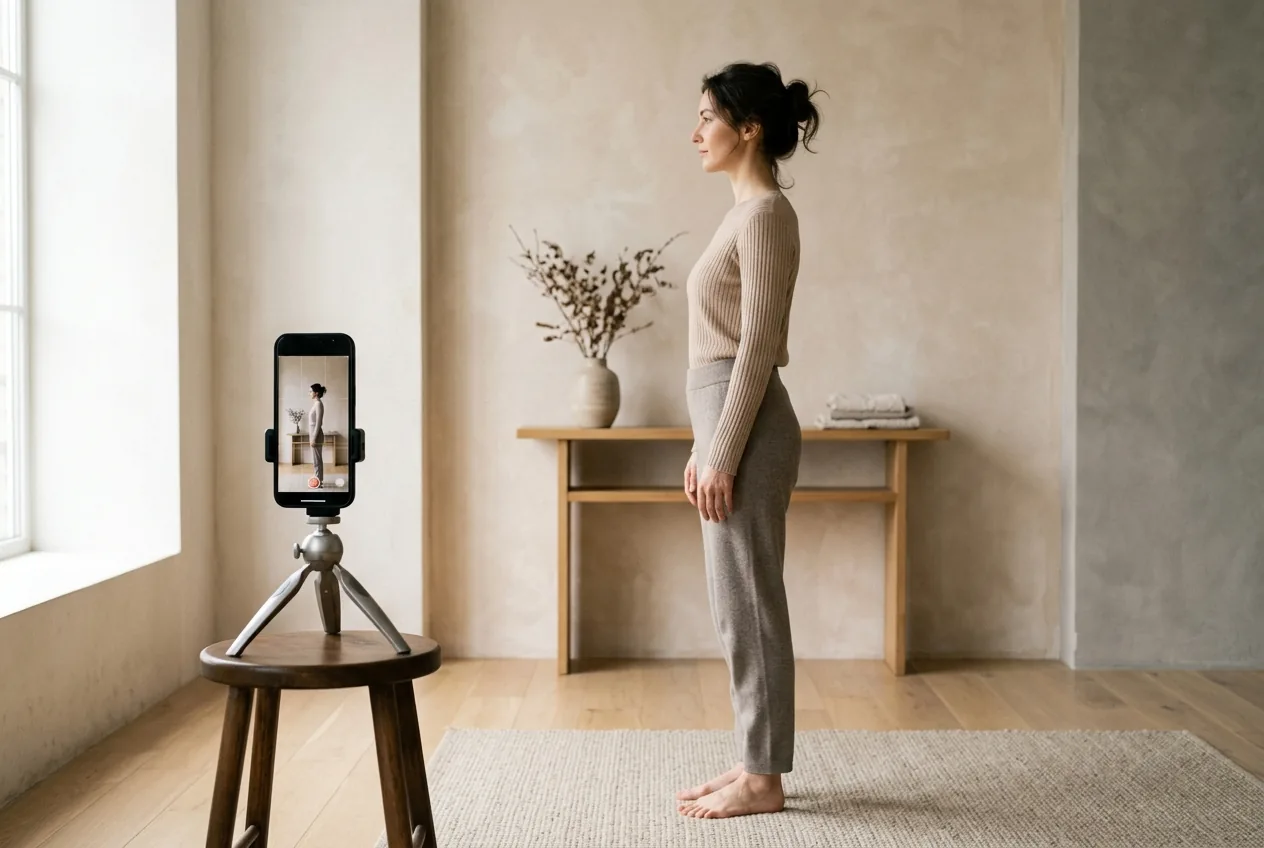
You're standing in front of two tabs: a $35 posture corrector brace with thousands of five-star reviews, and a vague sense that you should "do some exercises" but no idea which ones. The brace promises to fix your slouch by Friday. The exercises promise nothing except effort. So you almost buy the brace — and that's the decision worth slowing down on, because the two work in completely opposite ways.
One pulls your body into position from the outside. The other teaches your body to hold the position on its own. Knowing which does what saves you from the most common posture mistake: paying to be held upright when what you actually need is to get stronger at holding yourself.
How a posture corrector works
A posture corrector is a brace — straps over the shoulders, sometimes a band across the upper back — that physically pulls your shoulders back and discourages slumping. Put it on and you stand straighter instantly. That immediate result is exactly why the reviews are glowing and why the category sells so well.
The mechanism is external support. The brace does the work your muscles would otherwise do, holding your shoulders in a position they don't yet hold on their own. For the hour or two you wear it, your posture looks better because the strap is making it look better.
How corrective exercises work
Corrective exercises take the opposite route. Instead of holding you in position, they retrain the muscles that should be holding you — waking up the ones that switched off and easing the ones that overwork to compensate. There's no instant snap to attention. The change is gradual, and it's yours: at the end, your body holds the position without anything strapped to it.
This is slower and it asks more of you. It's also the only one of the two that changes your default posture — the shape you fall into when you're not thinking about it, which is the shape that actually matters. A full walk-through of the moves lives in how to improve posture.
The problem with relying on a brace
Here's what the brace reviews don't mention. Muscles adapt to the work they're asked to do. When a strap does the job of holding your shoulders back, the muscles that should do that job have less reason to fire. Wear a corrector for hours every day over months and there's a real risk those muscles get *less* capable, not more — so the moment the brace comes off, you slump straight back, sometimes worse than before.
That's why so many people describe the same arc: a brace that worked beautifully for two weeks, then a drawer. The brace never failed at what it does. It just doesn't do the thing they actually wanted, which was to not need it. We cover that arc in depth in do posture correctors work.
The deeper issue is that a brace treats posture as a position problem — get the shoulders back and you're done. But most chronic slouching is a pattern problem. The body settled into that shape because of an imbalance: some muscles off, others overworking. A strap pulls on the surface of that pattern without touching the cause, which is why the cause is still there when you take it off.
When a posture corrector still earns its place
This isn't a case for throwing the brace out. Used as a tool rather than a cure, a corrector has real uses:
- As a short-term awareness cue. Worn for 20–30 minutes, a brace reminds you what neutral feels like, so you can find that position on your own later. The goal is to need it less over time, not more.
- Alongside exercises, not instead of them. A brief stint in the brace to feel the target position, then the exercises to build the strength to hold it — that pairing makes sense.
- For specific medical situations a clinician recommends. Some conditions and recoveries genuinely call for bracing. That's a different use, prescribed for a reason.
The test is simple: are you using the brace to learn a position, or to avoid the work of holding it? The first is a tool. The second is a trap.
Which should you choose?
If you want your posture to look better for the next hour — a photo, an event, a long meeting — a corrector does that. If you want your posture to *be* better in six months, with nothing strapped to you, corrective exercises matched to your specific posture are the only option that gets you there. They're not really competitors. One is a temporary prop; the other is the actual fix.
The catch with exercises is matching: the right moves for rounded shoulders differ from the right moves for a flat back or a forward head, and the wrong ones can set you back. That's the gap an assessment closes — measuring your specific deviations so the routine fits your body instead of a generic average. A posture app that assesses and adapts does that matching for you, which is the practical way most people get exercises that actually fit. Either way, the principle holds: stop paying to be held up, and start training to hold yourself.
When to see a doctor first
Posture work — brace or exercises — is for the slow, nagging stiffness that builds over months from how you sit, stand, and move. It is not the first move for pain after a fall or accident, pain with fever, numbness or weakness in both legs, loss of bladder or bowel control, or sudden severe pain. Those are signs to see a clinician now, not strap on a brace or start a routine. When to worry about back pain lists the warning signs. Clear those first; correct your posture second.
Common questions
Is a posture corrector or exercise better for rounded shoulders?
Exercises, for lasting change. A corrector pulls rounded shoulders back while you wear it, but the muscles don't learn anything, so the rounding returns when it comes off. Exercises retrain the muscles that hold the shoulders back on their own. A brief stint in a brace to feel the position can help you learn the exercises faster.
Can wearing a posture corrector weaken my muscles?
It can, if you over-rely on it. When a strap holds your shoulders back for hours a day, the muscles meant to do that job have less reason to work and can get weaker over time. Used briefly as an awareness cue it's fine; used as a full-time substitute for muscle work, it can backfire.
How long should I wear a posture corrector?
If you use one, treat it as a short cue — roughly 20 to 30 minutes to feel neutral position — rather than something you wear all day. The aim is to need it less over time. All-day, every-day use is where the downsides show up.
Do posture exercises actually work?
Yes, when they're matched to your specific posture and done consistently. Generic stretches can disappoint or even backfire, because the right move for one posture is the wrong move for another. Exercises chosen for your actual deviations, repeated daily, are what change your default posture.
What's the fastest way to fix posture?
There's no genuinely fast fix — the brace's speed is an illusion that ends when you take it off. The fastest *real* route is a matched set of corrective exercises done daily, which most people feel within a few weeks and see clearly over two to three months.