
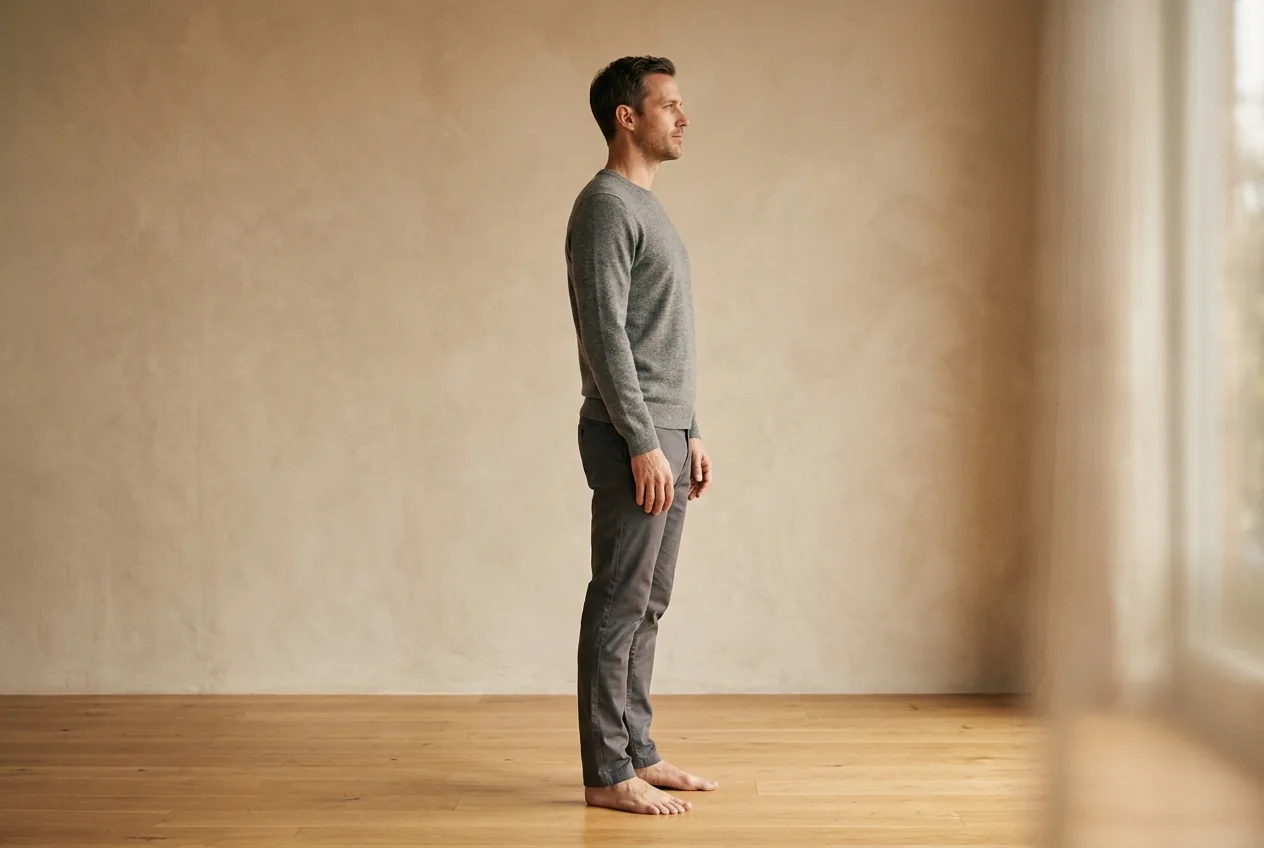
You catch your reflection in a shop window and there it is — head poking forward, shoulders rolled in, a slump you didn't choose. You pull yourself upright, hold it for about ninety seconds, and then forget. By the next window you've slid right back. If that's your experience of trying to fix your posture, you already know that "just stand up straight" doesn't work, and you're not lacking willpower.
Most advice on how to improve posture treats it as a discipline problem — sit tall, set reminders, try harder. That's why it fails. Good posture isn't something you hold. It's something your body defaults to when the right muscles are doing their jobs. This guide lays out a realistic framework for getting there: find what's actually pulling you out of line, then train the specific muscles that fix it, a little every day.
From our own assessment data: across 1,319 first photo assessments, scores ran from 18% to 82% with the median at 64. Almost nobody starts from "terrible" — and nobody starts from perfect. What separates people isn't the number; it's knowing which specific deviations are dragging it down.
Why "sit up straight" never sticks
Here's the thing nobody tells you. When you yank yourself upright, you're using the wrong muscles to fake a position the right muscles should be holding for free. It's effortful, so the moment your attention drifts — a phone, an email, a kid asking for juice — you collapse back to your default. Willpower can't win a fight it has to refight every thirty seconds.
Your default posture is set by which muscles are switched on and which have gone quiet. Sit slumped for years and certain muscles shorten and tighten while their opposites lengthen and weaken. Your body then treats that lopsided arrangement as "normal" and holds it without you noticing. To change the default, you change the muscle balance. You don't change it by clenching.
Good posture isn't a position you hold. It's the position your body falls into when the right muscles are doing their share.
Step one: find your actual pattern
This is the step almost everyone skips, and it's why generic routines disappoint. "Bad posture" isn't one thing. The fix for one pattern can make another worse. Before you do a single exercise, you need to know which way you're actually pulled.
A few of the common patterns:
- Forward head and rounded shoulders. Head drifts ahead of the shoulders, upper back rounds. The desk-and-phone default. Start with forward head posture and rounded shoulders.
- An over-arched lower back with a tipped pelvis. The belly pushes forward, the lower back curves in sharply. This is anterior pelvic tilt.
- A flattened, tucked lower back — the opposite problem, where the natural curve is lost.
- Uneven sides — one shoulder or hip sitting higher than the other.
The reason this matters so much: stretching a muscle that's already too long, or strengthening one that's already overworked, pushes you further out of line. A generic "posture routine" that helps the forward-head person can aggravate someone with the opposite pattern. The starting point is an honest look. The check your posture at home guide shows you how to take a proper side-on photo and read what it's telling you, and posture types explained walks through what each pattern looks like.
Step two: release what's tight
Once you know your pattern, the work has two halves, and they go in order. First you open up the muscles that have shortened and are pulling you out of line. They won't let go on their own, and trying to strengthen against them is like rowing with the brakes on.
For the common desk pattern, the tight spots are the front of the chest, the front of the hips, and the muscles at the base of the skull.
- Open the chest. A doorway chest stretch — forearms on the frame, lean gently through — releases the chest muscles that pull your shoulders forward. Thirty seconds, a couple of times a day.
- Open the hips. Hours of sitting shorten the hip flexors, which tip the pelvis and feed a lower-back arch. A hip flexor stretch in a kneeling lunge, tailbone tucked, undoes some of that.
- Loosen the mid-back. A rounded upper back stiffens into the slump. Gentle thoracic extension work restores the movement so your spine can sit tall instead of curled.
Releasing tight tissue feels good and gives you quick wins, but on its own it doesn't last. By the next afternoon at your desk, the tightness creeps back. That's because the other half of the equation is still missing.
Step three: strengthen what switched off
The muscles that hold you upright are postural muscles — the deep core, the glutes, the muscles between and below your shoulder blades, the ones at the front of the neck. Years of slumping let them go quiet. They're not weak from injury; they've just stopped firing because nothing asked them to. Wake them up and they start holding you in line on their own, which is the whole point. This is the part that makes good posture effortless instead of effortful.
A few foundational moves, each safe to start with:
- Chin tucks retrain the deep neck muscles that hold your head back over your shoulders instead of poking forward. The chin tucks exercise has the how-to. Done at red lights and in meetings, they add up.
- Wall angels wake up the muscles that pull your shoulder blades back and down, directly countering the rounded-shoulder slump. See wall angels.
- Glute bridges fire the glutes that level the pelvis, the foundation of a stacked spine. The glute bridge is a gentle starting point.
- Band pull-aparts strengthen the upper-back muscles that keep your shoulders set back through a long day. See band pull-aparts for posture.
You don't need all of these at once. Pick the two or three that match your pattern, and build from there. A focused set of posture-correcting workouts — release plus strengthen, matched to what's actually pulling you — is what turns a temporary fix into a new default.
Step four: make it a daily habit, not a project
Here's the part that decides whether any of this works: frequency beats intensity. Ten focused minutes a day will reshape your default posture far faster than an hour-long session once a week. Your nervous system learns a new resting position through repetition, the way you learned to type without looking. A long, occasional effort doesn't give it enough reps to learn.
Anchor the work to things you already do. A chin tuck every time you stop at a red light. A doorway chest stretch each time you walk through the kitchen. A set of glute bridges before you get in the shower. Stacking small reps onto existing habits is how the routine survives a busy week with young kids and a full inbox.
And be patient with the timeline. You're undoing years of a learned default, not flipping a switch. Most people feel looser within a week or two and notice their posture holding on its own after several weeks of steady daily practice. The honest answer to how long it takes to fix posture is weeks to months, depending on how set the pattern is — but the early wins come fast enough to keep you going.
What to stop doing
- Stop relying on posture reminders alone. They nag you into clenching, which doesn't change the underlying balance.
- Stop wearing a posture corrector as the whole plan. It holds you up passively while the muscles that should do the job stay asleep — useful as a brief cue at most.
- Stop doing a random "good posture" routine off the internet without knowing your pattern. The wrong moves can deepen your particular imbalance.
- Stop treating it as a one-off fix. Posture is a daily habit or it's nothing.
When to see a doctor
This is posture education, not medical advice. See a clinician promptly if poor posture comes with pain that follows a fall or accident, numbness, tingling, or weakness spreading into the arms or legs, any loss of bladder or bowel control, a visible spinal curve that's progressing, fever with back pain, unexplained weight loss, or pain that's severe or steadily worsening. Those need proper assessment before any exercise plan.
The shortcut: train your own pattern
Everything above is real and works. The catch is the first step — knowing which way you're actually pulled — because that's what decides which stretches and which strengthening moves belong in your routine and which ones would set you back. Guess wrong and you can spend weeks reinforcing the very imbalance you're trying to undo.
That's exactly what a posture assessment is for. It measures your real deviations from a couple of photos, then orders a daily program around them — the right releases, the right strength work, in the right sequence. Generic advice like this guide is a solid starting point. Lasting change comes from training your own pattern, every day, until upright stops being something you hold and becomes something you are.
The people who fix their posture for good aren't the ones with the most discipline. They're the ones doing the right small thing daily.
What I see in practice
The advice that has failed everyone for a century is "just sit up straight." Posture isn't a decision — you can hold a corrected position for exactly as long as you think about it, and your muscles pull you back the moment your attention moves on. What actually changes posture is retraining the muscles that hold you when you're not paying attention. That's why every lasting improvement I've seen starts with knowing your own pattern: correct a rounded shoulder on a rotated pelvis and you've built a straighter version of the same problem. Measure first, then correct in order — base before crown.
Common questions
Can you actually fix bad posture, or is it permanent?
You can change it. Posture is set by muscle balance — which muscles are tight and which have switched off — and that balance responds to training at any age. Long-standing patterns take longer and some structural curves have limits, but for the common desk-and-phone slump, a matched daily routine reshapes your default over weeks to months.
How long does it take to improve your posture?
Most people feel looser within a week or two and notice their upright position holding on its own after several weeks of steady daily work. Fully resetting a years-old default usually takes a few months. Frequency matters more than session length — ten focused minutes daily beats an hour once a week.
What's the fastest way to fix posture?
Find your actual pattern first, then do a short daily routine that releases the tight muscles pulling you out of line and strengthens the ones that switched off. Skipping the "find your pattern" step is the usual reason generic routines disappoint, because the wrong moves can deepen your specific imbalance.
Do posture correctors and reminders work?
They have a limited role as cues, but neither fixes the underlying problem. Correctors hold you up passively while the muscles that should do the job stay asleep, and reminders just prompt you to clench using the wrong muscles. Real change comes from training the muscle balance so good posture becomes your effortless default.