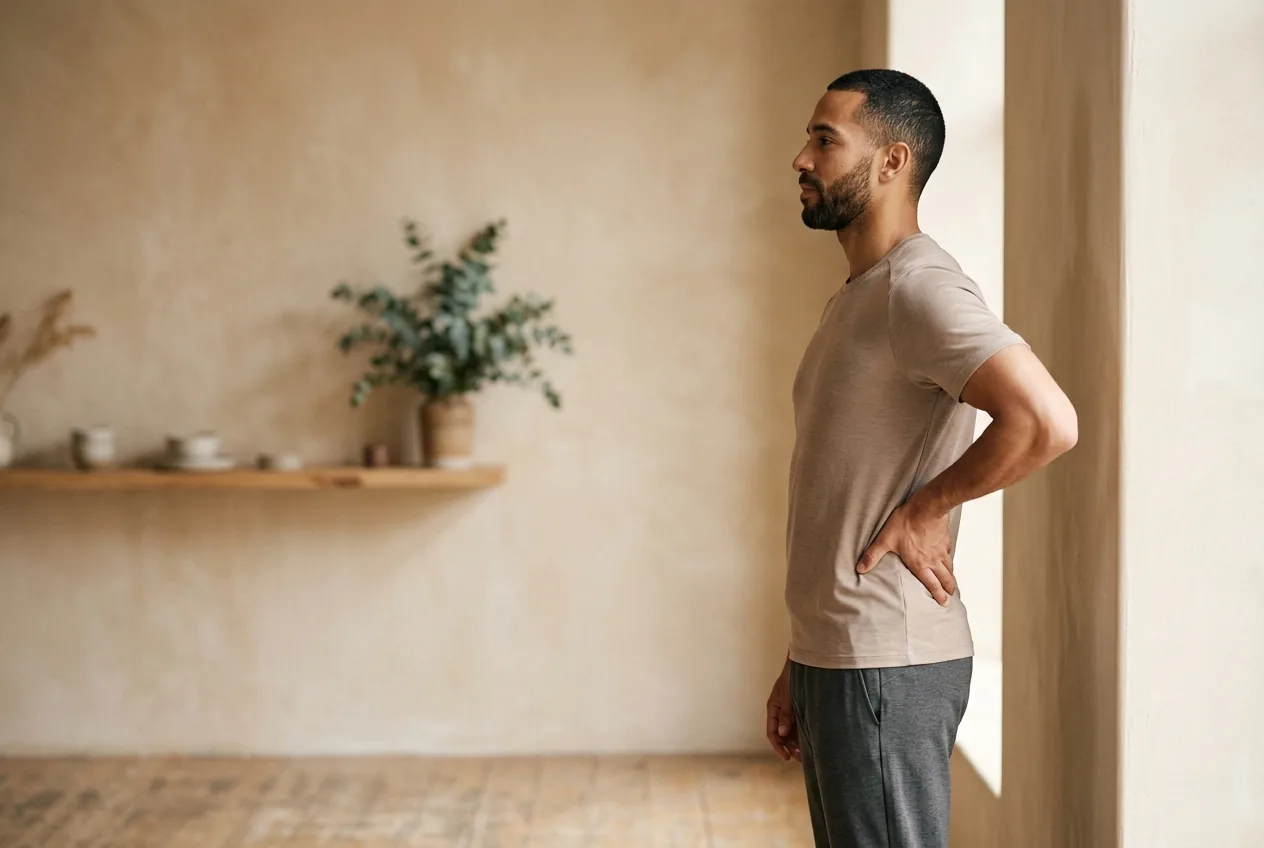

By the last hour of your shift your lower back feels like a clenched fist, and all you've done is stand there. Back pain from standing all day is its own kind of ache, different from the desk-bound version, and it's incredibly common for anyone whose job keeps them upright on a hard floor for hours.
People assume standing is the healthy alternative to sitting. For your lower back, standing badly for eight hours can be just as punishing. The problem usually isn't the standing itself. It's how you stand, and how long you hold one position.
Why standing all day hurts your back
When you stand for hours, a few things conspire against the lower back.
Most people lock into one position and let the lower back do the holding. The natural inward curve deepens, the pelvis tips forward, and the muscles of the lower back end up bracing all day while the glutes and deep core go quiet. That forward-tipped, slack-glute pattern is the anterior pelvic tilt, and standing tends to exaggerate it.
There's also no movement to pump blood and vary the load. A muscle held in one position with nothing changing fatigues and tightens. Add a hard concrete floor with no give, and every bit of impact travels straight up into the joints instead of being absorbed.
Then there's the tendency to shift onto one hip. Cocking the pelvis to lean on one leg feels restful for a minute, but standing that way for hours loads one side and builds the kind of asymmetry behind a lot of lower back pain when standing.
So standing-all-day pain is a locked posture, quiet support muscles, and no variation, all on an unforgiving surface.
What to change at work
You can't sit down on the job, but you can change how you stand.
- Stack instead of swaying. Bring your ribs down over your hips so you're not pushing the belly forward and arching the lower back. Ears over shoulders, shoulders over hips. A quick self-check using check your posture at home shows you the habit.
- Use a foot rail or low step. Rest one foot on a low stool, rail, or box, and swap feet every so often. Propping one foot up gently flattens the over-arch and takes pressure off the lower back. Bars have had a brass foot rail for a century for exactly this reason.
- Keep the knees soft. Locking your knees stacks you onto the joints and over-arches the back. A slight bend keeps the muscles working and the load shared.
- Shift your weight often. Don't freeze in one stance. Rock gently, take a few steps, change where your weight sits. The best standing posture is the one you keep leaving.
- Stand square. Catch yourself cocking a hip to rest on one leg. Keep your weight even between both feet most of the time.
A hard floor and a locked stance punish the back. Soft knees, a foot rail, and constant small shifts undo most of it.
Gear and habits that take the load off
A few practical changes matter more than willpower.
Anti-fatigue mats and good shoes. A cushioned mat where you stand most, and supportive shoes with some give, absorb the impact a concrete floor won't. Worn-out, flat-soled shoes pass every bit of shock straight to your back.
Build the muscles that should be helping. Standing loads the back; train the supports so the back stops carrying everything. A glute bridge wakes up the glutes that go quiet, and a hip flexor stretch loosens the front of the hips that tightens from a forward-tipped pelvis. Weak glutes are a bigger factor in standing pain than most people think, as weak glutes and back pain explains.
Move on your breaks. Don't just stand still on a break. Walk, and do a couple of gentle cat-cow movements or a backward bend to reverse the all-day arch.
Reset between tasks. Squeeze your glutes for a few seconds, soften your knees, and reset your stack. It re-engages the muscles that switched off and gives the lower back a moment of relief.
What to stop doing
- Don't lock your knees and let the lower back do the holding.
- Don't lean on one hip for long stretches.
- Don't wear flat, worn-out shoes on hard floors.
- Don't push through sharp pain. Ache that eases when you move is one thing; sharp or worsening pain is a stop sign.
When to see a doctor
Standing-related back pain is usually mechanical and eases when you vary your position, soften your knees, and cushion the surface. Some signs need a professional. See a clinician promptly if you have numbness, tingling, or weakness spreading down a leg, any loss of bladder or bowel control, back pain after a fall or accident, fever with back pain, unexplained weight loss, or pain that's severe or steadily worsening.
Why the right fix is specific to you
None of this is a single fixed stance, and that's deliberate. The position that relieves one person's lower back can aggravate another's, because they're standing on top of different imbalances. A forward-tipped pelvis needs a different default from a flattened lower back. A general rule gets you close; your own pattern gets you the rest of the way.
That's the argument for measuring instead of guessing. A short posture assessment that reads your actual alignment shows which way your pelvis and spine sit, then builds a daily routine to wake up the muscles that should be supporting you on your feet. Once they're doing their job, a long shift stops landing entirely on your lower back.
Start this week with a foot rail and soft knees, and shift your weight more than feels necessary. That last hour of the shift should stop feeling like a clenched fist.
Common questions
Why does standing all day cause lower back pain?
Standing for hours usually means locking into one position, which over-arches the lower back, tips the pelvis forward, and lets the glutes go quiet so the back braces all day. A hard floor and no movement make it worse.
Is standing all day worse than sitting for your back?
Neither is healthy when done badly for hours. Standing locked and unsupported on a hard floor can hurt as much as slumped sitting. With both, variation and supporting the natural curve matter most.
How do I relieve back pain from standing at work?
Rest one foot on a low rail and switch feet, keep your knees soft, stand square instead of on one hip, and shift your weight often. An anti-fatigue mat, supportive shoes, and stronger glutes take pressure off the back.
When should I worry about back pain from standing?
See a clinician promptly for numbness or weakness spreading down a leg, loss of bladder or bowel control, pain after a fall, fever, unexplained weight loss, or pain that's severe or steadily worsening.