You want to keep moving, keep the weight off, keep your heart in decent shape — but every time you try to run, your knees swell up and remind you for two days that they're not on board. So you stop, and then doing nothing makes the knees stiffer and weaker, which makes everything hurt more. That's the bad-knee cardio trap, and the way out isn't to give up on exercise. It's to pick the kind that doesn't pound the joint.
Plenty of cardio raises your heart rate without slamming your knees on every step. The best cardio for bad knees keeps the joint moving and fed, builds the muscle that supports it, and leaves you able to walk the next day.
Why impact is the problem, not exercise
A healthy knee absorbs the shock of each footfall through cartilage and strong muscle. When the joint is worn, irritated, or weakly supported, that repeated impact lands harder on the surfaces that can least handle it. Running, jumping, and fast downhill walking all spike the impact, which is why they tend to flare a bad knee.
But the knee still needs movement. The joint is fed by fluid that moves in and out as you bend and straighten it, and the surrounding muscles only stay strong if you use them. Stop moving and the knee stiffens, the muscles waste, and the joint loses the support that took load off it. So the goal is cardio that gives the knee motion and the body a workout without the pounding.
A bad knee doesn't need rest. It needs movement without impact, and the muscle around it kept strong.
The best low-impact cardio options
These raise your heart rate while keeping the impact low. Pick what you'll actually do — consistency beats the "perfect" choice.
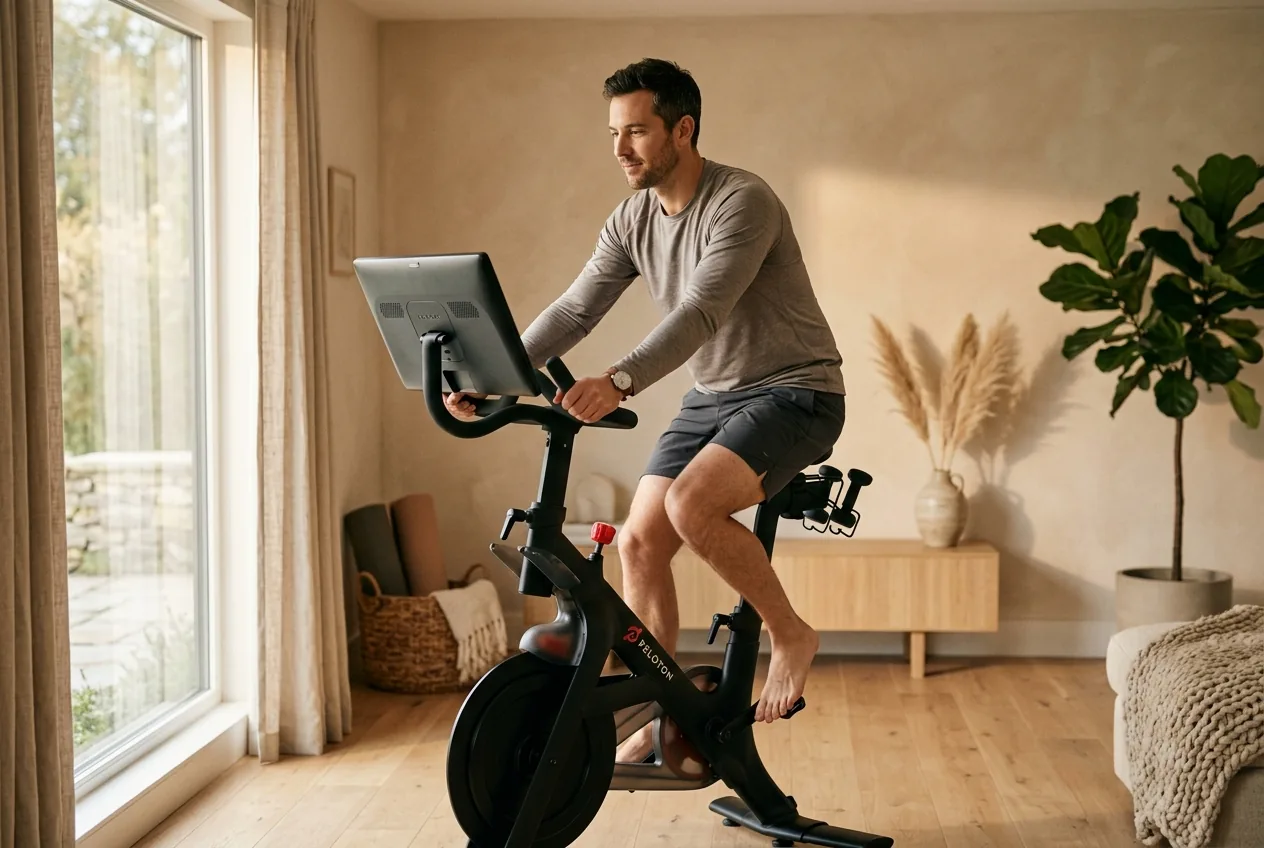
Cycling
Hard to beat for bad knees. The seat carries your weight, so the knee moves through a smooth range with no impact at all, and pedaling builds the quads that support the joint. Set the seat high enough that your leg nearly straightens at the bottom — too low forces a deep, loaded bend that some knees dislike. A stationary bike is easiest to control. Start with 10 to 15 minutes.
Swimming and water walking
Water takes most of your weight off, so you can move freely with almost no joint load while the water adds gentle resistance. Swimming, water aerobics, or simply walking lengths in the shallow end all work. This is often the best option when knees are too sore for anything weight-bearing on land.
Elliptical
Your feet stay on the pedals through a gliding motion, so there's no impact of foot striking ground. It mimics the motion of walking or jogging without the jarring. Keep the stride smooth and the resistance moderate.
Walking — on the right terrain
Level walking is low-impact and one of the simplest ways to keep a knee healthy. The terrain matters: flat, even ground and cushioned shoes are kind to the joint, while steep downhills load it hard. Build distance gradually. If walking reliably swells the knee, shorten it and lean on cycling or water work instead.
Rowing — with care
A rowing machine gives a strong full-body workout, but it does load the knees through the leg drive. If your knees tolerate it, keep the stroke smooth and the seat travel comfortable rather than driving into a deep bend.
How to ease in without flaring up
- Start short and build slowly. Ten to fifteen minutes, a few times a week, then add time before intensity.
- Use the next-day test. A little ache that settles is fine. Swelling or pain the next morning means you did too much — cut back.
- Warm up gently with a few minutes of easy movement before pushing the pace.
- Strengthen alongside cardio. Cardio keeps the knee moving, but the muscle that protects the joint comes from strength work — the same low-impact moves in the exercises for knee arthritis guide. Building the glutes also stops the knee caving inward, which is a big part of weak knees.
When to see a doctor
This is posture education, not medical advice. See a clinician if the knee is hot, red, and very swollen, especially with a fever, if it locks, catches, gives way, or buckles, if it swells hard after a specific injury, if you can't bear weight, or if pain is severe and steadily worsening. If you're not sure your knees can handle a new routine, a physical therapist can confirm what's safe and tailor it to your joint.
Why your own pattern matters
Two people with "bad knees" can have very different reasons for the pain. If your knee caves inward because the hip isn't steering the leg, the fix is glute strength, and the cardio that helps is whatever lets you build that without flaring up. If the joint is simply worn, the priority is keeping it fed and supported with zero pounding. Generic cardio advice doesn't ask why your knee hurts.
That's the case for knowing your own setup. A posture assessment looks at how your pelvis, hip, and knee line up — whether a dropped hip or weak side is loading the joint unevenly — so the cardio and strength work you choose actually unloads the part that hurts, instead of grinding it from a different angle.
Common questions
What is the best cardio for bad knees?
Cycling, swimming or water walking, and the elliptical top the list — all raise your heart rate with little or no impact on the joint. Level walking on flat ground works too. The best one is the one you'll do consistently, started short and built up gradually.
Is walking or cycling better for bad knees?
Both are good. Cycling is gentler because the seat carries your weight and the knee moves with no impact, which makes it the safer choice when the joint is sore. Walking is more convenient and still low-impact on flat ground. Many people do both and let the knee's response guide the mix.
Can I do cardio every day with bad knees?
Low-impact cardio like cycling or water work can often be done most days if it doesn't leave the knee swollen the next morning. Vary the type to avoid overloading one motion, keep sessions moderate, and leave strength work every other day so the muscles recover.
Is the elliptical or treadmill better for bad knees?
The elliptical is gentler. Your feet stay on the pedals through a gliding motion with no impact, while a treadmill still has your foot striking the belt on every step. If you use a treadmill, keep it flat, walk rather than run, and wear cushioned shoes.