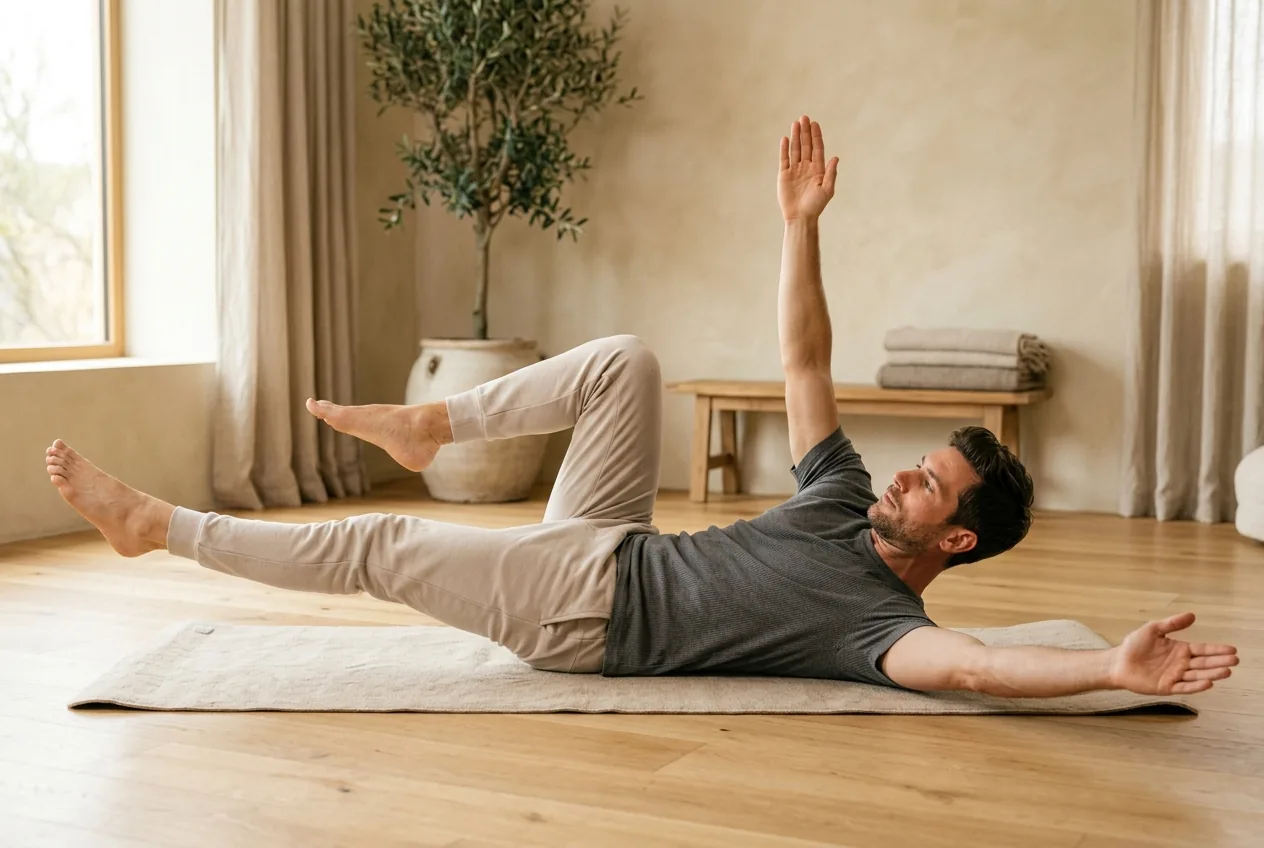

You've heard you need a stronger core for your back, so you tried sit-ups and crunches and your lower back felt worse, not better. That's a common dead end. The kind of core strength a sore back actually needs isn't the kind that curls you up — it's the kind that holds your spine steady while your arms and legs move. The dead bug exercise trains exactly that, lying on your back, with almost no strain on the spine. It's one of the safest core moves there is.
The name is unflattering and the movement looks odd — limbs waving slowly in the air — but the dead bug teaches your deep core to brace and hold while everything else moves, which is what your back needs all day.
What the dead bug actually trains
Your core isn't your six-pack. The muscles that protect your spine are the deeper ones — the transverse abdominis that wraps around your trunk like a belt, plus the obliques and the deep stabilizers. Their job is anti-movement: keeping your spine still and neutral while your arms and legs do their thing. Reach for a seatbelt, carry a bag, lift a toddler — your core's task is to stop your spine from buckling under the shifting load.
Crunches train the wrong thing. They flex your spine repeatedly, which can aggravate an already sensitive back and doesn't build the stability you use in real life. The dead bug flips it: your spine stays flat and still while your opposite arm and leg extend away, and your core has to work to keep your back from arching off the floor. That's the skill that protects you when life moves your limbs around.
This is why the dead bug sits in the same family as the bird dog exercise — both train the core to hold steady while the limbs move, just from different positions — and why both belong in a sensible set of core exercises for lower back pain.
The core's real job isn't curling you up. It's holding your spine still while your arms and legs move — and that's what the dead bug trains.
How to do the dead bug with good form
The whole exercise lives or dies on one thing: your lower back staying flat against the floor the entire time. If it arches, the movement stops working.
- Lie on your back, arms reaching straight up toward the ceiling over your shoulders.
- Lift your legs so your knees are bent at ninety degrees, stacked over your hips — the tabletop position.
- Flatten your lower back into the floor by gently drawing your belly down. There should be no gap under your lower back. This is your starting brace.
- Slowly lower your right arm overhead and your left leg straight out at the same time, reaching them away from each other, going only as far as you can while keeping your lower back flat.
- Pause, then return them to the start with control.
- Switch sides — left arm, right leg — and continue, alternating.
Breathe out as you extend, keep the movement slow, and the moment you feel your lower back start to arch off the floor, you've gone too far. Shorten the range and keep the brace.
Reps and sets
Two or three sets of eight to ten per side (so sixteen to twenty total reps a set) is a solid target. Quality beats quantity here — five clean reps with a flat back are worth more than fifteen with the back arching. Two or three sessions a week. If the full version is too hard at first, use the regressions below.
Easier and harder versions
- Easier — heel taps. Keep your arms still and just lower one leg to tap the heel down and back up, then switch. Master the leg movement before adding the arms.
- Easier — arms only. Hold the legs still in tabletop and just lower one arm overhead at a time.
- Standard dead bug. Opposite arm and leg together, as above.
- Harder — straight-leg lower. Extend the leg fully straight as it lowers, which lengthens the lever and makes the core work harder to keep the back flat.
- Harder — add a light weight. Hold a light weight in each hand or a band overhead for more resistance once the bodyweight version is easy and clean.
Common mistakes
- Letting the lower back arch. The big one. If a gap opens under your lower back, your core has stopped doing its job and your spine is taking the strain. Reduce the range and re-flatten the back.
- Holding the breath. Bracing by holding your breath makes you stiff. Breathe out as you reach, in as you return.
- Rushing the reps. Fast dead bugs use momentum and lose the brace. Slow and controlled is the point.
- Moving same-side arm and leg. It's opposite arm and leg — right arm with left leg — which mimics how you move in real life and trains the cross-body control.
- Reaching too far too soon. Range only counts if the back stays flat. Start small and extend the range as your control improves.
When to see a doctor
The dead bug is exercise and education, not medical treatment. Stop and see a clinician promptly if it brings on numbness, tingling, or weakness down a leg, any loss of bladder or bowel control, or if you have back pain after a fall, fever with back pain, unexplained weight loss, or pain that's severe or steadily worsening. Sharp pain during the movement means stop and get it looked at.
Why a core routine should fit your back
The dead bug is safe and useful for most backs, which is why it's a good default. But how much core stability you need, and where, depends on how your spine is actually loaded — a back stuck in too much arch braces differently than one that's collapsed and flat. The same routine that steadies one back under-serves another. General core work is a fair starting point. The version that holds is matched to your own pattern, which is what a posture assessment built around how your spine actually sits is for, rather than running a generic core circuit and hoping it fits.
Common questions
What does the dead bug exercise work?
The deep core muscles that stabilize your spine — the transverse abdominis, obliques, and deep trunk stabilizers. Rather than curling your spine like a crunch, the dead bug trains your core to hold your spine still and neutral while your arms and legs move, which is the kind of stability you use all day.
Is the dead bug safe for lower back pain?
For most people, yes — it's one of the safer core exercises because you stay on your back with your spine supported and neutral, with no spinal flexion or loading. The key is keeping your lower back flat against the floor; if it arches, shorten the range. Stop for sharp pain or leg symptoms and get them checked.
How many dead bugs should I do?
Two or three sets of eight to ten per side, two or three times a week, prioritizing clean form over reps. Five controlled reps with a flat lower back beat fifteen sloppy ones. Use the easier heel-tap or arms-only versions first if you can't keep your back flat.
Why does my lower back arch during the dead bug?
Your core isn't yet strong enough to hold the brace through that range, so the back arches to compensate. Reduce how far you extend your arm and leg, re-flatten your lower back into the floor before each rep, and use the easier regressions until your control improves.