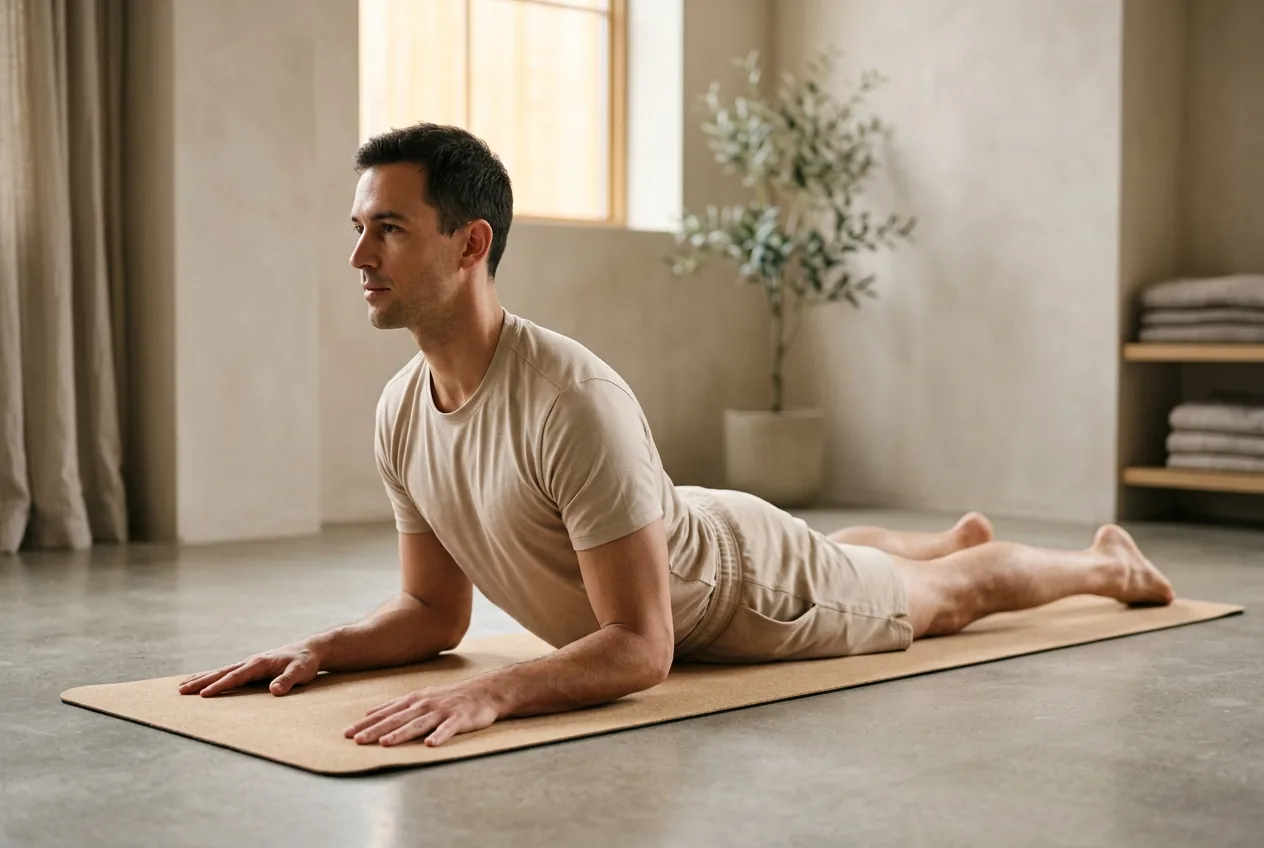

You straighten up after sitting, or you reach overhead, or you lean back to crack your spine — and a sharp, localized pain catches in your lower back, low and to one side. It eases when you bend forward or sit and bites again when you stand tall or arch. That specific on-off pattern is a clue, and it points toward a structure most people have never heard of: the facet joints.
Facet joint pain is one of the more common sources of mechanical lower-back pain, and it has a recognizable signature. Once you understand what these joints do and what irritates them, the things that help start to make sense. Here's the plain rundown.
What the facet joints are
Your vertebrae don't just stack on top of each other with a disc between them. At the back of each vertebra are two small joints — the facet joints — that link it to the bones above and below. They're paired, one on each side, and they guide and limit how your spine bends and twists. Like any joint, they have cartilage and a capsule, and like any joint, they can get irritated, inflamed, or worn.
When you arch backward or twist, the facet joints close and bear load. When you bend forward, they open and unload. That mechanical fact is the whole reason facet pain behaves the way it does: arching and standing close and load the joint, so they hurt; leaning forward and sitting open it, so they ease. If your pain follows that script, the facets are a prime suspect.
The pain is usually felt low in the back, often to one side, and can spread into the buttock or upper thigh. Unlike sciatica, it rarely shoots far down the leg or causes true numbness — that's one way to tell them apart, and the is it muscle or disc back pain breakdown helps with the wider sorting.
Why facet joints get cranky
Facet joints get irritated when they're loaded too much or too often in the closed, arched position. A few common reasons:
- An overly arched lower back. If your pelvis tilts forward and your lumbar curve is deep, the facets sit partly closed all day, carrying load they shouldn't. This is the anterior pelvic tilt pattern, and it's a frequent driver.
- Long standing or walking on hard surfaces in that arched posture.
- Repeated extension and twisting — overhead work, certain sports, reaching and rotating under load.
- Age-related wear that thins the cartilage and makes the joint more reactive (this is the facet's version of arthritis, which overlaps with arthritis in the lower back).
- Weak core and glutes that let the lower back do the stabilizing the hips should share.
The thread through most of these is posture and load. A lower back that lives in extension keeps the facets pressed together.
Facet pain has a tell: worse arching back and standing, better leaning forward and sitting. That on-off pattern is the joint opening and closing.
What tends to settle it
The aim is to unload the joint, build support so it isn't carrying everything, and ease the arch that keeps it pressed.
- Find your relief direction. Most facet pain eases in slight flexion. A gentle knee-to-chest stretch — drawing one or both knees toward the chest while lying down — opens the joints and often calms things quickly.
- Reset the pelvis. Pelvic tilts teach you to flatten the over-arch. The pelvic tilt exercise is a simple daily starting point.
- Strengthen the support crew. A daily glute bridge and gentle core exercises for lower back pain share the load so the facets stop overworking.
- Loosen tight hip flexors. Tight hip flexors pull the pelvis forward and deepen the arch; easing them helps unload the joints.
- Break up standing. If standing flares it, shift your weight, take sitting breaks, and avoid long stretches locked into the arch.
Ease off the moves that load extension hard — deep backbends, heavy overhead lifting with an arched back, and aggressive spinal twists — until things calm down.
When to see a doctor
Facet pain is usually mechanical and manageable, but get checked if you're not sure what you're dealing with or it isn't improving. See a clinician promptly if pain travels down the leg and worsens, if you develop leg weakness or numbness, or if numbness reaches the saddle area. Any loss of bladder or bowel control needs same-day care.
Also see someone if the pain followed a fall or accident, comes with fever or unexplained weight loss, or is severe and steadily climbing. This article is education, not a diagnosis — facet pain can be confirmed by a clinician, and persistent or worsening pain deserves a proper look. It helps to know when to worry about back pain.
The posture link that keeps it coming back
Facet pain that keeps returning usually isn't bad luck — it's a lower back that keeps living in extension. Treat the flare, feel better, go back to the same forward-tilted pelvis and deep arch, and the joints get pressed together again. The relief from a knee-to-chest stretch is real but temporary if the posture that loads the facets never changes.
Knowing your own pattern is what breaks that. A posture assessment measures how your spine and pelvis are actually positioned, so the routine eases the over-arch that's loading the facets rather than just relieving the ache for an hour. If your lower-back pain has that arch-it-and-it-bites pattern and keeps coming back, the posture therapy approach is built to address the setup underneath.
Unload the joint, ease the arch, build the support — that's the path out of a back that catches every time you stand tall.
Common questions
How do I know if my back pain is from the facet joints?
The classic tell is pain that worsens when you arch back or stand and eases when you lean forward or sit, usually felt low and to one side. It rarely shoots far down the leg. A clinician can confirm it, since other structures can mimic the pattern.
What's the difference between facet pain and a disc?
Disc-related pain often worsens with forward bending and sitting and can shoot down the leg with numbness. Facet pain typically worsens with backward arching and standing and stays more local. The directions that relieve each are roughly opposite.
Can facet joint pain be cured with exercise?
Exercise often controls it well by unloading the joint, easing an over-arched posture, and strengthening the core and glutes. It may not erase age-related wear, but it can keep the joint calm and the pain quiet.
Why does my facet pain keep coming back?
Usually because the posture that loads the joints — a forward-tilted pelvis and a deep lower-back arch — hasn't changed. The flare settles, the posture returns, and the facets get pressed together again. Addressing the underlying pattern is what breaks the cycle.