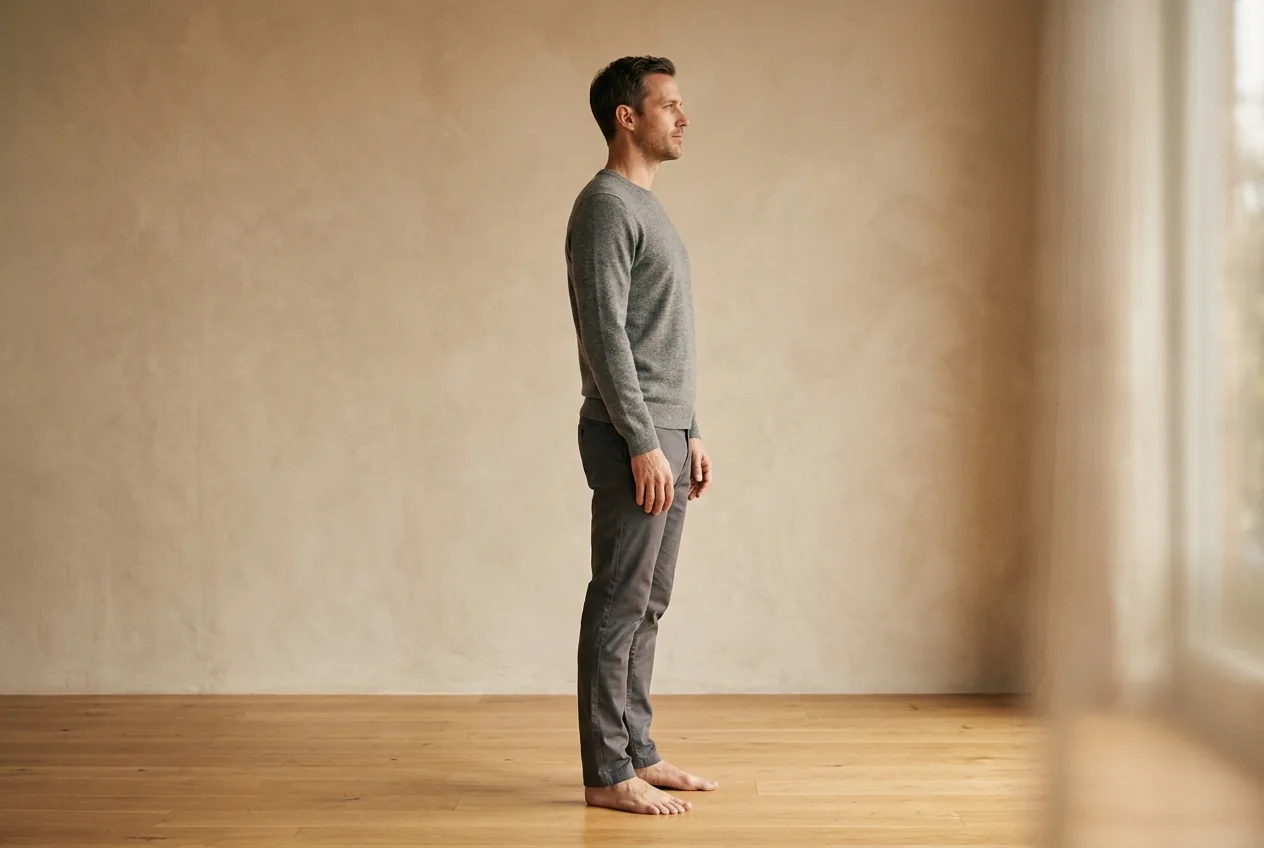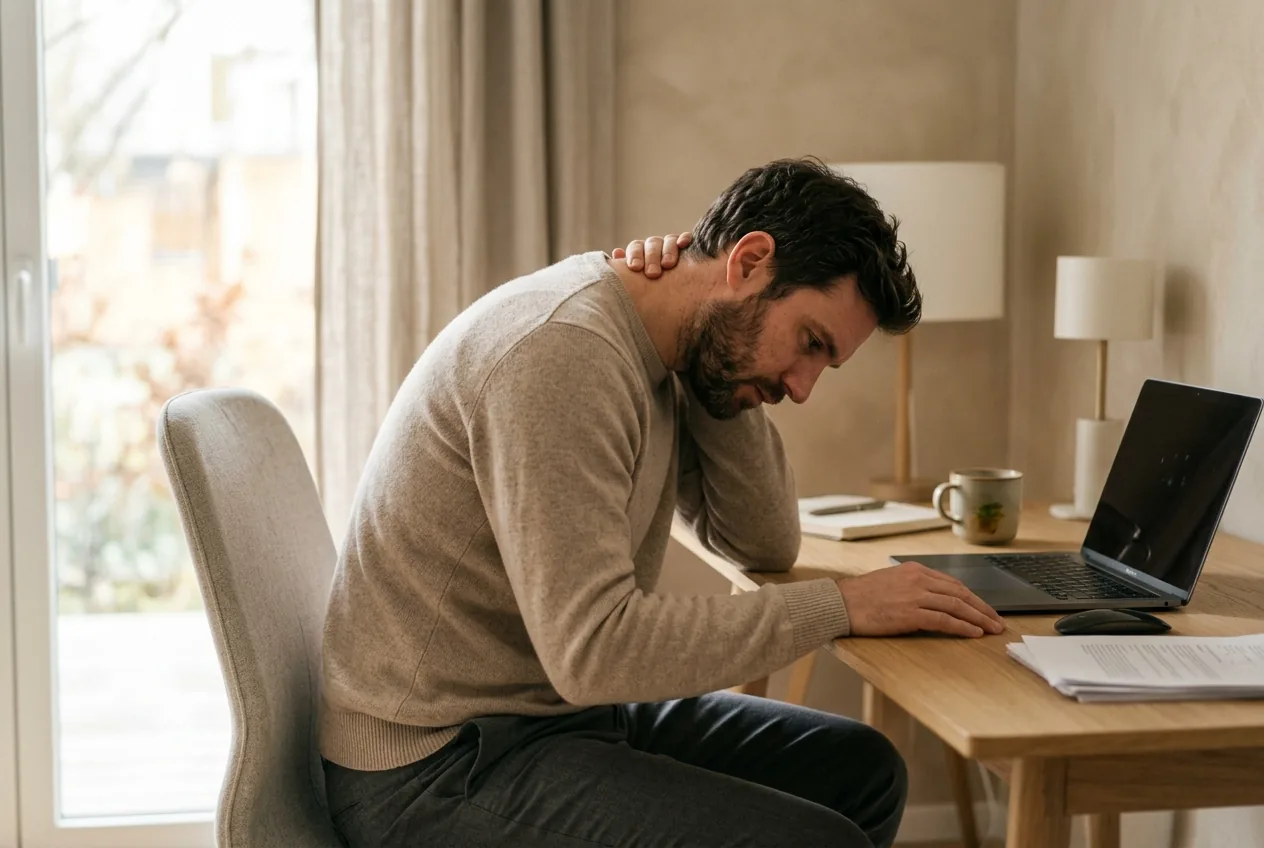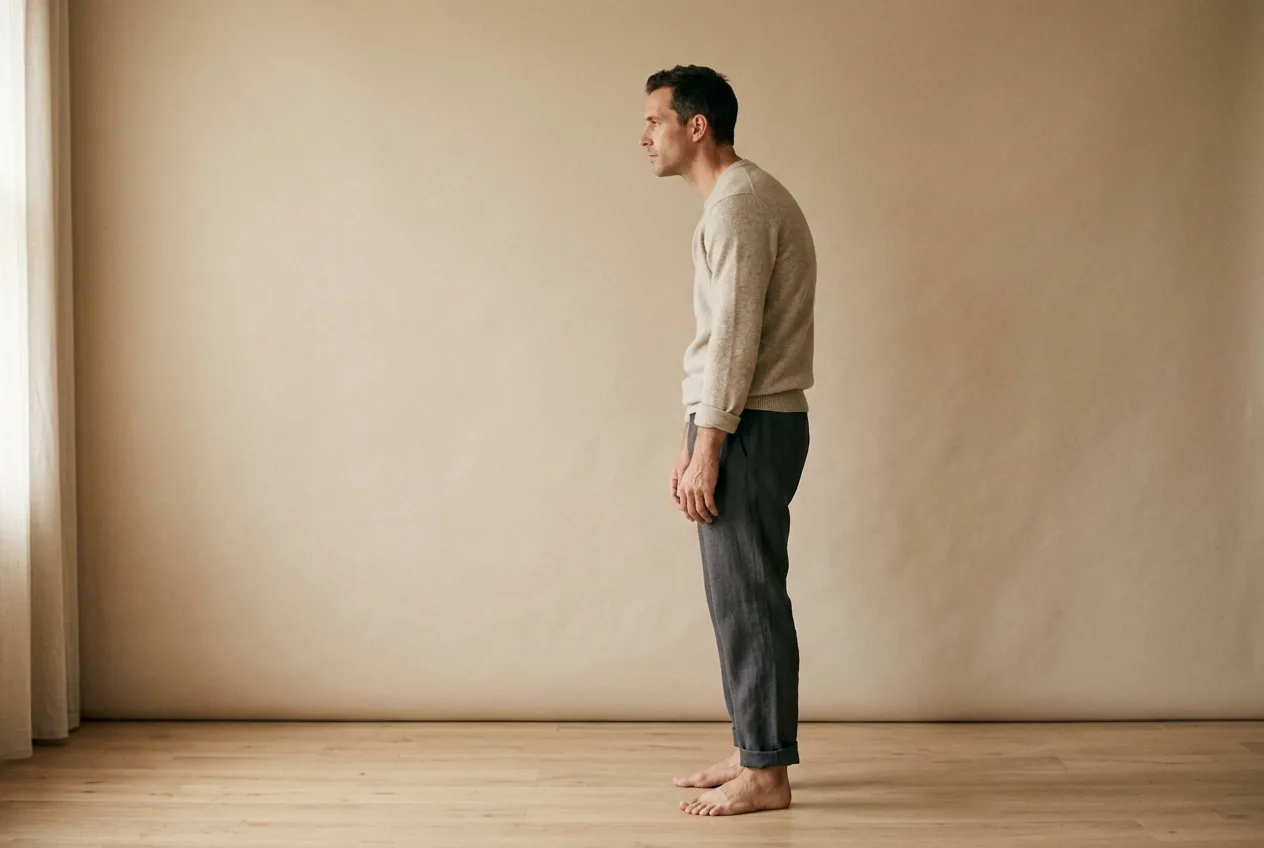

You catch yourself collapsed forward at your desk for the hundredth time, yank yourself upright, and ten minutes later you're right back in the slump. If that loop sounds familiar, you've already learned the hard part: knowing how to stop slouching isn't the problem. Holding the fix is. You can sit up straight on command. You just can't keep it there, because the moment your attention drifts, your body falls back into the shape it's been training for years.
That's the real story behind slouching, and it's why "just sit up straight" never works. This guide covers why your posture keeps caving, the muscles actually responsible, and the specific changes that make an upright spine feel like your default instead of a pose you have to consciously hold.
Why willpower alone never fixes slouching
A slouch is not laziness. It's a habit your nervous system has carved deep through thousands of hours of repetition — at a desk, in a car, over a phone. Your body has quietly decided that the rounded, head-forward shape is "home," and it returns there the instant you stop micromanaging it.
There's a physical reason it sticks. When you slump for years, some muscles get short and tight from being held in a shortened position — the chest, the front of the hips, the muscles at the base of the skull. Others get long and weak from being switched off — the deep neck flexors, the muscles between your shoulder blades, the lower traps. Your "good posture" muscles have essentially gone quiet, so when you sit up tall, you're asking weak, untrained muscles to do a job they've forgotten. They fatigue in minutes, and you sag.
So willpower fails not because you lack discipline, but because you're fighting the structure underneath. Change the structure and the upright position stops being a fight.
You don't hold good posture with effort. You earn it by retraining the muscles that are supposed to hold it for you.
The muscles doing the slouching (and the ones asleep)
Picture the typical desk slouch: head jutting forward, upper back rounded, shoulders rolled in, pelvis tipped back. Each of those involves a tug-of-war between a tight side and a weak side.
- Chest and front shoulders pull your shoulders forward. They get short from hours of reaching toward a keyboard.
- Upper traps and the muscles at the skull base overwork to hold your forward head up, which is partly why slouching feeds forward head posture and tension headaches.
- Mid-back muscles between the shoulder blades go weak and long. They're meant to pull your shoulders back, but they've stopped firing.
- Deep neck flexors at the front of the throat — the ones that should tuck your chin and stack your head — switch off, so your head drifts forward by default.
- Glutes and deep core lose tone from sitting, letting the pelvis collapse and the whole spine round.
Fixing the slouch means loosening what's tight and waking up what's weak. Doing only one half is why most posture advice underdelivers.
How to stop slouching: the daily fixes that hold
You don't need an hour. You need a few targeted moves done consistently, plus a couple of environment changes so your body isn't pulled back into the slump all day.
- Open the front first. Spend a minute in a doorway chest stretch to release the tight chest and front shoulders. Trying to pull your shoulders back while the chest is locked short is a losing battle — release it first.
- Wake the mid-back. Do wall angels — back against a wall, arms sliding up and down — to fire up the muscles between your shoulder blades that hold your shoulders back.
- Reset the head. Add chin tucks: gently draw your head straight back over your shoulders, like making a double chin. This retrains the deep neck flexors that keep your head stacked instead of jutting forward.
- Rebuild the base. A daily glute bridge wakes up the glutes that support an upright pelvis, so your lower back isn't doing all the work.
- Move the goalposts. Set your screen at eye level, your feet flat, and get up every 30 to 45 minutes. No posture holds when you're frozen in one shape for hours — the cure for sitting is moving, not sitting "perfectly."
The aim isn't to clench yourself upright all day. It's to do these often enough that the upright position needs less and less conscious effort, until it quietly becomes your resting shape.
What to stop doing
Some habits actively reinforce the slouch:
- Holding a "perfect posture" pose by force. Bracing rigidly tires you out and you collapse harder later. Aim for relaxed and stacked, not stiff.
- Working from the couch or bed. Soft, unsupported surfaces pull you into a deep round. If you can, set up a proper workspace.
- Looking down at your phone for long stretches. Bring it up to eye level instead of dropping your head to it.
- Relying on a posture brace to do the work. A strap can be a reminder, but it doesn't build the muscle that holds you up. Here's whether posture correctors actually work.
When to see a doctor
Slouching itself isn't dangerous, but pain that travels with it can signal something more. See a clinician promptly if you have numbness, tingling, or weakness spreading into an arm or leg, any loss of bladder or bowel control, back or neck pain after a fall or accident, fever alongside the pain, unexplained weight loss, or pain that's severe or steadily getting worse. This is education and posture therapy, not medical advice — and a sudden, fixed change in your posture deserves a professional look.
Why your slouch keeps winning
Here's the part most posture content skips: the exact way you slouch is specific to you. One person's slump is driven by a tight chest and a forward head. Another's starts at a tipped pelvis that rounds everything above it. The same generic "sit up straight" advice can target the wrong link entirely — which is why the corrections that transform one person do nothing for the next.
That's the real reason a slouch keeps coming back even when you're trying. You're treating the posture as one problem when it's a chain of specific tight-and-weak pairings unique to your body. A posture assessment measures where your spine and pelvis actually deviate and builds the release-and-strengthen routine around your pattern, so the upright position stops being a pose you hold and becomes the way you're built to sit. If you want a quick sense of where you stand, you can check your posture at home first.
Stop trying to win the slouch with attention. Retrain the muscles, and good posture stops needing you to remember it.
Common questions
How long does it take to stop slouching?
Most people feel less effort needed within a few weeks of daily work, but rewiring a years-old habit into a new default usually takes a couple of months of consistent release and strengthening. The looser and stronger the right muscles get, the less you have to think about it.
Can you fix a slouch you've had for years?
Yes. Soft tissue and muscle activation respond to training at any age. A long-standing slouch is held by tight and weak muscles, both of which change with the right routine — it just takes more consistency than a recent habit.
Does sitting up straight all day fix slouching?
No, and forcing it usually backfires. Holding any single position rigidly fatigues the muscles and you collapse harder afterward. The fix is releasing tight muscles, strengthening weak ones, and moving regularly — not clenching upright for eight hours.
Are posture correctors a good way to stop slouching?
A brace can remind you where upright feels like, but it doesn't build the muscle that holds you there, so the slouch returns when you take it off. Use it as a short-term cue at most, paired with actual strengthening work.