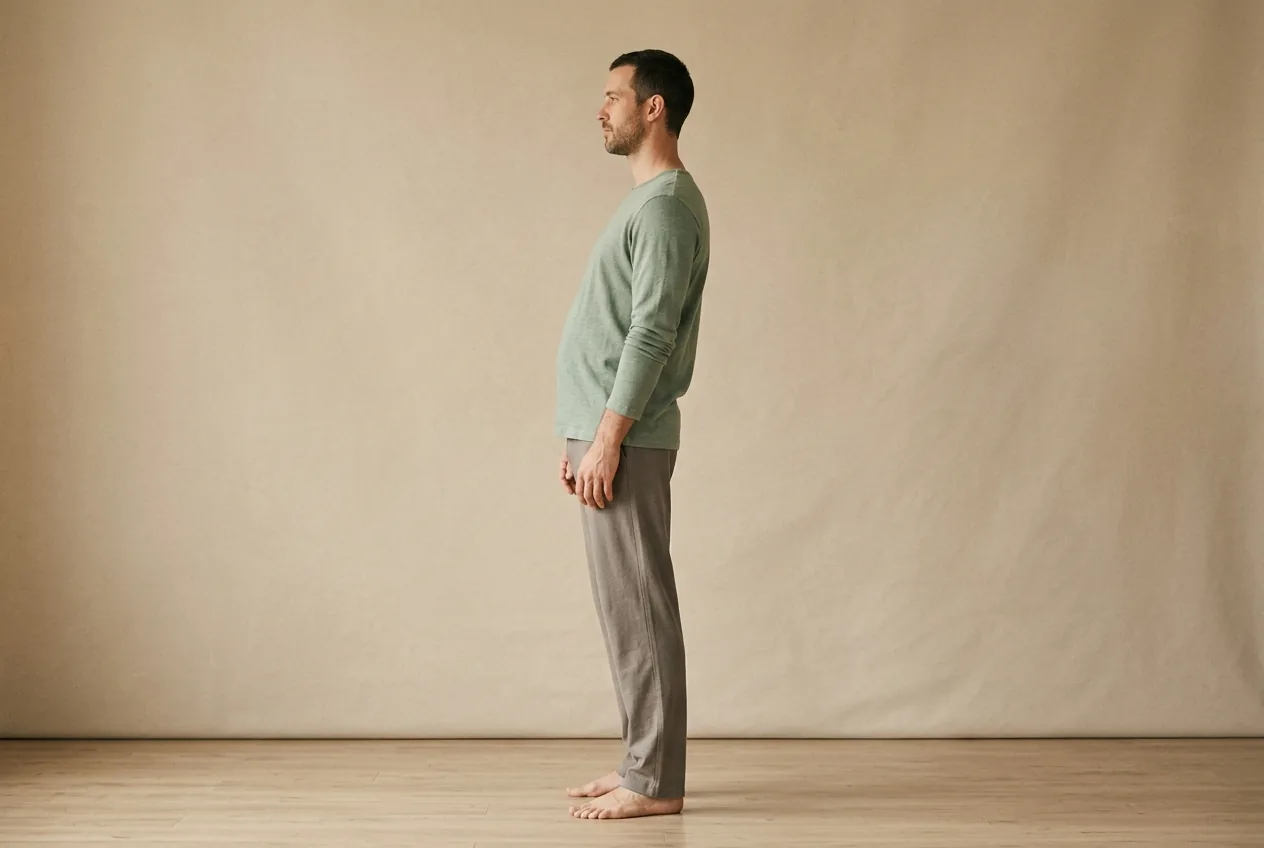
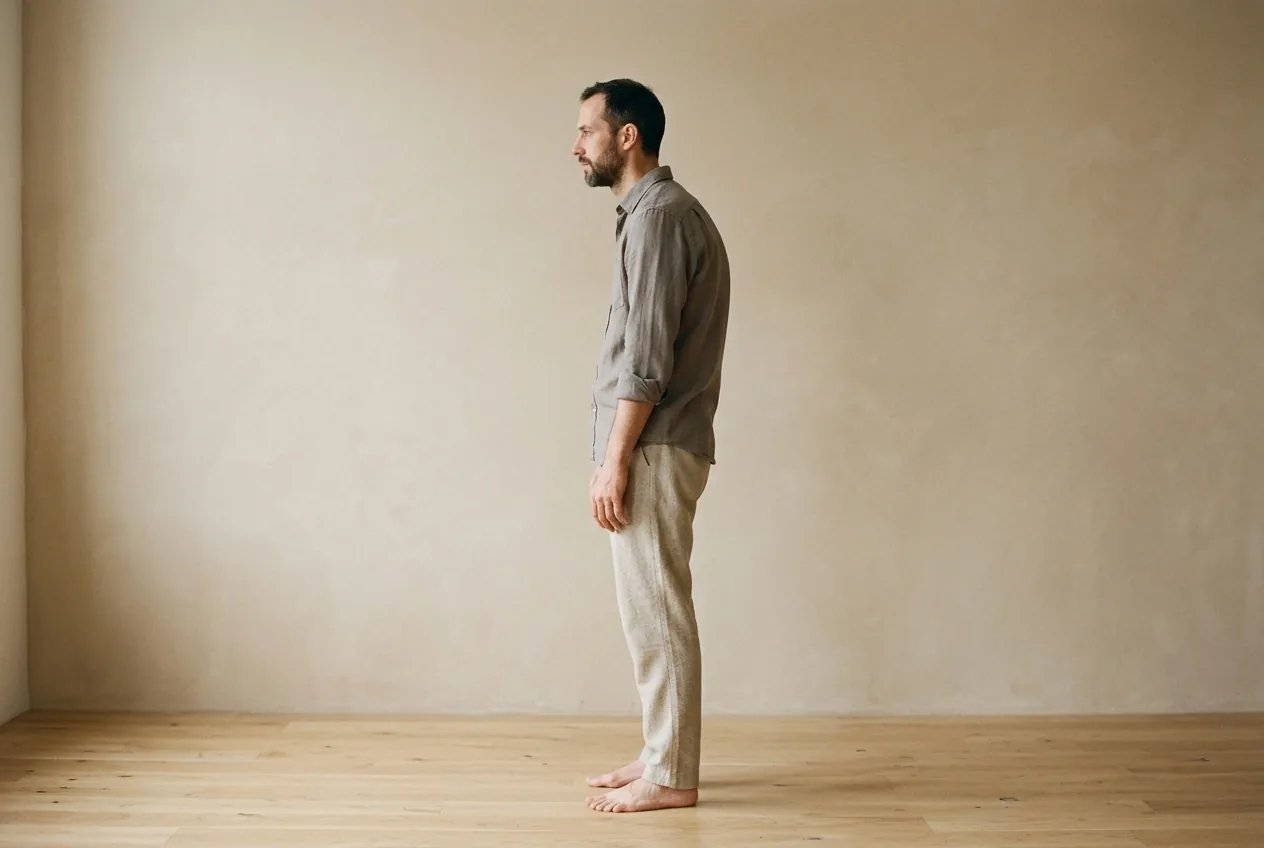
You see it in a side-on photo or a shop window reflection: your upper back curves forward, your shoulders roll in, and your head pokes out ahead of you. People have started telling you to stand up straight, and you realize you can't quite remember the last time you did. That forward rounding of the upper spine is kyphosis — the everyday word is hunchback posture — and knowing how to fix kyphosis posture starts with knowing which kind you have.
Some of it is fixed by structure. A lot of it, especially the version that built up from years at a desk, responds well to the right daily work. Here's how to tell the difference and what to do.
What kyphosis actually is
Your upper back, the thoracic spine, is meant to have a gentle forward curve. Kyphosis is when that curve becomes exaggerated and the upper back rounds noticeably forward.
The most common version in office workers is postural kyphosis. Nothing is wrong with the bones — the spine has simply adapted to thousands of hours of leaning toward a screen. The muscles down the front, the chest, get short and tight. The muscles of the upper back that should hold you tall get long and weak. The curve deepens to match the shape you spend your day in. This kind is flexible: you can straighten it when you consciously try, which is the strongest sign it'll respond to exercise.
There are structural versions too, where the bones themselves have changed shape — for example Scheuermann's kyphosis, which develops in the teen years, or the wedging that can come with thinning bones later in life. Those are stiffer and don't straighten on command. They still benefit from posture work, but they need a clinician's input on what's safe.
If you can straighten your upper back when you think about it, the curve is mostly habit. Habits respond to training.
How it connects upward and down
A rounded upper back rarely stays in its own lane. When the thoracic spine curves forward, the head drifts forward to keep your eyes level — the nerd neck and tech neck pattern — and the shoulders roll in, which is the rounded shoulders problem. At the top of the curve, a soft fatty pad sometimes builds at the base of the neck, the so-called neck hump or dowager's hump. Treat the rounding in isolation and you ignore the parts pulling it forward.
How to fix kyphosis posture: the routine
For postural kyphosis, the work is straightforward: open the tight front, strengthen the weak back, free up the stiff mid-spine, and rehearse standing tall until it stops feeling like effort. Most days, short sessions.
Thoracic extension over a support
Lie back over a firm rolled towel or foam roller placed across your upper back, knees bent, feet flat. Support your head with your hands and let your upper back ease into extension over the roller. Breathe. Move the roller up and down a few inches to work different segments. This restores the mobility a rounded upper back loses.
Open the chest — doorway stretch
Stand in a doorway with your forearms on the frame, elbows around shoulder height, and step through gently until you feel the front of your chest open. Hold 30 seconds, repeat twice. Tight pecs are part of what pulls you into the round.
Strengthen the upper back — wall angels and rows
Do wall angels: back to the wall, arms in a goalpost, slide up and down keeping hands and elbows on the wall. Ten reps. Add scapular squeezes — draw the shoulder blades down and back, hold five seconds, release, 10 to 12 times. These wake up the muscles that should hold you upright.
Chin tucks for the top of the chain
Because the head rides forward on a rounded back, finish with chin tucks: glide the head straight back over the shoulders, hold five seconds, repeat 8 to 10 times.
How long it takes, and what to watch for
For postural kyphosis, the change is gradual and stacks over weeks. Early on, the foam-roller extension work tends to free up the mid-back so you can straighten more easily when you try — that's the flexibility you want to protect and build on. Over the following month the upper-back muscles start holding you taller without conscious effort, and you catch yourself sitting upright at the desk for longer before the round creeps back in. Past that, standing tall starts to feel like the resting position rather than a pose.
A useful checkpoint: stand relaxed against a wall and see whether the back of your head reaches it without you having to crank your chin up. As the curve eases and the head comes back over the shoulders, that gets easier. Frequency is the lever — short daily sessions beat the occasional long one, because you're retraining a habit, and a curve built over years doesn't unwind in a weekend.
What to stop doing
- Stop "snap-straightening" for ten seconds and calling it correction. It teaches nothing.
- Stop relying on a brace to hold you up — it does the holding so your muscles don't, keeping them switched off.
- Stop spending evenings curled forward on the couch over a phone, undoing the day's work.
- Stop doing only chest and front-of-body work in the gym with no upper-back pulling to balance it.
When to see a doctor
This is posture education, not medical advice. See a clinician before starting if your upper-back curve is rigid and won't straighten when you try, if it appeared or worsened quickly, or if you have known bone-thinning. Seek prompt care for pain after a fall, numbness, tingling, or weakness in the arms or legs, fever with back pain, unexplained weight loss, or pain that's severe or steadily worsening. A stiff, structural curve needs a professional's guidance on what's safe to do.
Why a tailored routine beats a generic one
The moves here help most people with flexible, postural kyphosis. But how deep your curve is, how much your head and shoulders are pulling into it, and whether any of it is structural will be specific to you — and the right starting emphasis changes the result.
That's the reasoning behind a proper posture assessment: measure your actual curve and compensations, then build a daily program around them rather than guessing. To get a first read, you can check your posture at home with a side photo.
A rounded upper back from desk life is a learned shape. Open the front, strengthen the back, and repeat — that's how it straightens.
Common questions
Can kyphosis be fixed with exercise?
The common desk-driven kind, postural kyphosis, usually responds well to exercise because nothing is wrong with the bones. Structural versions, where the bone shape has changed, are stiffer and need a clinician's input, though posture work can still help around them.
How do I know if my kyphosis is postural or structural?
The quickest tell is whether you can straighten your upper back when you consciously try. A curve that straightens on command is mostly habit and tends to respond to training. One that stays rigid, or appeared and worsened quickly, is worth a professional's read first.
Is a hunchback the same as kyphosis?
"Hunchback" is the everyday word for the visible rounding that kyphosis describes. They point at the same forward curve of the upper spine; kyphosis is just the clinical term.
Does standing up straight fix a hunched back?
Snapping upright for a few seconds teaches the muscles nothing. Lasting change comes from opening the tight chest, freeing the mid-spine, and strengthening the upper back so standing tall stops feeling like effort — repeated in short daily sessions.