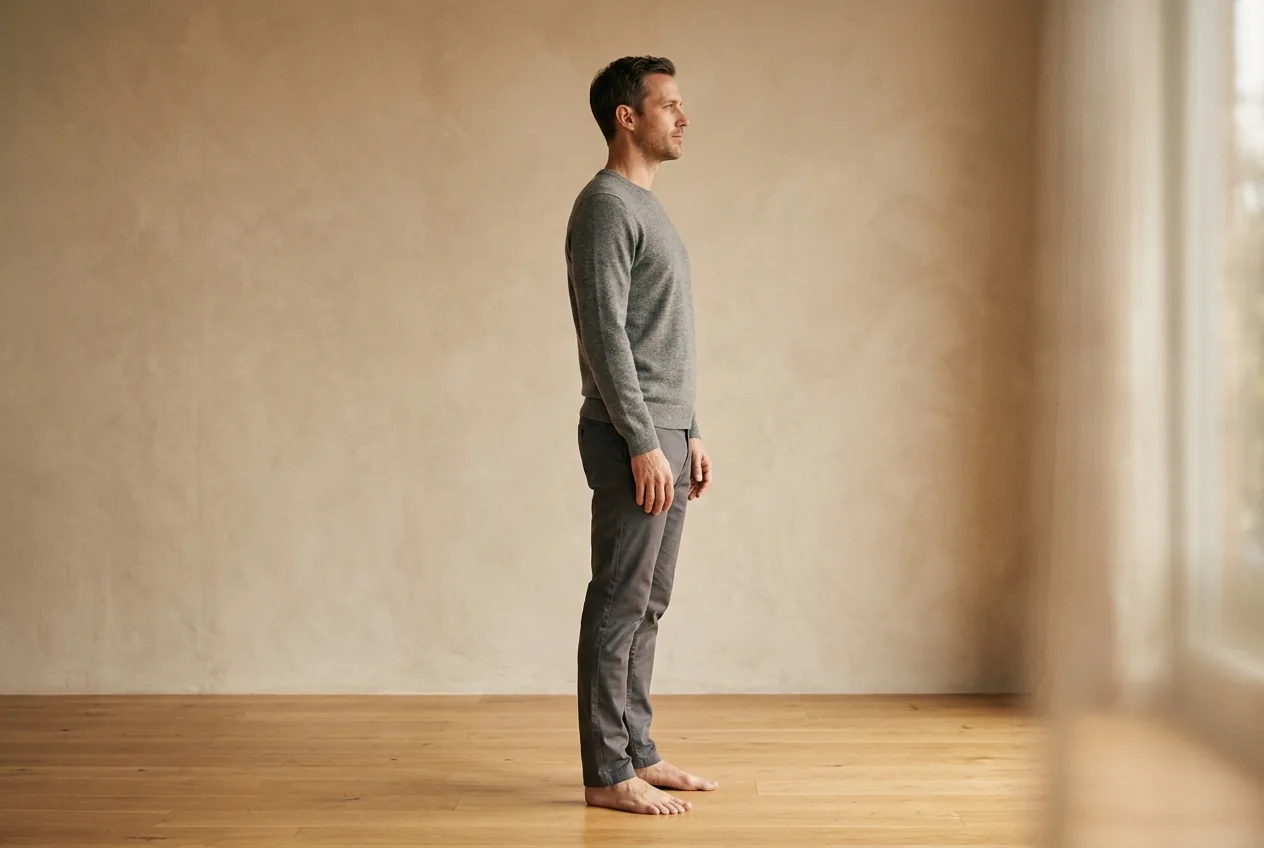
You stand up after a long stretch at your desk and your lower back is tight in the same band it always is. Your hips feel stiff, like the front of them won't fully open. You arch a little to stand tall, your belly pushes forward, and the ache settles in low across your back the way it has for years.
That combination — tight hips, a soft middle, and a lower back that's always working — has a name. Lower crossed syndrome is the muscle imbalance that builds in the bottom half of your torso, mostly from sitting, and it sits behind a lot of chronic, non-traumatic lower back pain.
What lower crossed syndrome is
Lower crossed syndrome is the mirror image of the desk-driven pattern up top. Some muscles around your hips and lower back get short and tight. Their opposites get long and weak. Draw lines between the tight and the weak and they cross into an X over your pelvis — same idea as the upper version, lower down.
On the tight side: the hip flexors at the front of the hips (the muscles that lift your knee, shortened from hours of sitting) and the muscles of the lower back. On the weak side: the deep abdominal muscles that should support your trunk, and the glutes — the big muscles in your backside that should power your hips and hold your pelvis level.
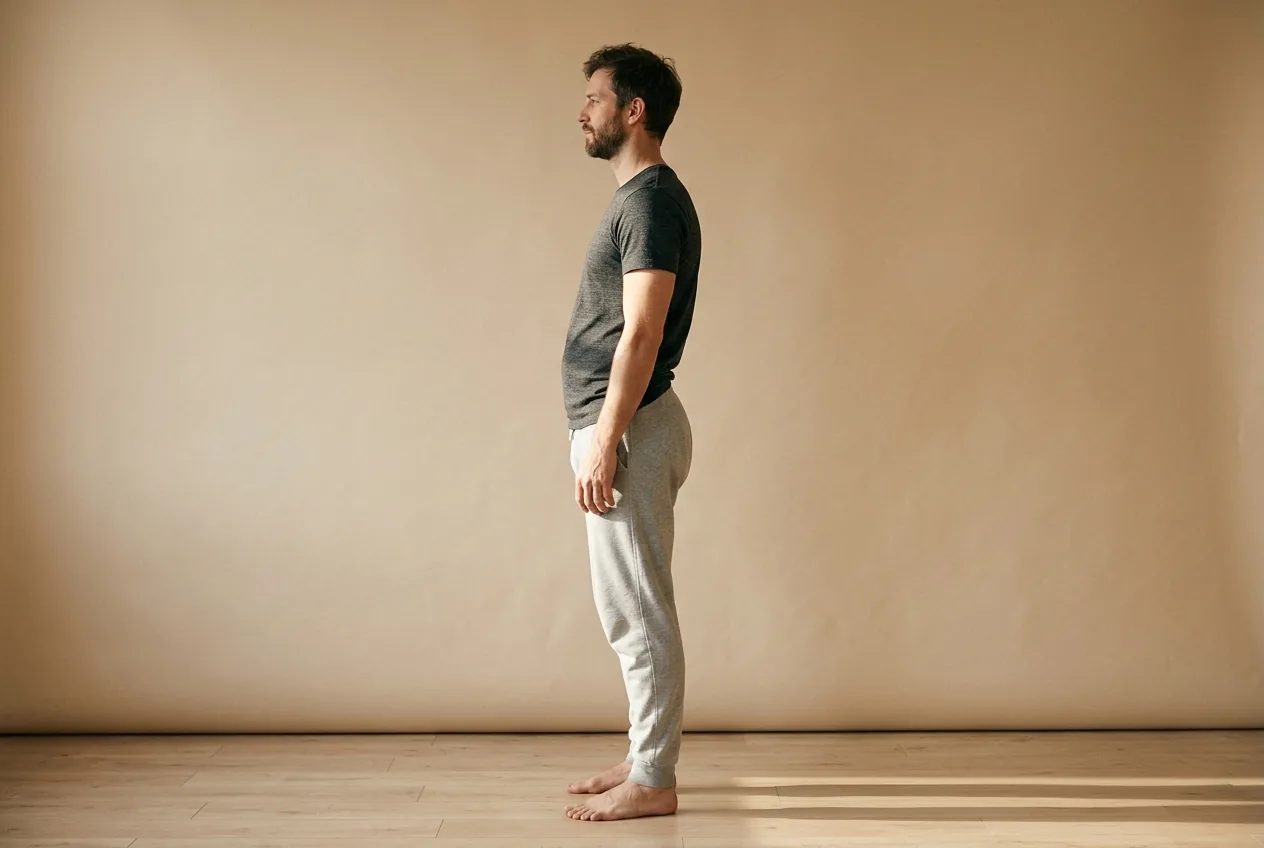
The result is a pelvis that tips forward and a lower back that arches more than it should. The belly pushes out, the backside sticks out, and the lower back lives in a constant slight overextension. You may know this shape as anterior pelvic tilt — that tilt is the front-facing symptom of the same imbalance.
The arch in your lower back isn't bad standing. It's a pelvis that's been tipped forward by tight hips and an off-duty core.
Why sitting builds it
Sit down and your hip flexors fold into a shortened position. Hold that for most of your waking hours, day after day, and they adapt by getting tight — that's tight hip flexors from sitting. When you stand, those short muscles tug the front of your pelvis down and forward, which tips it and deepens the arch in your lower back.
Meanwhile your glutes do almost nothing in a chair. Muscles that aren't asked to work switch off, and the glutes are easy to lose — the link between weak glutes and back pain is one of the most common in the whole picture. Your deep core goes quiet for the same reason. With the glutes and core off duty, the lower back muscles step in to hold you upright, and they end up doing a job they were never meant to carry alone. That's the tightness and ache you feel.
So the lower back isn't the villain. It's the muscle that got stuck covering for two larger ones that clocked out.
The four moves that rebalance it
The fix is the same logic as anywhere else: release what's tight, switch on what's weak, repeat often. You're loosening the front of the hips and lower back, and waking up the glutes and deep core.
Open the front of the hip — kneeling hip flexor stretch
Kneel on one knee with the other foot flat in front, like a low lunge. Tuck your tailbone slightly under and shift your weight gently forward until you feel a stretch across the front of the kneeling hip. Hold 30 seconds each side, twice. Keep the tuck — that's what targets the hip flexor instead of arching your back. The hip flexor stretch for back pain covers it in more detail.
Wake the glutes — glute bridge
Lie on your back, knees bent, feet flat. Press through your heels and lift your hips until your body makes a straight line from shoulders to knees, squeezing your backside at the top. Hold two seconds, lower slowly. Do 10 to 15. You should feel this in your glutes, not your lower back — if it's all in your back, you're arching instead of squeezing. The glute bridge for back pain walks through fixing that.
Switch on the deep core — dead bug
Lie on your back, knees bent up over your hips, arms reaching toward the ceiling. Press your lower back gently into the floor and keep it there. Slowly lower one arm overhead and the opposite leg toward the floor, then return and switch. The whole point is keeping your lower back flat so the deep core holds the trunk steady. Do 8 to 10 per side.
Build it into standing — pelvic tucks
Stand with knees soft. Gently tuck your tailbone under and feel your lower back flatten slightly, then release. This rehearses bringing the pelvis out of its forward tip. Do it through the day as a reset. More core options live in core exercises for lower back pain.
What to stop doing
- Stop doing endless lower-back extensions and arching stretches, thinking they'll loosen the ache. They often feed the overextension.
- Stop sitting for two hours straight. Stand and move every 30 to 45 minutes to stop the hip flexors locking short.
- Stop expecting a single hip stretch to undo it. Tight hips with sleeping glutes is a two-sided problem, so you need both halves.
- Stop letting your standing posture default to belly-forward, backside-out. Tuck and reset.
When to see a doctor
This is posture education, not medical advice. Lower crossed syndrome describes a muscle pattern, not a disease. See a clinician promptly if you have numbness, tingling, or weakness spreading down a leg, any loss of bladder or bowel control, pain after a fall or accident, fever with back pain, unexplained weight loss, or pain that's severe or steadily worsening. Those need a proper look, not a stretch.
Why a matched routine beats guessing
The moves above help most people with this pattern, because tight hips and a quiet core is such a common setup. But how far your pelvis is tipped, which side is tighter, and whether something higher up is stacking onto it will be specific to you — and a move that suits one person's pattern can do little for another's.
That's the reasoning behind a real posture assessment: you measure your own deviations from a few photos and build the routine around them, in the right order. For a quick first read, you can check your posture at home.
Lower crossed syndrome lives in the balance between your hips and your core. Even it out and the lower back finally gets to stop covering.
Common questions
What is lower crossed syndrome in simple terms?
It's a muscle imbalance in the bottom half of your torso, mostly from sitting. The hip flexors and lower back get tight while the glutes and deep core go weak. That combination tips the pelvis forward, arches the lower back, and leaves the lower back muscles overworking — which is the ache you feel.
Does sitting all day cause it?
Sitting is the biggest driver. A seated position holds the hip flexors short for hours so they tighten, and it gives the glutes and core nothing to do so they switch off. Over time that imbalance becomes the default, which is why standing tall feels like effort and the lower back stays tight.
How do you fix lower crossed syndrome?
By treating both sides of the imbalance: release the tight hip flexors and lower back, and strengthen the glutes and deep core with moves like bridges and dead bugs. Doing it most days matters more than intensity, since you're retraining a balance built over years of sitting.
Is lower crossed syndrome the same as anterior pelvic tilt?
They're closely related. Anterior pelvic tilt is the forward tip of the pelvis you can see; lower crossed syndrome is the underlying muscle imbalance that produces it. Addressing the tight and weak muscles is what brings the pelvis back toward neutral.