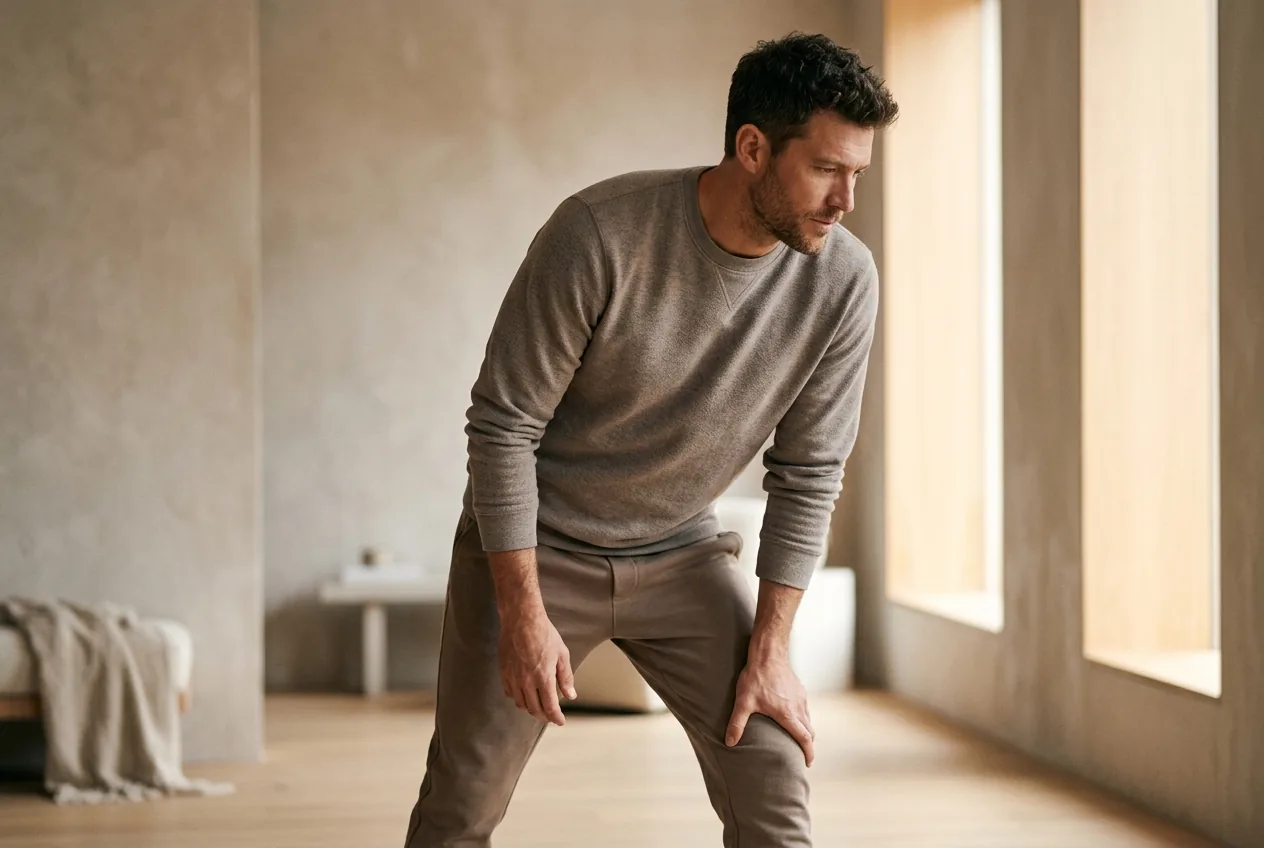
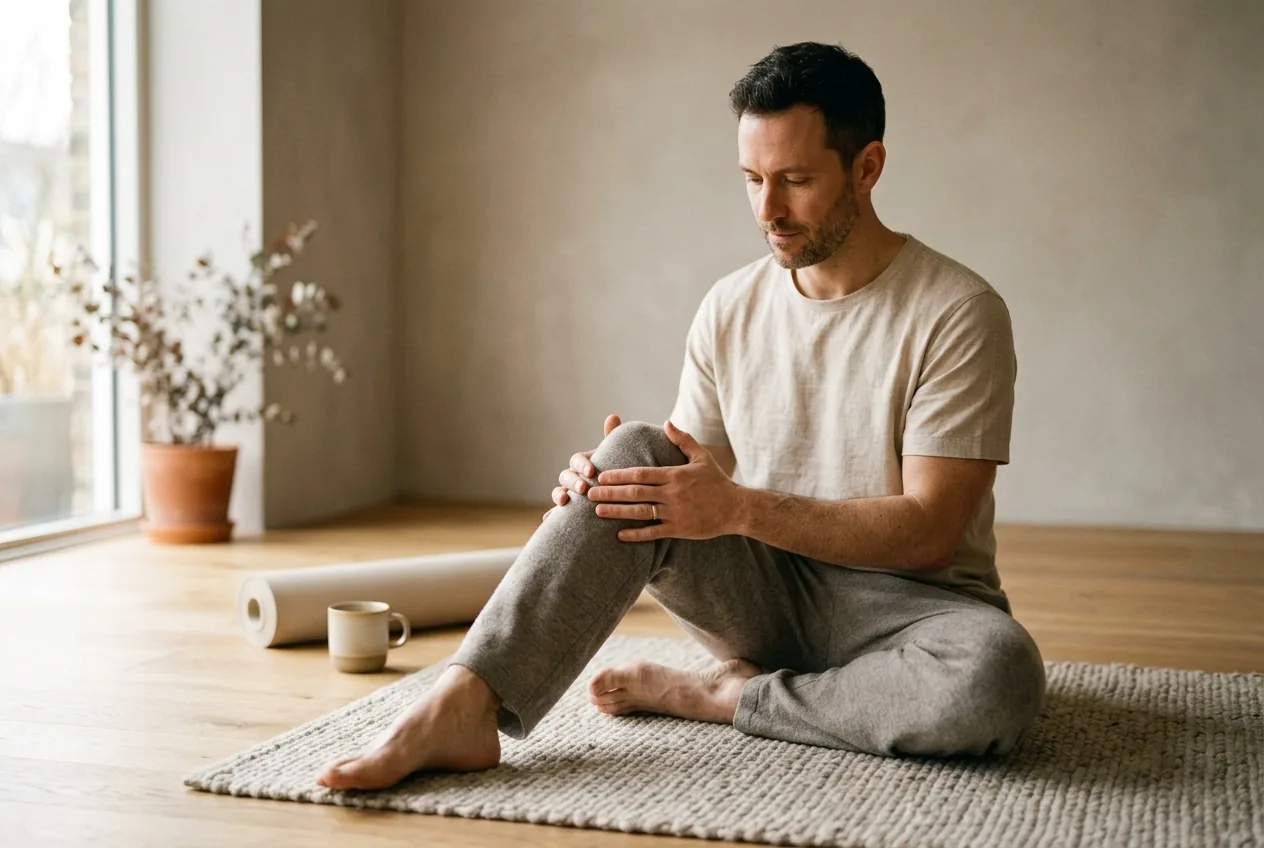
You've been sitting for an hour, you go to stand, and the knee won't quite cooperate. It feels thick and rusty, like it needs a few steps to remember how to bend. Maybe it aches as much as it stiffens. Then you walk it off and by the time you reach the kitchen it's mostly back to normal — until the next time you sit down.
A stiff knee that's worst after rest and better with movement is telling you something useful. Stiffness that loosens up is usually about how the joint moves and the tissue around it, not about something broken inside. And movement is exactly the lever you have.
Why a knee gets stiff
Knees are built to move, and they don't tolerate being held still. Sit for an hour with the knee bent and a few things stack up.
The joint slows its fluid circulation. Healthy knees pump fluid in and out as they move; that fluid lubricates and feeds the tissue. Hold the knee still and the circulation drops, so the joint feels dry and gritty on the first few bends. Movement turns the pump back on, which is why a few steps fixes it.
The muscles around it tighten and shorten. Sitting leaves the hamstrings and calves bunched and the hip flexors at the front short. When all of that is tight, the knee can't bend and straighten through its full range freely, and it reads as stiffness. This is the same mechanism behind a lot of knee pain from sitting.
If you've had a knock or a flare, the joint can also guard — the muscles around it stay a little braced and the range shrinks. And in older knees, ordinary wear can leave a baseline stiffness, especially first thing in the morning.
A knee that's stiffest after sitting and loosens with a few steps is usually a movement problem, not a structural one.
The posture link
How your hips sit decides how freely your knee moves. If your hip flexors are short from years of sitting and your glutes are quiet, your hip doesn't extend fully on each step, so the knee never gets driven through its full range — it learns to operate in a smaller arc, and that narrowed arc feels stiff. A tipped pelvis adds to it by changing the angle the whole leg works at. The chain that drives a stiff knee often starts at a hip that stopped extending, the same way it sets up knee pain when squatting. Patterns like tight hip flexors from sitting and anterior pelvic tilt feed directly into a knee that won't loosen.
Mobility fixes that work
The fix is gentle, frequent movement through range — not forcing, not grinding.
Heel slides. Lie or sit with the leg out, slowly bend the knee by sliding the heel toward you as far as it comfortably goes, then straighten fully. Ten slow reps coax the joint through its range and get the fluid moving. Do these morning and after long sitting.
Seated knee extensions. Sitting in a chair, straighten one knee out in front until the leg is level, hold a second, then lower. This restores the last bit of straightening that stiff knees tend to lose.
Gentle calf and hamstring stretch. Tight tissue at the back limits the knee. A wall calf stretch and an easy seated hamstring stretch — eased into, never bounced — give the joint room to move.
Loosen the hips. Because the knee's range depends on the hip, a daily hip flexor stretch for back pain and a glute bridge for back pain restore the hip extension that drives the knee through its full arc.
Move often. The strongest medicine for a stiff knee is simply not staying still. Stand and walk for a minute or two every half hour.
What to stop doing
- Don't sit motionless for an hour at a time. That's what builds the stiffness in the first place.
- Don't force the knee past a sharp pain to "break it in." Coax the range; don't grind it.
- Don't tuck your feet under the chair. It pins the knee in a deep bend that stiffens it further.
- Don't only stretch the knee. Loosening the hips usually does more than knee work alone.
When to see a doctor
This is posture education, not medical advice. See a clinician promptly if the knee is swollen, warm, or red, if it locks or catches and won't bend or straighten, if you can't bear weight, if there's a fever with the stiffness, or if it followed a fall or injury. Morning stiffness that lasts well beyond half an hour, stiffness in several joints, or knee stiffness that's steadily worsening rather than easing with movement also deserve a proper look. Calf swelling, warmth, or redness — particularly after a long period of sitting or travel — should be checked urgently.
Why knowing your own pattern matters
The mobility work above loosens most stiff knees. But why the knee narrowed its range in the first place — short hip flexors, a tipped pelvis, quiet glutes on one side — is specific to you, and the wrong emphasis can keep the stiffness circling back.
That's the case for a proper posture assessment rather than guessing: measure your real alignment, then restore the hip extension and muscle balance that drive the knee through its full range so the rusty-after-sitting feeling fades.
Common questions
Why is my knee stiff after sitting?
Sitting holds the knee bent, which slows the fluid that lubricates the joint and lets the surrounding muscles tighten and shorten. The joint feels dry and rusty until you move and the fluid starts pumping again. Moving the knee every 20 to 30 minutes prevents most of it.
How do I loosen a stiff knee?
Move it through its range gently and often — heel slides, seated knee extensions, and a few minutes of walking every half hour. Stretch the tight calf and hamstring at the back, and loosen the hips, since the knee's range depends on the hip extending fully. Coax the range; don't force through sharp pain.
Is a stiff knee a sign of arthritis?
Not necessarily. Stiffness that loosens quickly with movement is usually a mobility issue. Arthritis stiffness tends to be more persistent, often worse in the morning and lasting longer, and may come with swelling or grinding. If stiffness is steady, lasts well past half an hour, or keeps worsening, have it assessed.
Why does my knee feel tight when I bend it?
Tight hamstrings, calves, and hip flexors limit how freely the knee can move, so it reads as tightness when you bend. A knee that hasn't been driven through its full range — often because the hip stopped extending — also feels tight. Gentle range work and loosening the hips usually free it up.