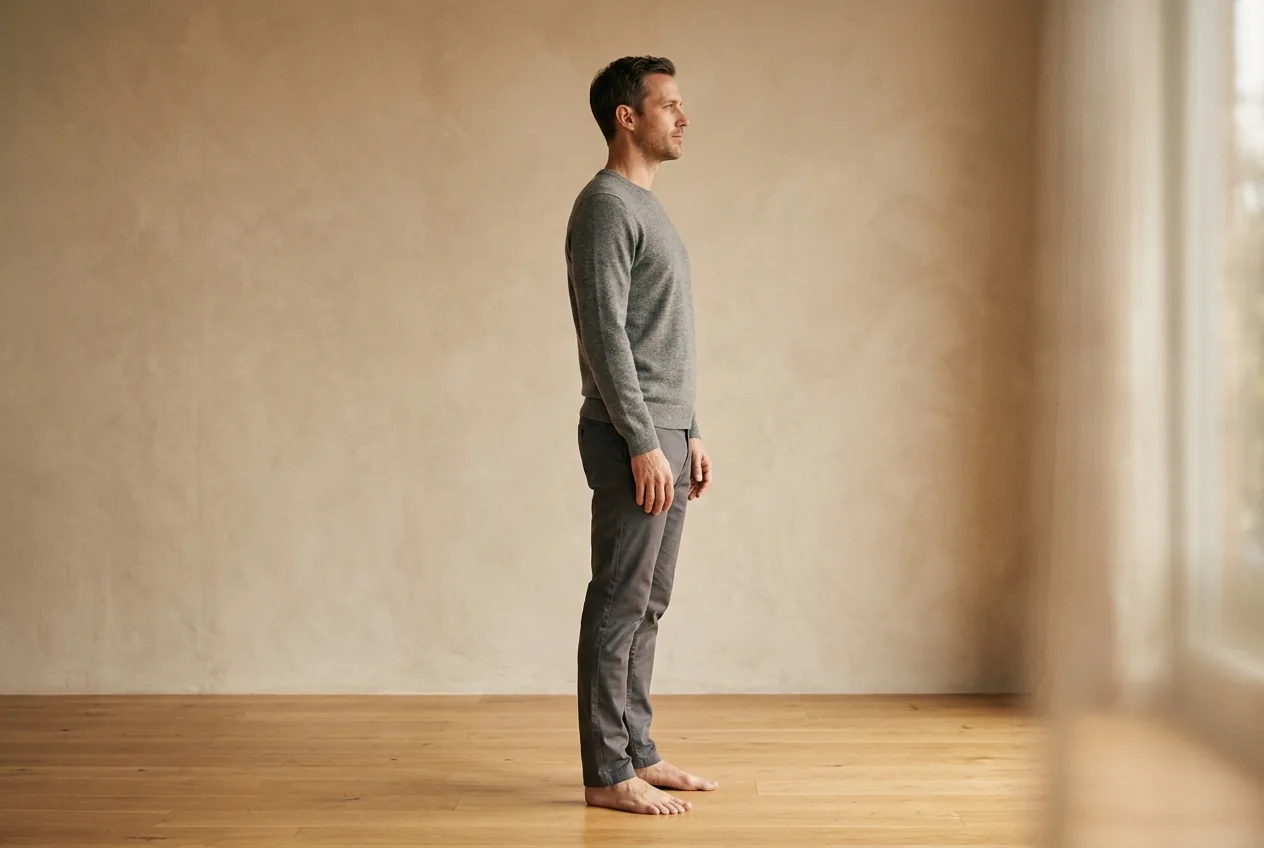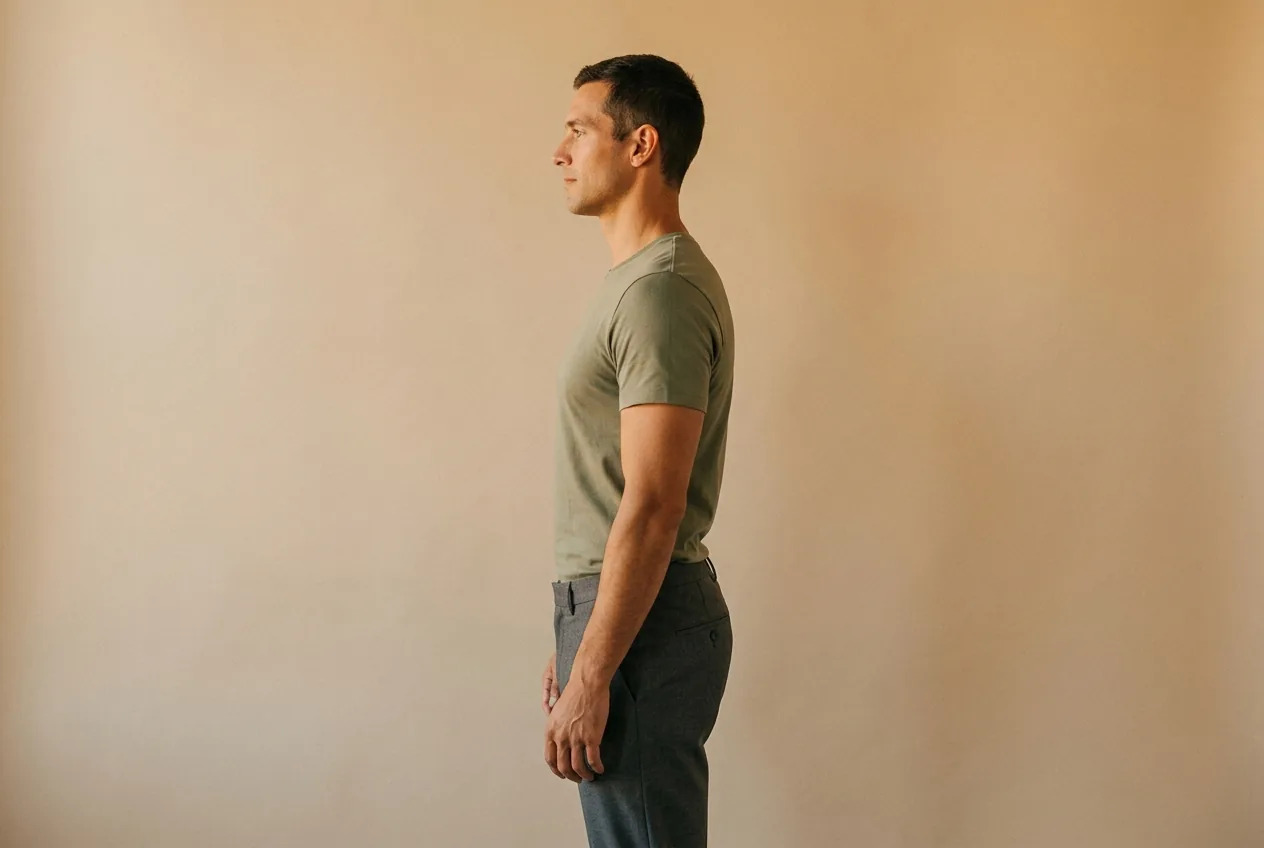

Tell someone to stand up straight and watch what happens: chest thrust out, shoulders yanked back, chin up, lower back cranked into a deep arch — a pose they can hold for about thirty seconds before everything starts to ache. That braced, military stance is what most people picture as good posture, and it's almost the opposite of how to stand properly. Real standing posture is relaxed, stacked, and nearly effortless.
If standing in a queue or at the kitchen counter leaves your lower back tired and sore, the problem usually isn't that you stand too little. It's how your weight is arranged when you do. Get the stack right and standing costs your muscles very little. Get it wrong and your lower back holds you up all day.
What "standing properly" actually means
Good standing posture is a stack. Your ears sit over your shoulders, your shoulders over your hips, your hips over your ankles, with each part balanced on the one below. When you're stacked like that, your bones carry most of your weight and your muscles only fire gently to keep you steady. It feels easy because it is easy.
The braced military version breaks the stack by forcing curves to extremes. Thrusting the chest and arching the lower back overloads the lumbar joints; yanking the shoulders back clenches the upper-back muscles. You're using a lot of muscular effort to hold an unnatural shape, which is why it tires so fast. Proper standing looks calmer and almost lazy by comparison.
The most common real-world fault isn't standing too stiff, though — it's the opposite. People stand with the pelvis pushed forward, weight slung into the lower back, often with one hip cocked out. The lower back hangs in a passive arch and the joints take the strain instead of the muscles. That hang-on-the-back habit is a big reason standing aches, and it ties into the wider map of where bad posture causes pain.
How to stand properly, head to feet
Build it from the ground up. None of these are about straining — each one is a small adjustment toward the easy stack.
- Feet. Hip-width apart, weight even across both feet, not slung onto one hip. Spread the load across the whole foot — heel, outer edge, and the ball — rather than rocking back onto your heels.
- Knees. Soft, not locked. Locking the knees jams them backward and tips your pelvis, dumping weight into your lower back. A barely-there bend keeps the stack honest.
- Hips and pelvis. Bring your pelvis back over your ankles instead of pushing it forward. A useful cue: imagine your tailbone dropping straight down rather than tucking under or sticking out. This is the single change that takes the most load off an aching lower back.
- Ribs and chest. Let your ribcage settle down over your pelvis rather than flaring up. Tall, not thrust out.
- Shoulders. Let them rest down and slightly back, not forced. A gentle roll back and down, then relax — don't hold them there by force.
- Head. Stack your ears over your shoulders. If your head drifts forward, the muscles at the base of your skull work all day to hold it, the same strain behind forward head posture.
The test that you've got it: standing should feel like you could hold it comfortably for a long time, with no single area burning. If something's aching within a minute, you're bracing somewhere — usually the lower back or the shoulders.
Good standing posture is a stack your bones hold up, not a pose your muscles fight to maintain.
Why locking up makes standing worse
Two habits quietly turn standing into a strain.
The first is locking the knees. It feels like rest — you stop using your thigh muscles — but it tips the pelvis and throws your weight back into the lower spine. Keep a soft, unlocked bend and the lower back gets a break.
The second is standing dead still. Even perfect posture isn't meant to be held motionless for an hour. The body likes to sway, shift, and reload gently. If your job keeps you on your feet, small shifts of weight, the occasional step, and changing which foot bears a little more load all keep any one area from being overloaded — which is the practical heart of coping with back pain from standing all day.
When to see a doctor
A lower back that tires and aches from long standing, then eases when you sit or move, is the ordinary picture of a postural load problem. See a clinician promptly, though, if standing brings on numbness, tingling, or weakness in the legs, any loss of bladder or bowel control, back pain after a fall, fever with back pain, unexplained weight loss, or pain that's severe or steadily worsening. Standing or walking that you can only manage for short distances before your legs ache or go heavy, easing when you sit or lean forward, is also worth getting checked rather than treating as plain posture.
Why a standing rule doesn't fit everyone
Here's the honest limit of any standing guide. "Bring your pelvis back and stop locking your knees" helps the most common standing fault, but not every aching back is hanging in too much arch — some have lost their normal curve and need almost the opposite cue. The same instruction that unloads one person's back loads another's. General cues are a fair start, but the standing position your back actually holds best depends on how your spine is built and where it's currently loaded. A posture assessment that measures your own deviations shows which way your pelvis tilts and which muscles have switched off, so you stand toward your balanced position rather than a generic one. It pairs naturally with getting your walking sorted in how to walk with good posture, since standing well is where walking well starts.
Stack the parts, soften the knees, bring the pelvis back, and let your bones do the holding. Done right, standing should feel like almost nothing.
Common questions
How should I stand to avoid back pain?
Stand with your feet hip-width and weight even, knees soft rather than locked, and your pelvis stacked back over your ankles instead of pushed forward into your lower back. Let your ribs settle over your pelvis, shoulders rest down, and head sit over your shoulders. The key change for most people is unlocking the knees and bringing the pelvis back, which stops the lower back from carrying everything.
Is it bad to stand up straight in a military posture?
Yes, the stiff chest-out, shoulders-back, deeply-arched stance is a strain, not good posture. It forces your spine's curves to extremes and uses constant muscular effort, which is why it aches within a minute. Proper standing is a relaxed, balanced stack where your bones carry your weight and your muscles only steady you.
Why does my lower back hurt when I stand for a long time?
Usually because your weight is slung into your lower back — pelvis pushed forward, knees locked — so the lumbar joints and muscles hold you up passively for the whole time. Bringing the pelvis back over the ankles, softening the knees, and shifting your weight regularly takes the load off. Building lower-back and core endurance helps too.
Should I stand completely still with good posture?
No. Even good standing posture isn't meant to be held motionless for long, because one set of muscles ends up loaded the whole time. Shift your weight, change which foot carries a little more, take the occasional step, and move every so often. Small, frequent movement keeps any single area from being overworked.