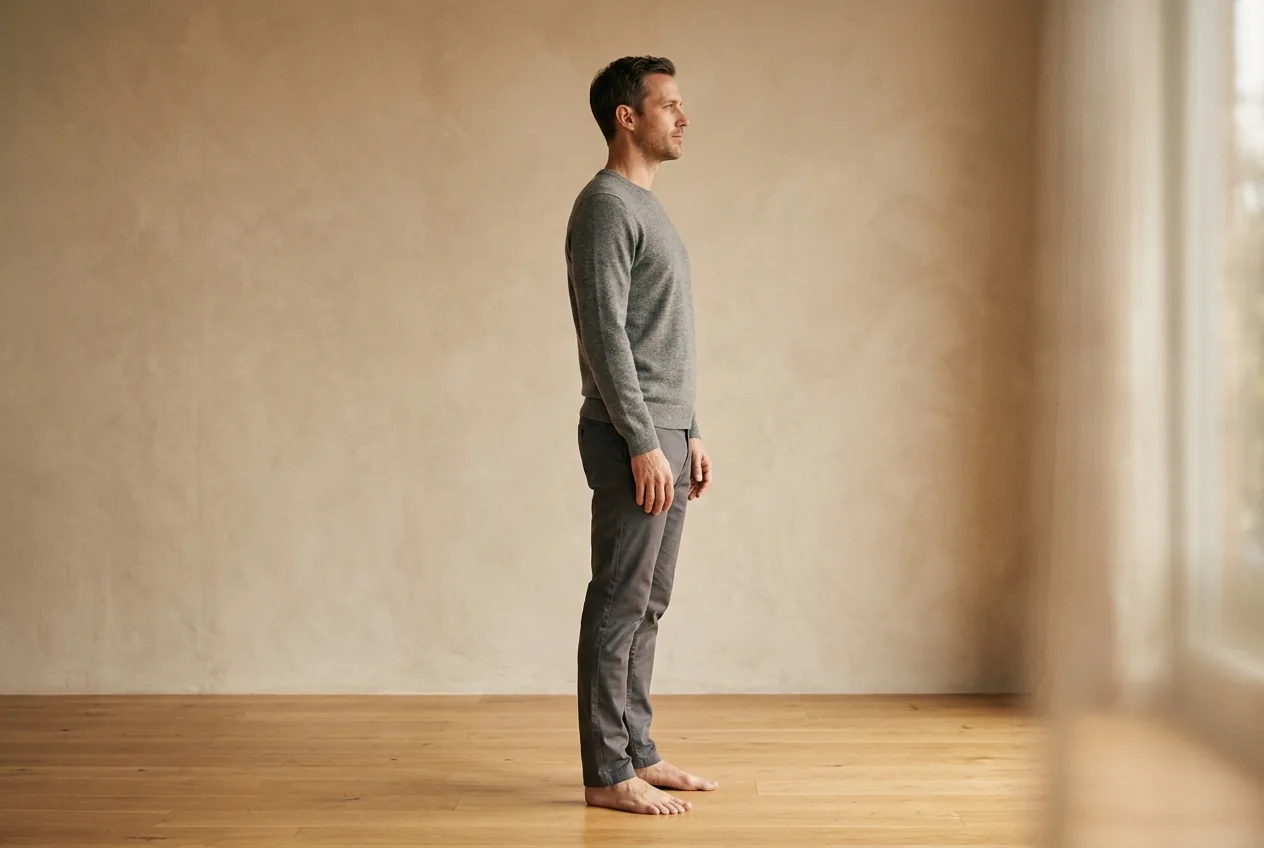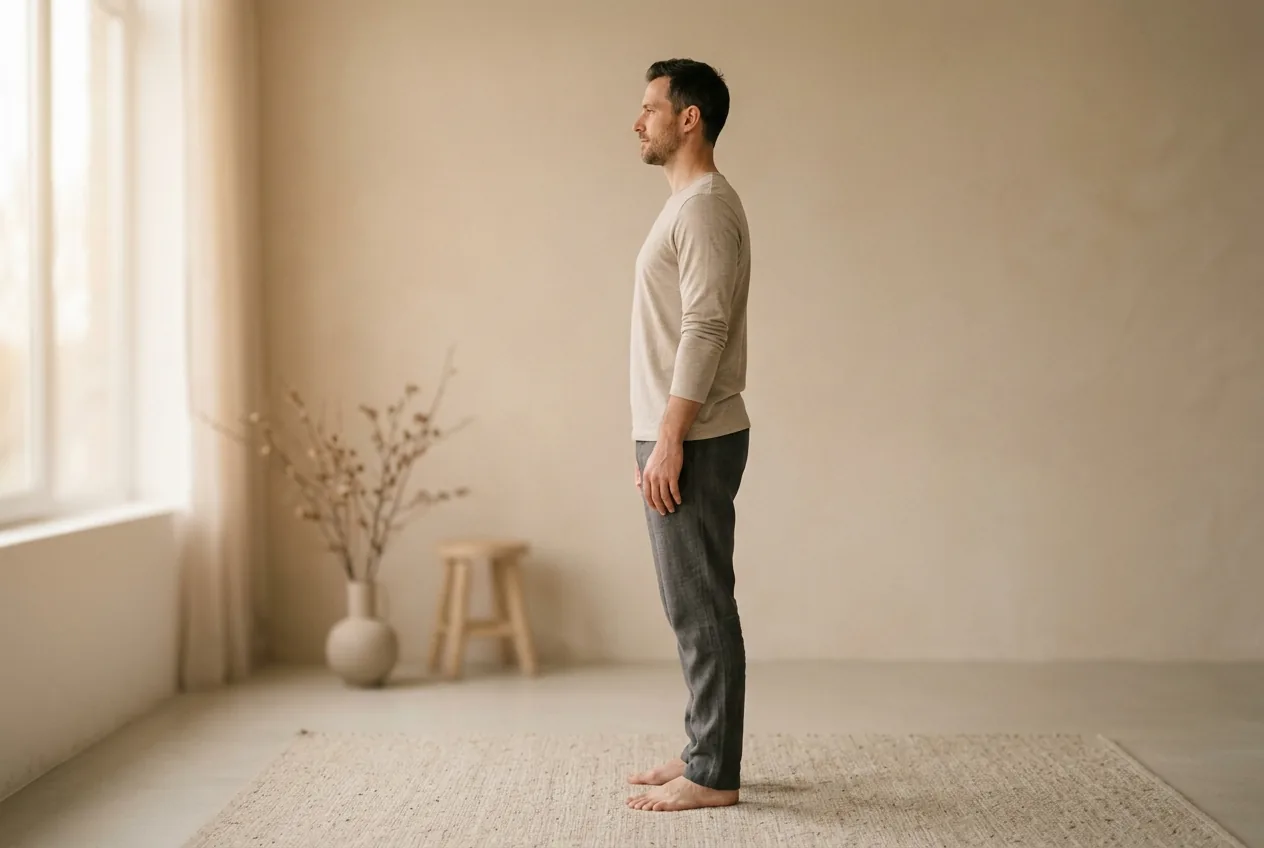
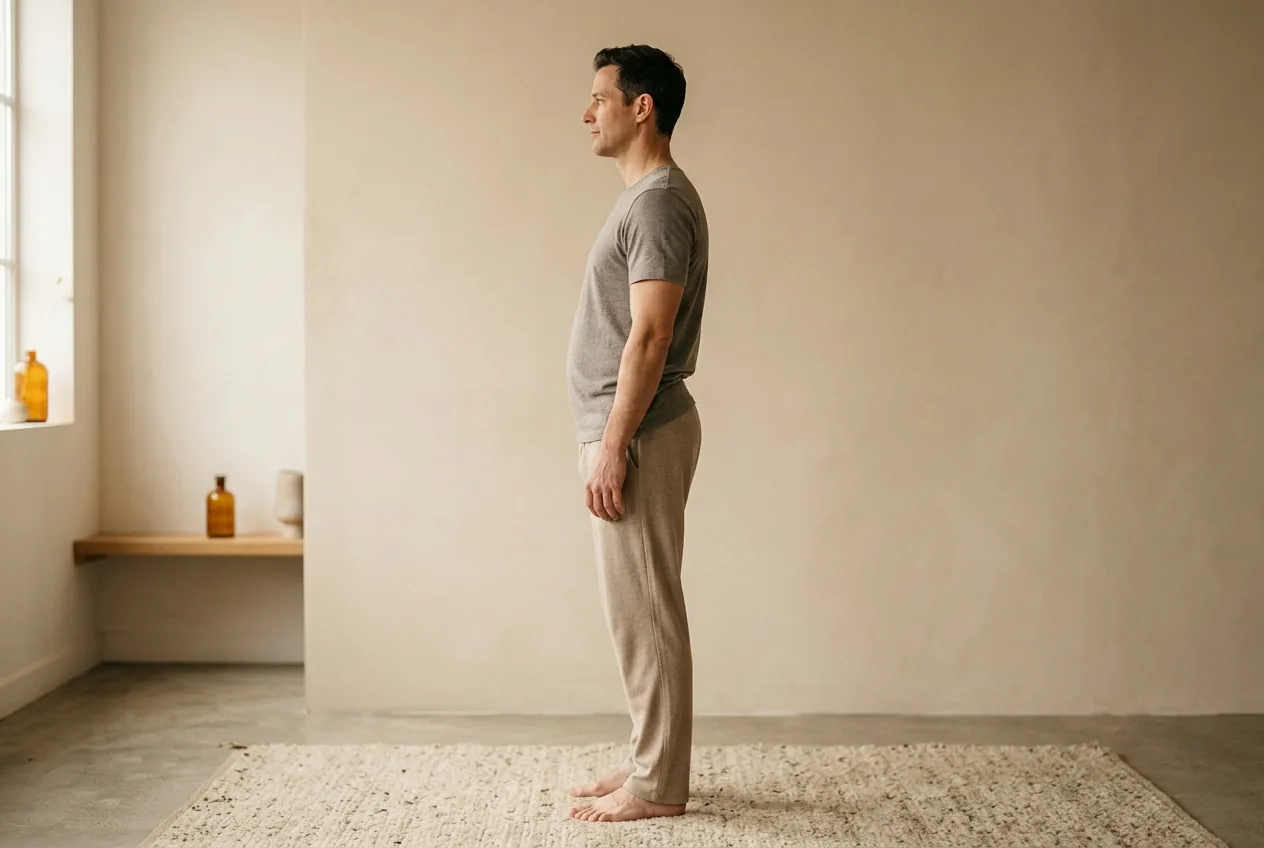
You look at yourself side-on and your lower back is oddly flat — no real curve, your tailbone tucked under, your hips pushed slightly forward of your shoulders. When you sit, you slump back onto your tailbone rather than sitting up on your sitting bones. That flattened, tucked-under look is posterior pelvic tilt, and the right posterior pelvic tilt fix is close to the opposite of what helps a forward tilt.
It gets far less attention than its better-known sibling, so people often grab the wrong advice — the stretches written for an overarched back — and feel worse. Let's sort out what it is and what genuinely helps.
From our own quiz data: only 11% of 1,477 people told us they came looking for help on a doctor's recommendation. Everyone else found their own way in, and finding your own way usually means finding your own routine. That's harmless when the routine happens to match your pelvis. A posterior tilt is where it goes wrong most visibly, because most of the stretching advice aimed at the lower back is written for an overarched spine — and a flat, tucked-under one gets handed the opposite of what it needs.
What posterior pelvic tilt is
Use the bowl-of-water picture again. In a neutral pelvis the bowl sits level. In a posterior pelvic tilt, the bowl tips backward — the back of the pelvis drops, the front lifts, and the water would spill out behind you. Your tailbone tucks under and your lower back loses its natural inward curve, going flat or even slightly rounded.
It's the mirror image of anterior pelvic tilt. Where the forward tilt comes from a tight front and weak backside, the backward tilt usually comes from the opposite balance: tight hamstrings and glutes and lower-ab muscles pulling the pelvis under, while the hip flexors and lower-back muscles get long and weak and stop restoring the curve. This is why a single "back stretch" routine can't serve both — the same move that helps one tilt feeds the other.
The two tilts are opposites. Stretch the wrong muscles and you don't just waste time, you reinforce the problem.
How a flat back behaves
A posterior tilt often shows up as part of a wider flat-back posture, where the whole lower spine loses its curve and the upper back may round to compensate. If the curve flattening continues up your spine and the head drifts forward, it starts to overlap with the flat-back posture pattern.
People with this tilt often feel okay standing but ache when sitting, because they collapse backward onto the tailbone and the lower back has no curve to absorb the load. If sitting is your worst position, that's a clue, and it ties into why lower back pain when sitting is so common with a flattened lumbar curve.
A posterior pelvic tilt fix that works
The aim flips the usual script: you release the tight hamstrings and over-tucking abdominals, you wake up the hip flexors and lower-back muscles that restore the curve, and you relearn how to sit and stand with a neutral pelvis. Do these most days.
Hamstring release — open the back of the legs
Sit on the floor with one leg straight, the other tucked in. Keep your back tall — don't round it — and hinge forward from the hips until you feel a stretch down the back of the straight leg. Hold 30 seconds each side. Tight hamstrings are a main driver of the backward tuck, so this earns its place first.
Pelvic rocks — find neutral
On hands and knees, slowly rock your pelvis to create a gentle arch in your lower back (tailbone lifting up), then rock the other way to round it. Move between the two and find the middle, where the curve is gentle and natural. This teaches your nervous system where neutral lives. The cat-cow stretch for back uses the same motion if you want a guided version.
Prone press-up — restore the lumbar curve
Lie face down. Place your hands under your shoulders and press your chest up gently while keeping your hips on the floor, letting your lower back ease into a small arch. Only go as far as is comfortable. Hold a few seconds, lower, repeat 8 to 10 times. For a flat, tucked back this gently coaxes the curve back — the same move would aggravate an overarched back, which is exactly why your pattern has to be right.
Standing alignment reset
Stand tall and gently rock your pelvis to find neutral — not tucked under, not overarched. Stack your ribs over your hips and your hips over your heels. Hold the feel of it for a few breaths. Repeat through the day until upright stops feeling like effort.
How it shows up in daily life
A posterior tilt has a signature you can feel. Sitting is usually the worst of it: within minutes you've slid down onto your tailbone, your lower back rounded against the chair back, and after a while that flattened spot starts to ache. Soft sofas and low car seats are the worst offenders, because they let you collapse backward with nothing to support the curve. Standing tends to feel better, though some people lock the knees and shove the hips forward to stay up, which just trades one compensation for another.
Tight hamstrings are the everyday tell. If touching your toes feels like the backs of your legs are made of steel cable, and bending to put on socks pulls there rather than freeing up at the hips, the hamstrings are likely part of what's tucking your pelvis under. Loosening them and rebuilding the lumbar curve usually makes sitting tolerable again first — that's an honest early sign the work is landing, and it tends to arrive within a few weeks of steady daily practice rather than overnight.
What to stop doing
- Stop doing knees-to-chest and other flexion stretches on repeat — they tuck you further under.
- Stop slumping back onto your tailbone in chairs. Sit up on your sitting bones with a small support behind your lower back.
- Stop assuming "core work means tucking." Bracing isn't the same as tucking the pelvis under.
- Stop borrowing routines written for an overarched lower back. They're built for the opposite problem.
When to see a doctor
This is posture education, not medical advice. See a clinician promptly if back pain follows a fall or accident, if you notice numbness, tingling, or weakness in the legs, any change in bladder or bowel control, fever with back pain, unexplained weight loss, or pain that's severe or steadily getting worse.
Why getting the direction right matters
Everything about a posterior tilt is direction-sensitive — the muscles to release, the curve to restore, the way you sit. Get the direction wrong and you can push yourself toward the opposite imbalance. That's the strongest argument against grabbing a generic routine off the internet.
A proper posture assessment measures which way your pelvis actually tilts and what's compensating around it, then orders the program accordingly. If you want a rough read first, you can check your posture at home with a side photo and a wall.
A flat, tucked pelvis isn't fixed by stretching harder. It's fixed by restoring the curve your body gave up — in the right direction.
What I see in practice
Posterior tilt is the pattern people are most surprised to hear they have, because they have spent years being told that the trouble with backs is too much arch. The giveaway I look for is how someone sits down: they lower into the chair by rolling back onto the tailbone instead of folding at the hips, and once they're in it they stay slid down. Plenty of them have also been faithfully doing knee-to-chest stretches every night because a list told them to — kindly meant advice pointed the wrong way. When I suggest the prone press-up, the first reaction is often nervousness about arching at all, so I start it much smaller than the version above: propped on the forearms, a minute at a time. The first change people tend to mention isn't less pain; it's that sitting up on the sitting bones stops feeling like work.
Common questions
What's the difference between anterior and posterior pelvic tilt?
They're opposites. An anterior tilt tips the pelvis forward and deepens the lower-back arch; a posterior tilt tucks it under and flattens the curve. The muscles you release and strengthen run the other way for each, which is why the wrong routine can backfire.
Why does my lower back hurt more when sitting than standing?
A tucked-under pelvis collapses backward onto the tailbone when you sit, so the lower back has no curve to absorb the load. Soft sofas and low car seats are the worst offenders. Many people with this tilt feel fine standing and ache only after sitting a while.
Are tight hamstrings linked to posterior pelvic tilt?
Often, yes. The hamstrings attach to the back of the pelvis, and when they're tight they can drag it under and flatten the curve from below — which is why a gentle hamstring release usually earns a spot early in the routine.
Why shouldn't I do knees-to-chest stretches for this?
Knees-to-chest and similar flexion stretches tuck the pelvis further under, feeding the exact pattern you're trying to undo. A flat, tucked back generally needs gentle extension to restore the curve, not more rounding.