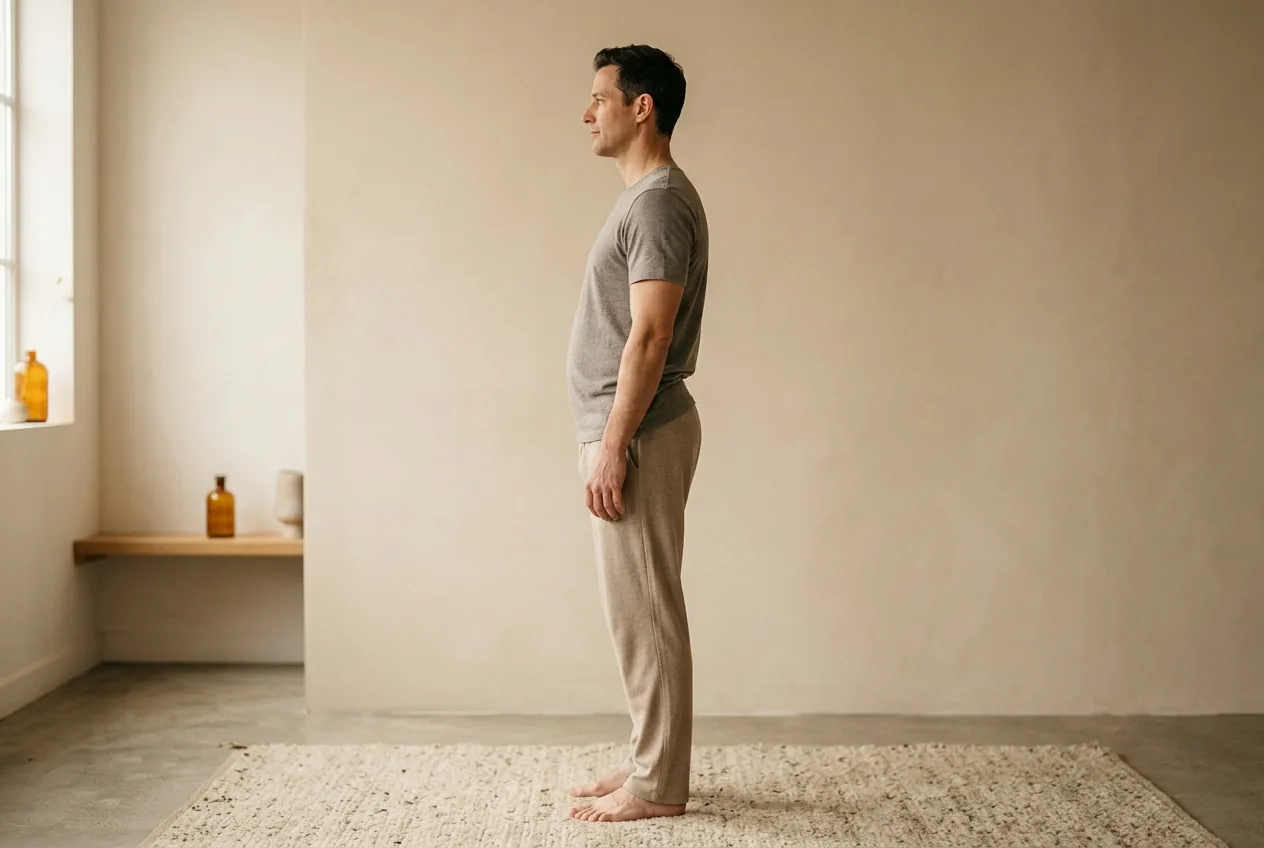

You're in a photo, or standing in front of the bathroom mirror, and you notice it: one shoulder is clearly sitting higher than the other. Maybe a shirt collar never sits straight, or a bag strap always slides off the same side. Once you see it, you can't unsee it.
The good news first. For most people, uneven shoulders are a posture pattern, not a structural defect — the result of how you sit, carry, and use your body day after day. That matters, because learning how to fix uneven shoulders depends entirely on what's causing the unevenness. Address the habit underneath it and the imbalance usually softens. Chase the symptom alone and it comes back.
What "uneven" usually means
Your shoulders hang from your shoulder blades, which glide on your rib cage and are held in place by a web of muscles running up into the neck and down into the mid-back. When those muscles pull evenly on both sides, your shoulders sit level. When one side pulls harder or sits tighter than the other, that shoulder rides up.
So an uneven shoulder is rarely about the shoulder itself. It's about what's tugging on it — the trapezius and the muscles at the base of the neck on one side staying switched on and shortened, while the other side stays comparatively relaxed. The shoulder you see riding high is the end of the chain, not the start of it.
Sometimes the unevenness traces lower, to the pelvis. If one hip sits higher than the other, the spine often curves slightly to compensate, and the shoulders tilt to keep your eyes level. In that case the shoulders are just following the foundation below them.
Why one side sits higher
The pattern almost always builds from repeated, one-sided load. Your body is efficient — give it the same asymmetric job a thousand times and it adapts to make that job easier, even when the adaptation is lopsided.
Common culprits:
- Always carrying on the same side. A bag, a briefcase, or a toddler parked on the same hip teaches one shoulder to hike up and stay there.
- A desk setup that's off-center. A monitor angled to one side, a mouse you reach for all day, or leaning on one armrest pulls one shoulder up over months.
- Phone cradling. Pinning a phone between ear and shoulder, even occasionally, locks one side in a raised, shortened position.
- Sleeping curled to one side with the top shoulder rolled forward and up.
- A foundation tilt. Uneven hips or a slight curve in the spine that the shoulders are quietly compensating for.
There's also a tie to the head and neck. When the head drifts forward — the forward head posture that comes from screen time — the muscles across the top of the shoulders take on extra work, and they rarely take it on evenly. One side tightens more, and the shoulder on that side creeps up.
How to fix uneven shoulders
The aim is to release the side that's working too hard, wake up the side and the muscles that have gone quiet, and stop feeding the one-sided habit that built the pattern. You can't muscle a shoulder down and hold it there — the pull underneath has to change.
A reasonable starting routine:
- Release the high side. Sit tall. Gently tip your head away from the high shoulder — ear toward the opposite shoulder — until you feel a mild stretch along the top of the raised shoulder and neck. Hold easy, breathe, don't force. Spend a little more time on the tight side than the loose one.
- Wake up the mid-back. Weak muscles between the shoulder blades let the upper traps take over. Wall angels — back against a wall, arms in a goalpost, sliding up and down while keeping contact — retrain the shoulder blades to move evenly.
- Even out the shoulder blades. Standing or seated, gently draw both shoulder blades down and slightly together, as if sliding them into your back pockets. The point isn't to crank them — it's to feel the lower, quieter muscles switch on so the upper ones can let go.
- Reset the head position. Since forward head feeds the imbalance, a few slow chin tucks — drawing the head straight back over the shoulders, not tipping it down — take load off the top of both shoulders.
An uneven shoulder is the end of a chain. Move it down without changing what's pulling it up, and it just climbs back.
The habit side matters most. Switch carrying sides, or use a backpack with both straps. Center your desk. Stop cradling the phone — use a headset or speaker. These changes do more over a month than any stretch does in a day.
How long it takes to even out
If the unevenness is a muscle habit, the tight, hiked side often starts to relax within a couple of weeks of daily release work and habit changes — that part is fast, because you're calming muscles that were simply overworked. The shoulder settling into a level resting position is slower, because that depends on the quieter muscles waking up and the foundation below staying level, and muscle re-education takes months, not days.
The honest expectation: a few minutes of the routine daily, plus genuinely switching carrying sides and centring your desk, gives you a real shift over a season. What doesn't work is a burst of stretching for three days and then back to the old one-sided habits — the shoulder climbs straight back, because the input that built it never changed. Frequency and the habit changes are the levers here, not how hard you stretch.
When to see a doctor
Posture work here is education, not medical advice. Most uneven shoulders are habit patterns. But see a clinician if the unevenness appeared suddenly, came with pain, numbness, tingling, or weakness in an arm, or followed an injury. In children and teens, a noticeable shoulder or shoulder-blade asymmetry — especially with one side of the back looking more prominent when bending forward — should be checked, since it can signal a spinal curve worth evaluating. Severe or steadily worsening pain, fever, or unexplained weight loss alongside it also warrants a prompt look from a professional.
Knowing what's really tilting
The tricky part is that an uneven shoulder can start at the shoulder, at the neck, or all the way down at the pelvis — and the fix is different for each. Stretching the high shoulder when the real driver is a tilted pelvis gives you a few minutes of relief and no lasting change.
Generic advice is a fine starting point. Lasting correction comes from knowing your own pattern — where the tilt actually begins and what's compensating for it. A posture assessment measures your specific deviations from a few photos and orders the corrective work accordingly, so you're not stretching the wrong side. For a quick first look on your own, the wall test at home helps you spot whether the shoulders, the hips, or the head are leading the imbalance.
Level shoulders aren't a matter of willpower. They follow the foundation and the habits underneath — change those, repeat the work daily, and the shoulder stops climbing.
Common questions
Why is one shoulder higher than the other?
For most people it's a posture pattern from one-sided load, not a structural defect. Always carrying a bag on the same side, an off-center desk, cradling a phone, or even a tilted pelvis below can teach one shoulder to hike up and stay there.
Can uneven shoulders be fixed?
If the cause is a muscle habit, usually yes. Releasing the tight, hiked side, waking up the quieter muscles, and changing the one-sided habits underneath tend to even things out over weeks. A genuine leg-length or structural difference is less responsive and worth a clinician's read.
How long does it take to even out uneven shoulders?
The tight, hiked side often starts to relax within a couple of weeks of daily release work. The shoulder settling into a level resting position is slower and depends on the quieter muscles waking up, which takes months of consistent practice plus the habit changes.
When should uneven shoulders be checked by a doctor?
See a clinician if the unevenness appeared suddenly, came with pain, numbness, tingling, or arm weakness, or followed an injury. In children and teens, a noticeable asymmetry — especially with one side of the back looking more prominent when bending forward — should be evaluated.